Why Was NASA Artemis II Launch Stopped? Know What Went Wrong
NASA has postponed its immediate launch plans for the Artemis II mission following technical complications during a critical "wet dress rehearsal" at Launch Pad 39B. Engineers were forced to halt the NASA Artemis II launch countdown on February 3, 2026, after detecting a persistent liquid hydrogen leak in the Space Launch System (SLS) rocket’s core stage.

- Read in
- हिंदी
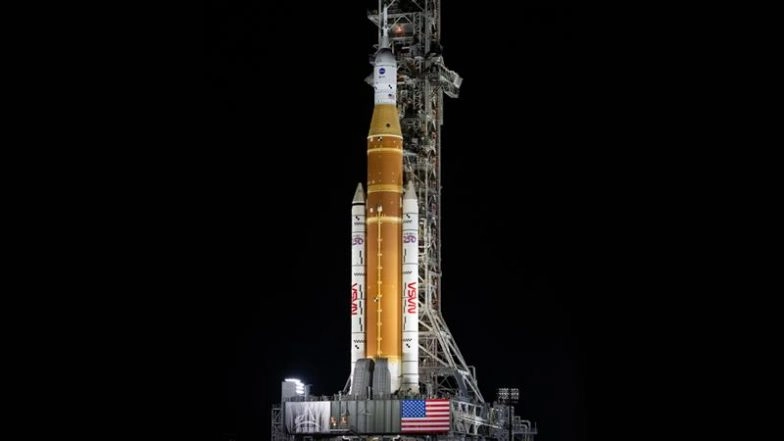
New York, February 3: NASA has postponed its immediate launch plans for the Artemis II mission following technical complications during a critical "wet dress rehearsal" at Launch Pad 39B. Engineers were forced to halt the NASA Artemis II launch countdown on February 3, 2026, after detecting a persistent liquid hydrogen leak in the Space Launch System (SLS) rocket’s core stage. The agency has now shifted its focus to a March launch window to allow teams sufficient time to troubleshoot the hardware and ensure the safety of the four-person crew.
The NASA Artemis II stoppage occurred during the tanking phase, where more than 700,000 gallons of cryogenic propellant were being loaded into the rocket. Monitoring systems identified a "flaking" seal and a malfunctioning valve in the umbilical arm that connects the fuel line to the rocket. Despite multiple attempts to "warm up" and reseat the seal, a standard troubleshooting tactic, the leak remained above acceptable safety limits, leading mission managers to scrub the remainder of the test. NASA Delays Artemis II Moon Mission to February 8 Due to Freezing Weather Conditions in Florida.
NASA Artemis II Launch Stopped: What Went Wrong?
The primary issue centered on the Quick Disconnect (QD) assembly, a complex interface where the fuel lines meet the rocket. Engineers reported an intermittent leak of liquid hydrogen, a highly volatile and difficult-to-contain substance. Because hydrogen molecules are extremely small, even a microscopic gap caused by a worn seal or thermal contraction can lead to a hazardous leak.
Additionally, data indicated a faulty sensor in one of the RS-25 engines, which failed to show the proper temperature required for the engines to be "conditioned" for launch. NASA officials decided to stop the test rather than risk damage to the multi-billion dollar flight hardware. How To Send Your Name To the Moon? A Step-by-Step Guide for NASA Artemis II Mission Digital Boarding Pass.
NASA Artemis II Launch Delayed
In a post-test briefing, NASA confirmed that while the halt is a setback, the purpose of the wet dress rehearsal is specifically to find these flaws on the ground rather than during a live launch. The agency is now targeting the next available lunar launch window, which opens in mid-March 2026.
"We are taking a methodical approach," a NASA spokesperson stated. "Safety is the absolute priority for this mission, as it will be the first time humans fly on the SLS. We will roll the rocket back to the Vehicle Assembly Building (VAB) if necessary to replace the faulty seals."
Artemis II is a historic 10-day mission intended to carry four astronauts, Reid Wiseman, Victor Glover, Christina Koch, and Jeremy Hansen, around the Moon and back to Earth. It serves as the final crewed test of the Orion spacecraft and the SLS rocket before the Artemis III mission attempts a lunar landing.
This mission will test the life-support systems, communication arrays, and navigation controllers in a deep-space environment. The delay to March ensures that the spacecraft’s trajectory will remain optimal for the required lighting conditions during the lunar flyby and the subsequent splashdown in the Pacific Ocean.
Over the coming days, engineers will drain the remaining propellant and conduct a "walk-down" of the launch pad to inspect the umbilical connections. If the leak is confirmed to be a simple seal issue, repairs may be conducted at the pad. However, if the valve malfunction is internal to the rocket, the 322-foot-tall stack will be returned to the hangar for more extensive maintenance.
(The above story first appeared on LatestLY on Feb 03, 2026 01:10 PM IST. For more news and updates on politics, world, sports, entertainment and lifestyle, log on to our website latestly.com).