
Business News | AI Apps, AI Models Covered Under Latest Personal Data Protection Law: Ashwini Vaishnaw in Parliament
Get latest articles and stories on Business at LatestLY. Taking part in the Question Hour in Lok Sabha today, the Minister responded to a member's concerns regarding data privacy and noted that the DPDP Act protects citizens' data, and that there was no previous mechanism by which personal data could have been protected.

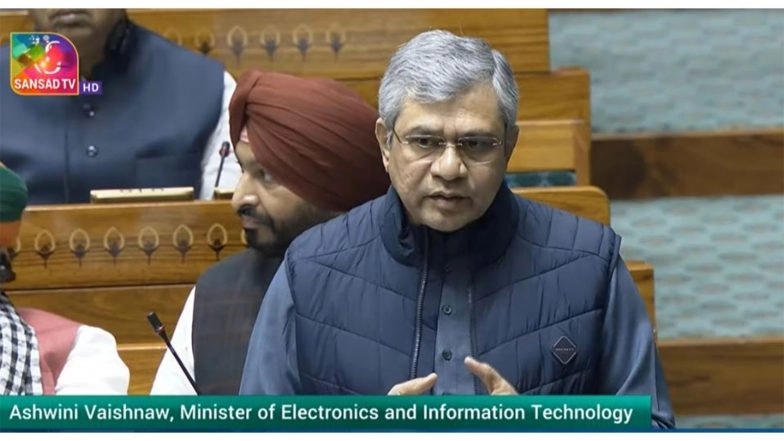
New Delhi [India], December 3 (ANI): Union Minister for Electronics and Information Technology, Ashwini Vaishnaw, on Thursday said all AI apps and the AI models covered as a part of the recently notified Digital Personal Data Protection (DPDP) Act, reassuring that the personal data of all citizens is protected.
Taking part in the Question Hour in Lok Sabha today, the Minister responded to a member's concerns regarding data privacy and noted that the DPDP Act protects citizens' data, and that there was no previous mechanism by which personal data could have been protected.
"Before this Act, there was no mechanism by which the personal data could have been protected," the Minister said in the Lok Sabha.
Acccording to Minister Vaishnaw, the Act has been notified on November 13, and "this has created a totally new regime of protection for the citizens' data and that is the spirit with which we are working."
Because of the DPDP Act, Minister Vaishnaw, as part of his reply to suplementaries in Lok Sabha, said, "now anybody who uses personal data of any user, any citizen of India will basically have a protection mechanism through which consent would have to be taken, data minimization would have to be done, the right to forget will have to be done, and the purpose will have to be very clearly defined."
The government notified the Digital Personal Data Protection (DPDP) Rules, 2025 on November 14, 2025. This marks the full operationalisation of the Digital Personal Data Protection Act, 2023 (DPDP Act).
Together, the Act and the Rules form a clear and citizen-centred framework for the responsible use of digital personal data. They place equal weight on individual rights and lawful data processing.
The Ministry of Electronics and Information Technology invited public comments on the draft Rules before finalising them. Consultations were held in Delhi, Mumbai, Guwahati, Kolkata, Hyderabad, Bengaluru and Chennai, as per a recent statement from PIB Headquarters.
A wide range of participants took part in these discussions. Startups, MSMEs, industry bodies, civil society groups and government departments all offered detailed suggestions.
Citizens also shared their views. In total, 6,915 inputs were received during the consultation process. These contributions played a key role in shaping the final Rules, the PIB Headquarters' statement added. (ANI)
(The above story is verified and authored by ANI staff, ANI is South Asia's leading multimedia news agency with over 100 bureaus in India, South Asia and across the globe. ANI brings the latest news on Politics and Current Affairs in India & around the World, Sports, Health, Fitness, Entertainment, & News. The views appearing in the above post do not reflect the opinions of LatestLY)