













 Quickly
 Socially
 Trending
 Crypto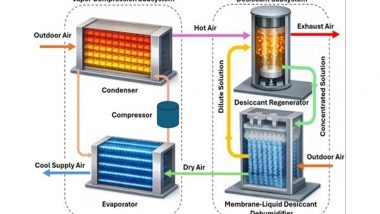
New Delhi [India], February 26 (ANI): Researchers from the Department of Mechanical Engineering at IIT Delhi are developing a new type of high-efficiency air conditioner that has shown potential to reduce electricity use by roughly one-third, addressing concerns over rising power consumption for cooling.The health risks and productivity loss due to rapidly increasing heat stress are already reaching alarming levels. With the rise in temperature and increased use of air conditioners in homes and offices, electricity consumption for cooling is projected to triple by 2037-38, according to the India Cooling Action Plan, Report by Ministry of Environment, Forest and Climate Change, Government of India, 2019.An increase in power consumption would put stress on natural resources and lead to higher electricity bills for consumers. To address this, researchers from the Department of Mechanical Engineering at IIT Delhi are developing a new type of high-efficiency air conditioner.The research team led by Prof Anurag Goyal, which also includes Ananthakrishnan K, a PhD research scholar in the Department of Mechanical Engineering, is currently testing a laboratory-scale prototype of this proposed system, which has shown potential to reduce electricity use by roughly a third.The vapor-compression system-based ACs in use today remove humidity by overcooling the air until moisture condenses, which is a highly energy-intensive process. Prof Anurag Goyal's research group has developed a new concept that utilizes a compact add-on module to directly tackle moisture.The module uses a salt solution (liquid desiccant) that absorbs water vapor from incoming outdoor air. A thin and selective polymer membrane sits between the air and the salt solution and prevents the salt from carrying over into the building's air, which is a common concern with existing liquid-desiccant systems.After the solution is diluted by absorbed moisture, it must be dried to allow continuous reuse. The team uses an innovative system integration concept to continuously revive and recirculate the same salt solution. Instead of adding a burner or an electric heater, the design uses heat that the AC already throws away through its condenser (the outdoor unit) and redirects it to a regenerator module to dry the salt solution again.The system is designed to precisely match the energy transfer rate in the two parts, vapor compression and desiccant modules, across various outdoor cor the hybrid, resulting in around 33 per cent lower energy consumption, while meeting the same indoor comfort targets. Across representative Indian climates, the predicted savings range from 28 per cent (in very humid areas) to 41.5 per cent (in dry and arid areas)," Prof Anurag Goyal said.
The research team anticipates wider adoption of such a sustainable cooling technology, particularly in Indian buildings.
Also Read | Rangbhari Ekadashi 2026: Vrat Date, Rituals and Cultural Significance of Amalaki Ekadashi.
A study titled 'Model-based analysis of a novel hybrid membrane-liquid desiccant air conditioner for high-efficiency space cooling' on their work has been published in the Journal of Building Engineering. (ANI)
(The above story is verified and authored by ANI staff, ANI is South Asia's leading multimedia news agency with over 100 bureaus in India, South Asia and across the globe. ANI brings the latest news on Politics and Current Affairs in India & around the World, Sports, Health, Fitness, Entertainment, & News. The views appearing in the above post do not reflect the opinions of LatestLY)
 Share Now
 Google Trends



 Live Bot