
World News | Former FS Shringla Calls out Unraveling Long-term Erosion of Secularism, Rise of Extremism in Bangladesh
Get latest articles and stories on World at LatestLY. Former Foreign Secretary and Rajya Sabha MP Harsh Vardhan Shringla on Tuesday flagged the long-term erosion of secularism and the gradual rise of extremist forces in Bangladesh, saying these developments are rooted in historical patterns rather than sudden political shocks that the country has been witnessing for the last two years following the July Uprising in 2024.

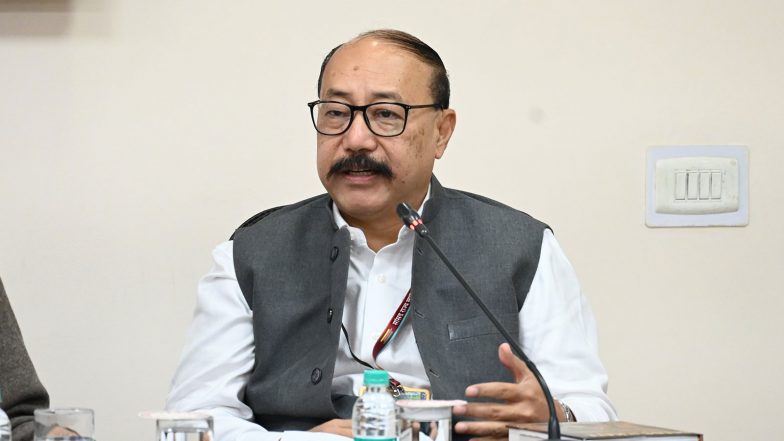
New Delhi [India], February 10 (ANI): Former Foreign Secretary and Rajya Sabha MP Harsh Vardhan Shringla on Tuesday flagged the long-term erosion of secularism and the gradual rise of extremist forces in Bangladesh, saying these developments are rooted in historical patterns rather than sudden political shocks that the country has been witnessing for the last two years following the July Uprising in 2024.
Speaking at a book discussion on "Seeds of Hate: Bangladesh's Extremist Surge - Jamaat-e-Islami Bangladesh and Other Radical Organisations", hosted by the Vivekananda International Foundation (VIF), Shringla said the volume performs an important public function by documenting not just events, but enduring political structures and patterns.
"It is not an easy book to write, and it is certainly not a comfortable book to read. But it is a necessary one," Shringla said.
He cautioned against focusing solely on immediate political developments, such as elections or protests, stressing that the resurgence of extremism must be understood through the accumulation of ideas, organisations, and political habits over decades.
Bangladesh is set to hold national elections on February 12, with a constitutional referendum scheduled for the same day.
Drawing on his experience serving as High Commissioner to Bangladesh, Shringla said the book underscores that Bangladesh was founded with an explicitly secular and democratic vision, consciously rejecting communal politics in favour of a citizenship-based identity.
However, he noted that this founding consensus was steadily eroded over time--often not through dramatic ruptures, but through "quiet accommodation", selective forgetting, and the rehabilitation of forces that had opposed the Liberation War of 1971.
The former Foreign Secretary highlighted that the book does not treat extremism as an abstraction.
"It identifies organisations, leadership structures, ideological lineages, and specific incidents. Jamaat-e-Islami figures prominently not as a rhetorical symbol but as a historically grounded political actor with a documented trajectory," he said, noting that the book situates Jamaat within a broader ecosystem of Islamist organisations that have operated in parallel, sometimes in competition and sometimes in convergence.
Shringla further observed that extremist groups did not emerge overnight but persisted across decades--sometimes banned, sometimes marginalised, and at other times legitimised--waiting for moments of political uncertainty to re-enter the mainstream.
He warned that periods of institutional weakening and political ambiguity have historically benefited actors with ideological discipline, organisational memory, and patience.
Commenting on contemporary developments, Shringla said Bangladesh's crises often appear sudden but are rarely new, describing them as "the delayed consequences of unresolved political habits."
"Power in Bangladesh has seldom changed hands easily. When it has moved through elections, it has often done so in an absolutist fashion: the winner takes all, institutions bend, and opposition space contracts. When power has not moved electorally, it has moved through interruption," he added.
He also underlined that exclusionary political processes, even if procedurally valid, struggle to generate durable legitimacy.
On India-Bangladesh relations, Shringla said New Delhi's approach has never been about personalities but about outcomes.
"A stable, plural, constitutionally governed Bangladesh has been India's strongest partner in the east. Periods of instability or ideological hardening have invariably produced security complications, particularly in the North-East," the former Foreign Secretary said.
The discussion also featured VIF Director Arvind Gupta, who described the book as a timely and authoritative intervention amid Bangladesh's uncertain electoral phase.
He noted that Jamaat-e-Islami is likely to acquire a higher political profile and stressed that the book extends beyond Jamaat-e-Islami to examine groups such as Hifazat-e-Islam, Khilafat Majlis, Islami Andolan, Hizbut Tahrir, and HUJI--several of which have transnational linkages and documented involvement in past terrorist activities.
Editor of the Dipanjan Roy Chaudhury said the volume is grounded in field-based research and open-source documentation, mapping six Islamist groups through their leadership hierarchies, funding networks, madrasa ecosystems, and foreign linkages, particularly to West Asia and cautioned against attempts to "whitewash" Jamaat-e-Islami, asserting that its political identity is historically rooted in anti-India and anti-1971 narratives.
The book, largely based on Shahriar Kabir's decades-long civil society work, seeks to move beyond rhetoric and sensationalism, offering a dispassionate, evidence-based account of how extremist networks aim to erode Bangladesh's liberation ethos and replace it with a theocratic order.
Shringla concluded by noting that Bangladesh today is not suffering from a lack of elections but is grappling with a deeper question--"whether political processes will once again serve as instruments of renewal or merely as pauses in an ongoing struggle over power and identity." (ANI)
(The above story is verified and authored by ANI staff, ANI is South Asia's leading multimedia news agency with over 100 bureaus in India, South Asia and across the globe. ANI brings the latest news on Politics and Current Affairs in India & around the World, Sports, Health, Fitness, Entertainment, & News. The views appearing in the above post do not reflect the opinions of LatestLY)