













 Quickly
 Socially
 Trending
 Crypto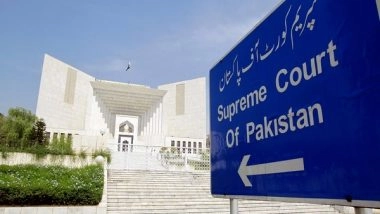
Islamabad [pakistan], April 7 (ANI): Pakistan Supreme Court on Thursday resumed hearing on the case related to the constitutionality of the steps taken by the National Assembly Deputy Speaker Qasim Suri for the dismissal of the no-confidence of motion filed against Prime Minister Imran Khan and subsequent dissolution of the National Assembly.
The top court had taken a suo motu cognizance of the current political situation in the country.
Also Read | Yemen President Cedes Powers to Council as Saudi Arabia Pushes to End War – Latest Tweet by Reuters.
A five-member larger bench of the apex court, headed by Chief Justice of Pakistan (CJP) Umar Ata Bandial and comprising Justice Ijazul Ahsan, Justice Muneeb Akhtar, Justice Mazhar Alam Khan Miankhel, and Justice Jamal Khan Mandokhel, is hearing the arguments on the question of the legality of the decision of the Deputy Speaker of the National Assembly, according to Dawn.
Today, the court is expected to hear the arguments of Attorney General for Pakistan (AGP) Khalid Jawed Khan and Naeem Bukhari, the counsel for National Assembly Speaker Asad Qaiser.
Also Read | Sri Lanka Economic Crisis: President Gotabaya Rajpaksa Appoints Advisory Group on Debt Sustainability.
During yesterday's hearing, CJP Bandilal observed that Article 69 of the Pakistan Constitution bars interference in parliamentary proceedings, but whatever happened on April 3 was unprecedented.
"The no-confidence resolution which had a constitutional backing and liable to be succeeded was scuttled at the last minute," the CJP said, adding that if "we permit such a deviation" then the situation would become the same as Advocate Salahuddin Ahmed had referred to on Tuesday, Dawn newspaper reported.
Representing the Sindh High Court Bar Association, Advocate Ahmed recalled the 1933 incident when the speaker of the then German assembly, even though called the members of the communist party, traitors, still allowed the voting on a constitutional amendment that gave Adolf Hitler and his cabinet with unlimited powers to bring any law without formal approval of German parliament.
Earlier, Pakistan Tehreek-e-Insaf (PTI) counsel Babar Awan began his contentions and said "The case in the court is not of basic human rights, it is a must for all citizens to remain loyal to the state."
However, the CJP asked the counsel to furnish the minutes of the National Security Council meeting held over "foreign conspiracy" in Pakistan and further asked for the material on basis of which the deputy speaker exercised powers, according to ARY news.
"The diplomat sent the message of the national security council of another country to three persons. The message was given to the Head of Mission, Deputy Head of Mission and Defence Attache via the embassy. The letter arrived on March 07 after a meeting of our diplomats abroad," the media outlet quoted Awan, who refused to disclose details of the letter under the official secret act.
On Sunday, Pakistani President Arif Alvi dissolved the Pakistani parliament following Imran Khan's advice. Imran Khan made the proposal minutes after parliament's deputy speaker rejected a motion of no confidence in him as "unconstitutional." (ANI)
(The above story is verified and authored by ANI staff, ANI is South Asia's leading multimedia news agency with over 100 bureaus in India, South Asia and across the globe. ANI brings the latest news on Politics and Current Affairs in India & around the World, Sports, Health, Fitness, Entertainment, & News. The views appearing in the above post do not reflect the opinions of LatestLY)
 Share Now
 Google Trends



 Live Bot