UFOs: 'Most Are Reported by People out for an Evening Smoke'
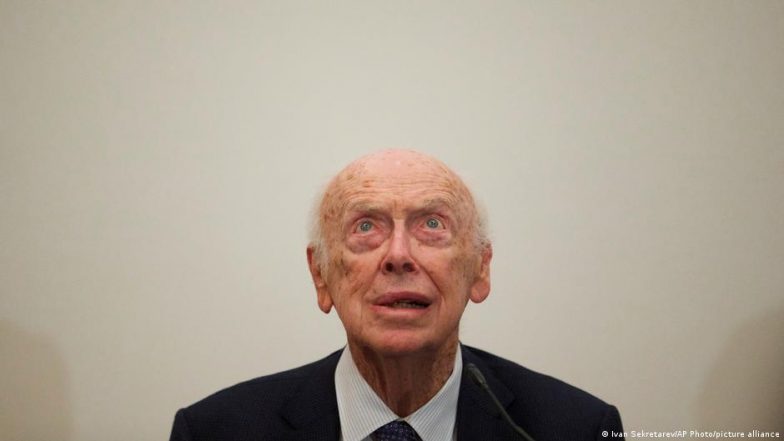
Hansjürgen Köhler has been a volunteer UFO hunter for more than 50 years.

Hansjürgen Köhler has been a volunteer UFO hunter for more than 50 years. He sees his work as scientific investigation, but sometimes also as caring for others.Anyone in Germany who thinks they have seen an unidentified flying object, or UFO, can notify the Central Research Network for Anomalous Phenomena, better known as CENAP — a UFO research network. One of CENAP's hotlines, run by Hansjürgen Köhler and a five-person team of volunteers, is based in Germany's southwestern Odenwald region.
Köhler is friendly and chatty man in his late 60s. He became a salesman early in life because he was not allowed to become an astronomer. At the time, his father advised him to "do something respectable." That meant that Köhler's love of space would have to remain a hobby — albeit one he still takes very seriously. In 2023, NASA appointed its first ever director of Unidentified Anomalous Phenomena (UAP) — as UFOs are now more frequently called — while in Germany, Hansjürgen Köhler has been investigating UFO reports for more than 50 years.
High percentage of 'UFO' sightings solved
Köhler says CENAP has processed 13,621 reported UFO sightings since it was founded in 1976 and has been able to explain almost all of them — with only 89 cases unresolved. Reported sightings have increased annually over the past five years, he says, with 1,348 sightings registered in 2025 alone.
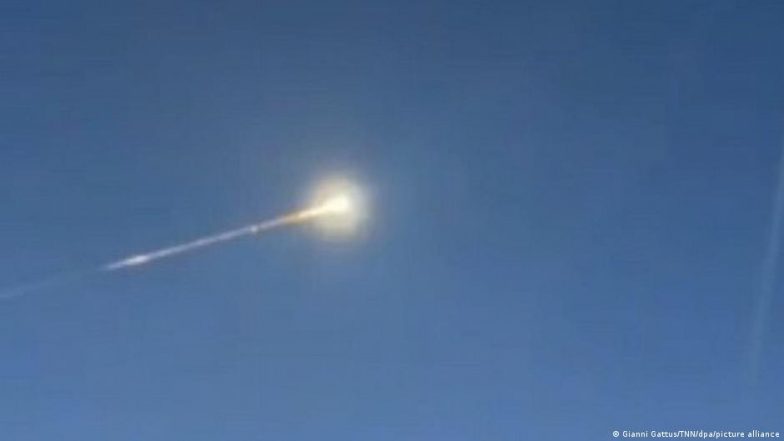
Most sightings are easily explained and involve people misidentifying rockets, satellites, bright planets or stars. Köhler says a classic case involves Sirius, the brightest star in the sky, located slightly above and to the left of the Orion constellation. Sometimes, it's also a fireball or a meteorite — "those really get an astronomer's heart pounding," he says.
CENAP is not the only outfit looking into such cases. Germany alone has a number of UFO hotlines. Among them are the German Society for UFO Research (DEGUFO), or the German-language chapter of the Mutual UFO Network (MUFON-CES), or the Society for the Study of UFO Phenomena (GEP).
Köhler told DW that about 40% of all reported sightings can be traced back to space technology. Elon Musk's Starlink satellites have also triggered confused sightings over the past few years, because, according to Köhler, the satellites can exhibit "extreme flaring" in some situations, causing more and more people around the globe — including airplane pilots — to report UFO sightings.
Airplanes, helicopters and drones also spur calls. Köhler says it is not surprising that drones — which can dart around executing crazy maneuvers — confuse people. But often, the sightings are triggered by more mundane phenomena: Balloons, for instance, especially those made with bright foils, are often culprits because they are so highly reflective. Laser shows can be similarly irritating, with beams capable of traveling dozens of kilometers from event venues, lighting up skies in the middle of nowhere.
CENAP, the UFO hotline that never sleeps
CENAP's hotline is manned 24 hours a day. People can also report sightings via WhatsApp or e-mail, or fill out contact forms on the CENAP website. Köhler sees it as his duty to look into every query and respond to senders and callers within 24 hours. When reports come in, Köhler needs to know the date, time, location, compass direction, duration of sighting and the number of witnesses. Photos and videos, he says, are also helpful.
His main office hours are from 10:00 p.m. until midnight, which is when most people are on their balconies looking at the night sky, often because they are out for a smoke. When the skies over Germany are busy, for instance during a meteor shower, Köhler says he can receive 60 to 80 calls in a single night. "When the first one comes in," he says, "you can turn off the TV and forget the rest of the night because you know the phone is going to keep ringing off the hook."
Köhler's favorite reports come in the early morning hours, between 3 and 4 a.m. He leaps out of bed on such nights knowing that it might be a spectacular meteor show that has people calling. The sooner people notify CENAP the better, he says, "Then we can take a look at the computer and see exactly what the caller is seeing."
In best-case scenarios, he and his team are able to resolve the issue on the spot.
People generally lack knowledge of astronomy
Inside the "UFO scene" Hansjürgen Köhler is a skeptic. He is careful to distance himself from "UFO freaks," seeing his own work as more akin to a space criminologist than someone who believes in flying saucers and little green men.
Köhler also believes there is room for improvement when it comes to society's knowledge of astronomy, adding that it is a phenomenon he first recognized while visiting a space observatory as a youth. He is not alone in his assessment. Recently, the world's recognized authority on professional astronomy, the Paris-based International Astronomical Union (IAU), created the "Big Ideas in Astronomy" project, which defines what should be considered general astronomical understanding.
But it isn't just lack of specific knowledge that can lead to misidentifying objects in space. Our senses and perception can trick us, too. Psychology defines this as pareidolia, or the tendency of the brain to see images or meaning in arbitrary patterns. The phenomenon can lead an individual to see nebulous structures or reflections as UFOs, though people can be susceptible to the phenomenon to different degrees, depending on personality, stress or expectation.
Between forensic criminology and spiritual counseling
Köhler uses astronomy software, space agency information and flight data to get to the bottom of most UFO sightings — occasionally even dialing up the German military in special instances. At other times, he proceeds like a police detective.
One case has been on Köhler's mind since the 1990s. It involved a young woman who spent several months chasing a UFO around western Germany and even into Belgium in her car. One night, she says a truck driver in Belgium blew his airhorn when she passed him on the highway — for her a sure sign that he had seen the UFO, too.
The odd thing about that particular UFO, says Köhler, was that it was constantly changing its form, sometimes appearing larger, sometimes smaller. Köhler eventually discovered that the woman was half blind, had lost her contact lenses and was wearing defective glasses. What she was seeing was not a UFO, but the waxing and waning of the moon. Köhler described the case as odd, yet dramatic. In the end, he believes, she was just lonely.
He says when people call it is often as if they are old friends — no matter their age or gender, whether they are relaxed or excited. Köhler recalls one woman who called from inside her barricaded apartment, convinced that a war had broken out when in fact she had seen a meteor.
"It helps people to call," says Köhler.
When he can explain what is happening, people often thank him and are relieved that they can finally lay down to sleep.
The European Space Agency (ESA) calls, too
Lately, the European Space Agency (ESA) has begun referring cases to Köhler and CENAP. One such case came three years ago when a research team observing the northern lights in Norway noticed something unusual. Köhler was able to determine that the phenomenon had been caused by a rocket launch in which the vessel's fuel had crystalized in the icy cold, "creating a spectacular sight in the sky."
In a different case about six months back, he got a call about aliens landing on a beach in Portugal. He says a woman — who documented the situation with extremely detailed drawings — claimed she had seen aliens appearing and disappearing as she sat by a bonfire at night. After looking into the case, Köhler soon found out that the location was also home to a diving school. Although UFO fans would likely file the encounter under "alien sightings," Köhler simply said "humbug" and listed it as a "night dive."
Not to say that UFOs won't land at some point
So does Köhler think an alien UFO will land on earth one day?
"They haven't been here yet," he says.
At the same time, he is convinced that we are not the only living beings in the galaxy. He says that would be a waste of space.
"I can't say for sure they won't come," he says, but adds that if they ever do land on our blue planet and see what's going on, he's sure that they'll be out of here in a hurry.
This article was originally published in German.
(The above story first appeared on LatestLY on Apr 12, 2026 01:20 AM IST. For more news and updates on politics, world, sports, entertainment and lifestyle, log on to our website latestly.com).