












 Quickly
 Socially
 Trending
 Crypto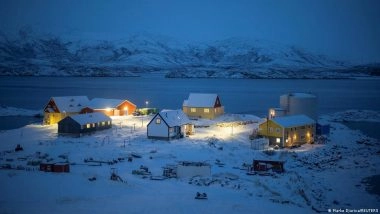
The US president's curt description of Greenland recalls a pattern in which colonial authorities have sometimes classified land as "not used" or "uninhabited," overlooking Indigenous land relations and stewardship.When US President Donald Trump referred to Greenland as "a piece of ice" during his recent speech at the World Eonomic Forum in Davos, the remark jarred: Greenland has been inhabited for close to five millennia and is home to over 56,000 people, mostly of Inuit descent.
Also Read | Business News | Budget Reinforces Long-term Biopharma Growth Despite No New Tax Incentives: EY.
It also echoed a long‑standing pattern by colonial powers to apply their own ideas of land ownership to places that were already inhabited, often overlooking established local systems. It's a pattern that reveals a deeper divide — two very different ways of understanding the significance and use of land.
Also Read | India News | Supreme Court Grants Bail to Three Accused in Pune Porsche Case.
Greenland's Inuit hold land to be shared collectively, rather than privately owned, an idea that fundamentally conflicts with Trump's desire to buy or otherwise acquire the country.
Historically, in many Indigenous societies, people saw themselves as stewards of the land, managing it through seasonal hunting and harvesting, safeguarding water sources, and maintaining ancestral sites. European empires, meanwhile, approached land as property: a defined asset that could be claimed, bought or transferred between states. Landscapes that didn't match European ideas of land use were labeled "unused," "wild" or "uninhabited" and thus, available.
A 2023 study in the journal of Australian Historical Studies shows that in the 18th century, British officials used "uninhabited" to mean a land without a sovereign or "civilized" government, not a land without people. This meant that communities could be living in, fishing, farming or naming places — and could have been doing so for millennia — and still not count as "inhabitants."
This influenced how states defined and justified control over land in different regions. Here are four examples:
Alaska: When deals trumped Indigenous interests
In 1867, the United States purchased Alaska from the Russian Empire for $7.2 million, about two cents per acre then. American newspapers mocked the deal — brokered by then US Secretary of State William H. Seward — as "Seward's Folly," calling Alaska "Seward's icebox" or even a "polar bear garden." It was later acknowledged as one of the country's most strategic land acquisitions, rich in gold, oil, timber and fish.
Yet the agreement between the United States and Russia was made without consulting Alaska Natives, Indigenous peoples whose ancestors had lived in the region for at least 10,000 years.
Across Alaska, many native communities organized their lives around seasonal salmon runs, whale, seal and walrus hunting areas, berry‑gathering grounds, river routes, and places with cultural or ancestral importance. These areas were managed through shared rules and responsibilities that had developed over generations. None of this was reflected in the 1867 transfer, which treated Alaska as territory to be exchanged between empires and did not account for existing Indigenous land‑use systems.
Australia: The myth of terra nullius
For more than a century, British authorities labelled Australia "terra nullius," Latin for "land belonging to no one," despite at least 60,000 years of Aboriginal presence and land care.
For Aboriginal peoples, "Country" is a holistic concept encompassing land, waters, skies, plants, animals and ancestral responsibilities. Their practices — including using small, planned fires to clear dry vegetation, moving with the seasons, and protecting water and food sources — helped keep the environment healthy.
Because these practices didn't resemble European farming or permanent settlement, British officials in the 18th century took them as evidence that no recognizable government existed and declared the continent "terra nullius," drawing on British legal traditions that linked sovereignty to centralized authority.
The doctrine remained in Australian law until 1992, when the Australian High Court overturned it, recognizing the existence of Indigenous Australians' traditional land rights.
North America: Mobility vs. 'improvement'
When European settlers arrived in large numbers in the 1600s in what is now the Eastern and Central United States, they encountered Indigenous nations, some of whom moved seasonally within ancestral territories to harvest berries or hunt game and salmon, and gather for ceremonies and trade. These cycles were organized systems for managing land and resources, not mere "wandering."
But Europeans operated using a different framework. They justified their actions partly based on the writing of English philosopher John Locke, who had posited that land became legitimate property when people "improved" it through visible labor such as tilling, farming or building, and that land not used in these ways could be claimed by others who would use it accordingly.
This argument shaped early US legal ideas about who had the right to own or sell land. In 1823, the US Supreme Court ruled that Native Americans could live on their land but were not allowed to sell it to anyone except the federal government.
The court said this came from the old European "Doctrine of Discovery," a 15th-century legal and religious principle asserting that Christian European nations acquired ownership and sovereignty over non-Christian lands upon "discovering" them, disregarding Indigenous inhabitants. This meant Native Americans were treated as occupants rather than full owners, giving the US government a monopoly over land purchases and providing the legal basis for large‑scale dispossession.
This ruling's logic echoed in later policies and disputes, including the 2016 protests at Standing Rock, where the Standing Rock Sioux Tribe objected to the Dakota Access Pipeline because it threatened their main water source and several sacred sites, and because federal agencies approved the project without securing their consent. It reflected a system in which the US government retains final authority over land and resource decisions affecting Native Americans.
Southern Africa: Wandering vs. vacancy
In southern Africa, Khoekhoe and San communities organized their lives around seasonal water and grazing cycles. They were guided by customary law — an oral, community‑based system passed down through practice rather than written rules that governed access to waterholes, grazing areas and ancestral sites. Their rotational movement protected fragile ecosystems, a system now recognized by UNESCO as an example of sustainable pastoral knowledge.
To Dutch and later British settlers, however, land without fences appeared "unused," and seasonal mobility was misread as "wandering." This interpretation enabled settlers to take over grazing lands and enforce private property systems, destroying long‑standing systems of belonging — a loss still felt today in movements to recover cultural items and ancestral land.
Edited by: Cristina Burack
(The above story first appeared on LatestLY on Feb 02, 2026 02:00 PM IST. For more news and updates on politics, world, sports, entertainment and lifestyle, log on to our website latestly.com).
 Share Now
 Google Trends



 Live Bot