













 Quickly
 Socially
 Trending
 Crypto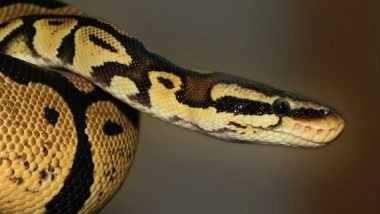
Washington [US], December 15 (ANI): Robots have been designed to move in ways that mimic animal movements, such as walking and swimming. Scientists are now considering how to design robots that mimic the gliding motion exhibited by flying snakes.
In Physics of Fluids, by AIP Publishing, researchers from the University of Virginia and Virginia Tech explored the lift production mechanism of flying snakes, which undulate side-to-side as they move from the tops of trees to the ground to escape predators or move around quickly and efficiently. The undulation allows snakes to glide for long distances, as much as 25 meters from a 15-meter tower.
To understand how the undulations provide lift, the investigators developed a computational model derived from data obtained through high-speed video of flying snakes. A key component of this model is the cross-sectional shape of the snake's body, which resembles an elongated frisbee or flying disc.
The cross-sectional shape is essential for understanding how the snake can glide so far. In a frisbee, the spinning disc creates increased air pressure below the disc and suction on its top, lifting the disc into the air. To help create the same type of pressure differential across its body, the snake undulates side to side, producing a low-pressure region above its back and a high-pressure region beneath its belly. This lifts the snake and allows it to glide through the air.
"The snake's horizontal undulation creates a series of major vortex structures, including leading edge vortices, LEV, and trailing edge vortices, TEV," said author Haibo Dong of the University of Virginia. "The formation and development of the LEV on the dorsal, or back, surface of the snake body plays an important role in producing lift."
The LEVs form near the head and move back along the body. The investigators found that the LEVs hold for longer intervals at the curves in the snake's body before being shed. These curves form during the undulation and are key to understanding the lift mechanism.
The group considered several features, such as the angle of attack that the snake forms with the oncoming airflow and the frequency of its undulations, to determine which were important in producing glide. In their natural setting, flying snakes typically undulate at a frequency between 1-2 times per second. Surprisingly, the researchers found that more rapid undulation decreases aerodynamic performance.
"The general trend we see is that a frequency increase leads to an instability in the vortex structure, causing some vortex tubes to spin. The spinning vortex tubes tend to detach from the surface, leading to a decrease in lift," said Dong. (ANI)
(The above story is verified and authored by ANI staff, ANI is South Asia's leading multimedia news agency with over 100 bureaus in India, South Asia and across the globe. ANI brings the latest news on Politics and Current Affairs in India & around the World, Sports, Health, Fitness, Entertainment, & News. The views appearing in the above post do not reflect the opinions of LatestLY)
 Share Now
 Google Trends



 Live Bot