Veteran German Actor Mario Adorf Dies at Age 95
Few actors had a career as rich as Mario Adorf.

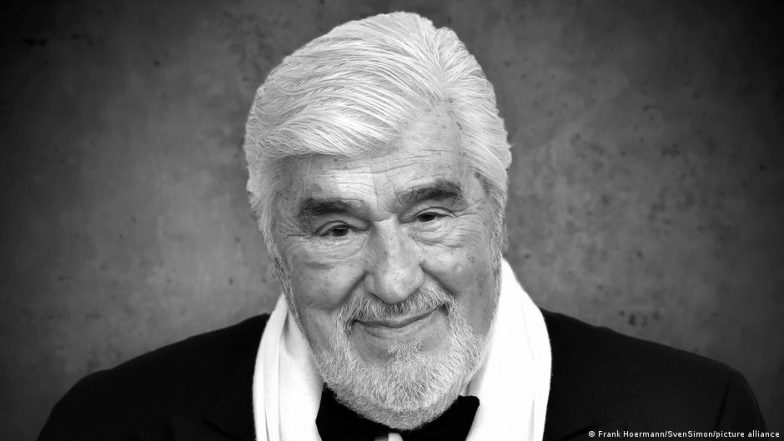
Few actors had a career as rich as Mario Adorf. He played legendary Hollywood villains, wrote German TV history and still had film roles at age 90.German actor Mario Adorf was a phenomenon. On screen, he beat people up, shot and killed them. He was loud, he was rude and used foul language. And yet, in the end, he was beloved by all.
Many other actors have been around for a long time, too, but who else can claim to have been as much a part of post-war German cinema as he was of the inspiring works of Rainer Werner Fassbinder and Volker Schlöndorff's New German Cinema movement?
Also Read | Sports News | England’s Charlie Dean Eyes Comeback Ahead of Home T20 WC 2026.
Who else can look back on a cinematic vita that includes Italian Spaghetti Westerns as well as classic mafia films, working with Hollywood directors as well as with leading European filmmakers?
Even as a nonagenarian, Adorf still played in films.
Landing in Hollywood
Born in the Swiss capital, Zurich, on September 8, 1930 to a German mother and an Italian father, Adorf grew up in the hilly rural Eifel region in western Germany. His mother Alice Adorf was an x-ray assistant, and his father Matteo Menniti was a surgeon.
Mario Adorf studied criminology, but dropped out to start acting for the theater before moving on to film.
In 1957 he played a murderer in "The Devil Strikes at Night," directed by Robert Siodmak, who had returned from Hollywood. The role was Adorf's breakthrough, but it also meant he was initially pegged as the actor to play villains, bad guys, creeps and gunslingers.
And he loved playing bad guys. "In and of itself, the villain is the interesting role in a book. I don't love the villains as people, as characters, but I know their significance, so I'm happy to lend them my body, my face," Adorf said early on in his career.
He was caught totally by surprise when in 1963 audiences were outraged because he, in the role of the bad guy, shot the father and sister of Winnetou, a fictional American Indian character beloved by Germans.
It added to his popularity and from there it was not much of a stretch to play the bad guy in many Spaghetti Westerns. He put down roots in Italy at the time and was also cast in several major Italian mafia films.
Back to 'New German Cinema'
He returned to Germany to work with a new generation of filmmakers, including Rainer Werner Fassbinder and Volker Schlöndorff — "Lola," "The Lost Honor of Katharina Blum," and in 1979, the Oscar-winning film adaptation of Günter Grass' novel of the same title, "The Tin Drum."
A detour to Hollywood netted Adorf a role in Sam Peckinpah's "Major Dundee," a Western movie, but in the end his character was almost completely cut from the finished film.
European filmmakers loved him too, and he worked with directors including Claude Chabrol, Damiano Damiani and Billy Wilder.
The actor also made films for German TV. Many Germans will remember Adorf for his roles in the legendary TV productions "Kir Royal" and "Der Grosse Bellheim."
Asked about his polyglot origins, he once replied that he didn't really like the term European. "I object a bit to the fact that it's so easy to say European," said the actor who was born in Switzerland, grew up in Germany and had lived in Italy with a French wife. "If it were that easy, Europe would have been there a long time ago, but it's certainly not that easy," Adorf said at the time.
Fondness for his boyhood hometown
Over the past decades he spent a great deal of time in his house in St. Tropez in southern France, but the Eifel region in western Germany remained close to his heart, too. It's where he grew up. He would frequently stop by his hometown of Mayen, which awarded him honorary citizenship. The traces of the Eifel dialect were noticeable in how he spoke long after he lived there.
Mario Adorf won just about every award there is in film and television.
His roles in more recent years reflected his career, from a three-part German TV movie about Winnetou to a mafia film in 2019. Adorf remained true to his themes, even into old age.
The actor was undoubtedly a star and over decades, he was one of the outstanding actors in European film and television.
But the term "film star" never really suited the likeable and modest Mario Adorf, who died after a short illness on April 8, 2026, aged 95 in his home in Paris.
This article was originally published in German.
(The above story first appeared on LatestLY on Apr 09, 2026 02:50 PM IST. For more news and updates on politics, world, sports, entertainment and lifestyle, log on to our website latestly.com).