













 Quickly
 Socially
 Trending
 Crypto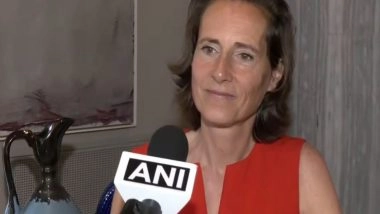
New Delhi [India], March 8 (ANI): India, as a democratic and technologically advanced nation, can play a pivotal role in global discussions on the ethics of emerging technologies like artificial intelligence (AI), according to Professor Marilyne Andersen, Director General of the Geneva Science and Diplomacy Anticipator (GESDA).
In an interview with ANI on Friday, Andersen highlighted GESDA's interest in forging a "privileged relationship" with India to address ethical challenges and promote responsible innovation in fields poised for breakthroughs over the next 5, 10, and 25 years.
"India contributes to this global conversation, obviously, and GESDA is only a small entity. We are very interested in working with India in particular as a democratic voice, a powerful voice in a very advanced country, technologically speaking and on many levels," Andersen said.
She explained that GESDA facilitates ethical discussions by compiling a "radar" of anticipated scientific advancements, drawing insights from a global community of 2,300 scientists across various regions.
This tool, according to her, helps balance the opportunities and risks of emerging trends, ensuring multiple stakeholders--including governments, businesses, and scientists--engage in dialogue to steer developments toward benefiting humanity.
"GESDA works on two main missions. One is to anticipate what the next scientific breakthroughs are that are coming in the upcoming 5, 10, and 25 years and do that through the voice of scientists working with 2,300 scientists all around the world in many different regions and economies," Andersen elaborated.
"The action part of that mission is to embed a project or new projects around a given emerging scientific field and to work on real-world cases and use cases with local ecosystems and different regions of the world," she added.
On collaboration between Indian scientific institutions and policymakers with GESDA, Andersen emphasised the need for better dialogue between the scientific and diplomatic worlds.
"These are two worlds that should speak to each other more, but they have different languages. The scientific language is very straightforward, very much evidence-based and can be used as a support to build policies," she noted.
GESDA positions itself as a neutral facilitator, providing awareness of upcoming disruptions without prescribing specific policies. Instead, it supports frameworks for "responsible innovation" that prioritise societal good over mere speed.
"The GESDA doesn't position itself as a direct advocate nor as a direct guide to policy-making; it will not use the anticipation work of saying what is coming to say that, therefore, you should go in this direction or that," Andersen said.
"We stay scientific in that sense of staying agnostic to whether we want what science is coming to, but we bring awareness that it is coming," she added.
Andersen's remarks come amid growing global concerns over the ethical implications of rapid technological advancements, underscoring India's potential to influence international standards through its robust scientific ecosystem and democratic values. (ANI)
(The above story is verified and authored by ANI staff, ANI is South Asia's leading multimedia news agency with over 100 bureaus in India, South Asia and across the globe. ANI brings the latest news on Politics and Current Affairs in India & around the World, Sports, Health, Fitness, Entertainment, & News. The views appearing in the above post do not reflect the opinions of LatestLY)
 Share Now
 Google Trends



 Live Bot