Elon Musk at WEF Predicts 'More Robots Than People' on Earth; Says Humanoid Robots Could Go on Sale by End of 2026 (Watch Video)
In his 2026 debut at the World Economic Forum in Davos, Elon Musk predicted that humanoid robots would eventually outnumber the human population. Speaking with BlackRock CEO Larry Fink, Musk envisioned an "Age of Abundance" driven by Tesla's Optimus robots. He also said that humanoid robots could go on sale by the end of this year.

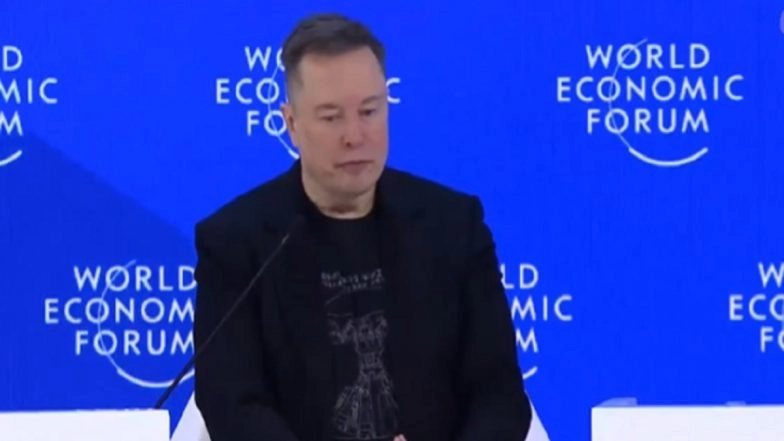
Mumbai, January 22: Tech billionaire Elon Musk made a high-profile debut at the World Economic Forum (WEF) in Davos on Thursday, January 22, where he predicted that the global population of humanoid robots will eventually surpass that of humans. In a sit-down interview with BlackRock CEO Larry Fink, the Tesla and SpaceX chief outlined a future of "sustainable abundance", suggesting that advanced robotics and artificial intelligence (AI) will soon saturate all human needs, effectively ending global poverty and making traditional labour optional.
There'll Be More Robots Than People, Says Elon Musk
Musk’s prediction is rooted in the rapid development of Tesla's humanoid robot, Optimus. He told the audience in Davos that these robots are already performing basic tasks in Tesla factories and are expected to handle complex industrial work within the next 12 months. "My prediction is that there will be more robots than people," Musk said, adding that everyone on Earth will likely want at least one personal robot. He envisioned these machines performing roles ranging from elder care and domestic chores to childcare, provided they are proven to be "very safe". He also added that humanoid robots could be sold to the public by the end of 2026. Elon Musk Buying Ryanair? Airline CEO Michael O’Leary Calls Press Conference To Address Tech Billionaire’s Acquisition Tease via Poll on X.
My Prediction Is There'll Be More Robots Than People, Says Elon Musk
NOW - Musk: "My prediction is there'll be more robots than people... everyone on Earth is going to have one and going to want one... who wouldn't want a robot to... watch over your kids, take care of your pets... we are in the most interesting time in history." pic.twitter.com/NzqeM3X9ja
— Disclose.tv (@disclosetv) January 22, 2026
Elon Musk Says Humanoid Robots Could Go on Sale by End of 2026
NOW - Elon Musk to BlackRock's Larry Fink: "By the end of next year I think we'd be selling humanoid robots to the public." pic.twitter.com/yvBUU7MA7l
— Disclose.tv (@disclosetv) January 22, 2026
Economic and Biological Shifts
The tech mogul argued that the integration of ubiquitous robotics will trigger an "unprecedented explosion" in the global economy. According to Musk, as machines take over physical and repetitive labour, the concept of work will become optional - likening future employment to playing a sport or a video game. Beyond economics, Musk addressed the challenges of human ageing, calling it a "very solvable problem". He suggested that AI and robotics could help manage the needs of an ageing global population in regions where birth rates are declining, and there are not enough young people to provide care.
Elon Musk's First Appearance at Davos
Musk’s attendance marks a significant shift in his relationship with the WEF. For years, he has been a vocal critic of the event, famously dismissing it in 2023 as an "unelected world government." However, his 2026 appearance saw him take centre stage alongside other major world figures, including President Donald Trump and European Commission President Ursula von der Leyen. Despite the cordial setting, Musk maintained his characteristic unpredictability, joking about extraterrestrial life and questioning US energy infrastructure. He warned that electricity generation in the United States is currently failing to keep pace with the power demands of AI chips, pointing to solar energy as the only viable long-term solution. Humanoid Robots Deployment Will Bring ‘Employment Shocks’, Hyundai Motor’s South Korean Labour Union Warns Automaker.
Market Projections and Scepticism
While Musk’s timelines are famously ambitious, market analysts are beginning to reflect the sector's potential. Barclays analysts recently estimated that the humanoid robotics market, currently valued at roughly $3 billion, could expand to USD 40 billion by 2035. However, some experts at the forum remained cautious, noting that large-scale deployment of humanoid robots still faces significant hurdles in battery life, sensor precision, and regulatory approval. Economists also warned that while automation could create wealth, robust policies would be required to prevent a surge in global inequality.
(The above story first appeared on LatestLY on Jan 22, 2026 11:13 PM IST. For more news and updates on politics, world, sports, entertainment and lifestyle, log on to our website latestly.com).