Peacock Feathers Emit Laser Light in 1st Known ‘Biolaser Cavity’ in Animal Kingdom, Say Scientists
Peacock feathers, already adored for their dazzling structural colour, have now been found to hide an even more remarkable optical feature, the ability to emit laser light. The discovery adds a new dimension to how complex biological structures manipulate light and could open up new avenues for biophotonic research.

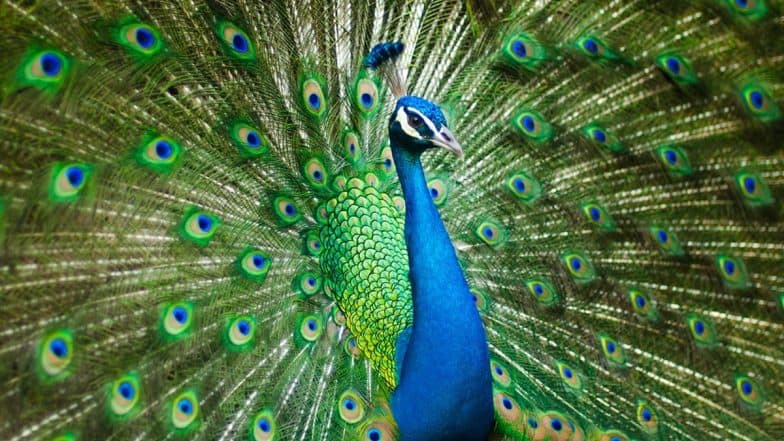
Mumbai, August 2: Peacock feathers, already adored for their dazzling structural colour, have now been found to hide an even more remarkable optical feature, the ability to emit laser light. According to a new study, scientists discovered that under specific conditions, the eye-catching feathers can amplify light into narrow laser beams, marking the first known example of a laser cavity in the animal kingdom.
The study, published in Scientific Reports, was led by physicists from Florida Polytechnic University and Youngstown State University. The discovery adds a new dimension to how complex biological structures manipulate light and could open up new avenues for biophotonic research. Is There a Surya Grahan on August 2, 2025? Is the Longest Solar Eclipse of the Century Causing 6 Minutes of Darkness Across the World Taking Place Today? NASA Debunks Viral Claim.
Scientists Produced Yellow-Green Laser Emissions From Peacock Feathers
By dyeing the colourful eyespots of Indian peafowl feathers and exciting them with light pulses at 532 nm, the researchers were able to produce yellow-green laser emissions from the feather structures. Interestingly, laser light was emitted from various parts of the eyespot at two distinct wavelengths, despite differences in visible colour. The emissions were not visible to the naked eye but were detected using sensitive optical instruments.
How the Feathers Produce Laser Light
Researchers believe the laser effect is due to microscopic, periodic nanostructures within the feather’s barbules, small filament-like structures that help give peacock feathers their iridescence. These nanostructures act similarly to photonic crystals by reflecting light at specific wavelengths. While the exact microstructures responsible for the lasing remain unidentified, scientists suggest that protein granules or similar internal structures could be acting as natural laser cavities. Will AI Take Away Your Job? Microsoft Study Identifies 40 Jobs AI Will Replace and 40 That Remain Safe, Full List Here.
Notably, multiple cycles of dye application and drying were needed to achieve laser emission, suggesting that deep dye penetration and interaction with internal structures are crucial.
Though there’s no evidence that peacocks use laser light biologically, the findings have broader implications. The study not only offers insights into how nature can engineer coherent light but also hints at potential applications, from biocompatible lasers for medical imaging to identifying microstructures in biological tissues. Researchers now hope to explore similar laser effects in other natural materials and even engineer synthetic versions for optical and biomedical technologies.
(The above story first appeared on LatestLY on Aug 02, 2025 04:23 PM IST. For more news and updates on politics, world, sports, entertainment and lifestyle, log on to our website latestly.com).