













 Quickly
 Socially
 Trending
 Crypto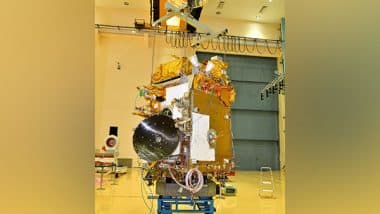
Bangalore (Karnataka) [India], August 14 (ANI): The Indian Space Research Organisation (ISRO) has announced the launch of its next big project, the PSLV-C57/Aditya-L1 Mission, marking the country's mission that could revolutionise the understanding of the Sun's dynamics and space weather.
The project is going to be India's first space-based solar observatory.
https://twitter.com/isro/status/1690935417342967808?s=20
"Aditya-L1, the first space-based Indian observatory to study the Sun, is getting ready for the launch. The satellite realised at the U R Rao Satellite Centre (URSC), Bengaluru, has arrived at SDSC-SHAR, Sriharikota," ISRO said in a post on X (formally known as Twitter) on Monday.
An exact date regarding the launch of the project is, however, yet to be announced.
The announcement comes after the arrival of the satellite, developed at the U R Rao Satellite Centre in Bengaluru, at the Satish Dhawan Space Centre (SDSC-SHAR) in Sriharikota, Andhra Pradesh.
Aditya-L1, named after the Sun's core, aims to provide unprecedented insights into the Sun's behaviour by placing itself in a halo orbit around the Lagrange point 1 (L1) of the Sun-Earth system, approximately 1.5 million kilometres from Earth.
This strategic location will enable Aditya-L1 to continuously observe the Sun without being hindered by eclipses or occultation, allowing scientists to study solar activities and their impact on space weather in real-time.
The spacecraft is equipped with seven advanced payloads designed to scrutinize various layers of the Sun, from the photosphere and chromosphere to the outermost layer, the corona.
These payloads employ electromagnetic, particle and magnetic field detectors to capture data crucial for understanding phenomena like coronal heating, coronal mass ejections, solar flares, and more.
One of the most exciting aspects of Aditya-L1's mission is its ability to directly view the Sun from its unique vantage point at L1.
This will enable four payloads to capture clear observations of the Sun, while the remaining three payloads will conduct in-situ studies of particles and fields at this Lagrange point.
These combined observations promise to unlock the mysteries behind solar dynamics and their effects on the interplanetary medium.
Scientists have high hopes for Aditya-L1's payload, which is expected to shed light on the physics of the solar corona and its heating mechanism, magnetic field topology, and the development of coronal mass ejections.
The spacecraft's data will help identify the sequence of processes that lead to solar eruptive events and contribute to a deeper understanding of space weather drivers.
ISRO Chairman S Somanath shared an update on June 28 revealing that the organisation is targeting the end of August for Aditya-L1's launch. (ANI)
(The above story is verified and authored by ANI staff, ANI is South Asia's leading multimedia news agency with over 100 bureaus in India, South Asia and across the globe. ANI brings the latest news on Politics and Current Affairs in India & around the World, Sports, Health, Fitness, Entertainment, & News. The views appearing in the above post do not reflect the opinions of LatestLY)
 Share Now
 Google Trends



 Live Bot