Severe G4 Geomagnetic Storm Triggers Global Aurora Alert As Rare Sightings Possible Tonight; Know if Northern Lights Will Be Visible in India
A severe G4 geomagnetic storm is striking Earth today, January 20, pushing the Northern Lights as far south as the US mid-latitudes and Europe. Triggered by a massive solar flare, the storm could make auroras visible in 28 US states and northern India (Ladakh). Experts warn of potential GPS and power grid disruptions through tonight.

- Read in
- हिंदी
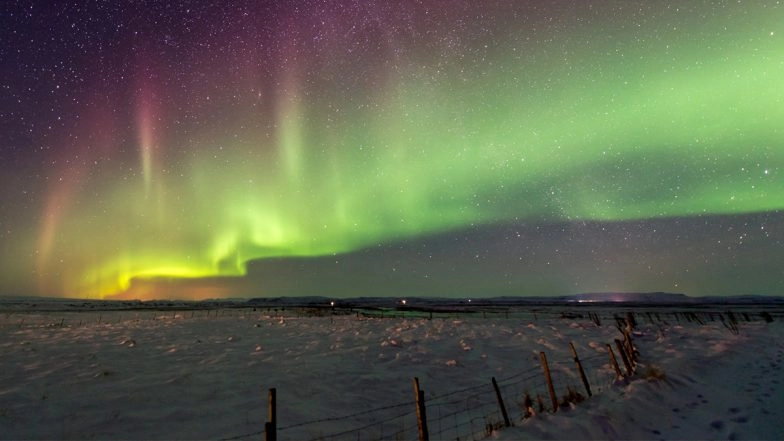
Mumbai, January 20: A powerful G4-class geomagnetic storm is currently striking Earth, prompting the National Oceanic and Atmospheric Administration (NOAA) to issue a "severe" space weather alert for Tuesday, January 20. Triggered by a massive coronal mass ejection (CME) that erupted from the Sun on Sunday, January 18, the storm has reached its peak intensity, pushing the Aurora Borealis significantly further south than its typical polar boundaries.
This rare cosmic event, described as the strongest in over two decades, has already painted the skies of Europe and China in vivid hues of red and green, and skywatchers across the United States and parts of Asia are now bracing for potentially historic sightings. Earth Going To Lose Gravity for 7 Seconds on August 12, 2026? Fact Check Reveals Truth About Viral Social Media Claims.
What Are Geomagnetic Storms?
A geomagnetic storm is a major disturbance of Earth's magnetosphere that occurs when solar wind - specifically from events like solar flares or coronal mass ejections (CMEs) - interacts with Earth's magnetic field.
When a billion tons of solar plasma (charged particles) slam into our atmosphere at millions of miles per hour, it transfers immense energy. This energy funnels toward the poles, exciting oxygen and nitrogen molecules in the upper atmosphere. As these molecules return to their normal state, they release light, creating the shimmering curtains known as the Aurora Borealis (Northern Lights) and Aurora Australis (Southern Lights).
Global Visibility of Northern Lights and 'Southward Dip'
Because this storm is rated as a G4 (Severe) on a 5-point scale, the "auroral oval" has expanded dramatically. While usually restricted to high latitudes like Alaska and Scandinavia, the lights are now visible in mid-latitude regions.
North America: Forecasts suggest visibility in as many as 28 US states, including regions as far south as Pennsylvania, Ohio, and even parts of Colorado and Utah.
Europe & Asia: Breathtaking displays have already been reported in Portugal, France, Germany, and northern China.
India: While the Northern Lights are exceptionally rare in India, during extreme storms (G4-G5), a faint "SAR arc" (Stable Auroral Red arc) or a deep red glow can sometimes be captured via long-exposure photography in high-altitude northern regions like Ladakh (Hanle and Spiti Valley). While not visible to the naked eye in most of the country, the 2026 solar maximum makes this the best opportunity in years for Indian astrophotographers.
Impact on Technology and Infrastructure
While the auroras are a visual marvel, severe geomagnetic storms pose risks to modern infrastructure. NOAA and NASA have alerted satellite operators and power grid managers to prepare for potential disruptions:
Power Grids: The changing magnetic fields can induce currents in long-distance power lines, potentially leading to voltage instabilities.
Navigation: GPS and GNSS signals may experience "scintillation," leading to degraded accuracy or total signal loss for several hours.
Communication: High-frequency (HF) radio used by aviation and maritime services can be completely blacked out, particularly in polar flight paths. NASA Makes History With First Medical Evacuation as Ailing Astronaut Returns to Earth Early.
Best Way to View the Northern Lights
For those hoping to catch the display tonight, experts recommend the following:
Timing: The peak viewing window is typically between 10:00 PM and 2:00 AM local time.
Location: Get away from city light pollution and find an unobstructed view of the northern horizon.
Photography: Even if the lights look like a faint grey cloud to the naked eye, modern smartphone cameras in "Night Mode" with a 3–5 second exposure can often reveal the hidden colours.
Space weather officials expect the storm to begin weakening late on January 21, though residual effects may keep the auroras active for another 24 hours.
(The above story first appeared on LatestLY on Jan 20, 2026 04:51 PM IST. For more news and updates on politics, world, sports, entertainment and lifestyle, log on to our website latestly.com).