













 Quickly
 Socially
 Trending
 Crypto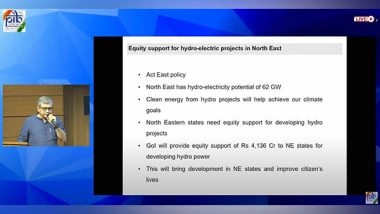
New Delhi [India], August 28 (ANI): The Union Cabinet, chaired by Prime Minister Narendra Modi, has approved the Ministry of Power's proposal to provide Central Financial Assistance (CFA) to the North Eastern Region (NER) state governments with an outlay of Rs. 4,136 crore for their equity participation in developing hydroelectric projects.
According to the official statement, these projects will be executed through Joint Venture (JV) collaborations between state entities and Central Public Sector Undertakings (CPSUs).
The scheme will be implemented from FY 2024-25 to FY 2031-32 and aims to support a cumulative hydro capacity of approximately 15,000 MW. It will be funded through 10 per cent Gross Budgetary Support (GBS) for the North Eastern Region, drawn from the Ministry of Power's total budget. The Ministry's plan includes forming a JV company for each project between a central PSU and the respective state government.
The CFA for the NER state governments' equity share will be capped at 24 per cent of the total project equity, with a maximum of Rs 750 crores per project.
This cap may be revisited on a case-by-case basis. The equity ratio between the CPSU and the state government in the JV will be maintained when disbursing the grant. CFA will only be provided to viable hydroelectric projects, with states expected to waive or stagger free power and/or reimburse SGST to ensure project viability.
This scheme aims to encourage state governments' participation in hydro development, allowing for a more equitable sharing of risks and responsibilities.
By involving state governments as stakeholders, issues related to land acquisition, rehabilitation, resettlement, and local law and order are expected to be minimized, thereby reducing the chances of project delays and cost overruns.
The scheme is expected to play a crucial role in harnessing the hydropower potential of the North East, attracting significant investment to the region, and generating substantial direct and indirect employment opportunities, including in sectors like transportation, tourism, and small-scale businesses.
Moreover, the development of these hydroelectric projects will contribute to India's Nationally Determined Contribution (INDC) goal of establishing 500 GW of renewable energy capacity by 2030 and enhance the flexibility, security, and reliability of the national grid by integrating renewable energy sources.
To address the challenges hindering hydropower development, the Government of India has implemented several policy initiatives.
Notably, on March 7, 2019, the Cabinet approved measures to promote the hydropower sector, such as classifying large hydro projects as renewable energy sources, introducing Hydro Power Purchase Obligations (HPOs), rationalizing tariffs through escalation, and providing budgetary support for flood moderation and the construction of enabling infrastructure like roads and bridges. (ANI)
(The above story is verified and authored by ANI staff, ANI is South Asia's leading multimedia news agency with over 100 bureaus in India, South Asia and across the globe. ANI brings the latest news on Politics and Current Affairs in India & around the World, Sports, Health, Fitness, Entertainment, & News. The views appearing in the above post do not reflect the opinions of LatestLY)
 Share Now
 Google Trends



 Live Bot