













 Quickly
 Socially
 Trending
 Crypto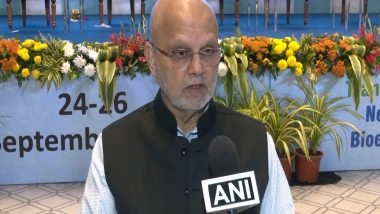
By Kaushal Verma
New Delhi [India] September 24 (ANI): Flex engines are gaining a foothold in India, backed by the country's growing ethanol blending programme and other biofuel initiatives, Pramod Chaudhari, President of the Indian Federation of Green Energy, said on Wednesday.
"Flex engine is catching up in India now. Toyota has already introduced it. It is a mixture of alcohol, ethanol, and petrol, and it is also flexible with electricity. So it is a hybrid. You see the vehicles on the road that can partly run on one source and partly on another," Chaudhari told ANI on the sidelines of the 2nd International Conference and Exhibition on Bioenergy and Technologies held in New Delhi.
Flex engines, or flex-fuel engines, are designed to run on gasoline and any blend of gasoline and ethanol or methanol, including pure ethanol. They use sensors to detect the fuel blend and an electronic control system to adjust engine parameters like the fuel-air mixture and ignition timing for optimal performance. This technology supports renewable energy sources, increases energy security, and is being increasingly adopted in vehicles to reduce greenhouse gas emissions.
Earlier in the conference, Minister of Road Transport and Highways Nitin Gadkari also advocated flex-fuel vehicles. He said automakers, including Toyota, Tata, Mahindra, Suzuki, and Hyundai, are adopting flex-fuel technology, while tractor makers and construction equipment manufacturers are also shifting to biofuels and hydrogen.
Talking on ethanol blending in the country, Choudhari said that India has already reached the milestone of 20 per cent ethanol blending in petrol, known as E20, and is now awaiting the next step.
"E20 rollout has already been achieved. We started with 2 per cent, and in the last five to six years, with the push it has received, we have reached the 20 per cent level. Now we are waiting for the next announcement--whether it is 25, 27, or 30 per cent," he explained.
Pointing out the broader scope of biofuels, Chaudhari said work is underway to create blends for diesel and aviation fuel. "Diesel blending is still not done much anywhere, so we are trying to develop a new blend for diesel. Aviation fuel is another development, and government policy has already declared that by next year, there will be 1 per cent blending, then 2 per cent, and 5 per cent like that," he noted.
He further pointed to ongoing projects, including the Panipat biofuel plant based on crop residue (stubble), which is undergoing final validation. "By the year-end, it will be completely completed. Two more plants, one in Bathinda and another in Bargarh in Odisha, are also coming up," he said.
On bamboo as a fuel stock, he added, "There is only one plant that is partly commissioned, but bamboo has huge potential. It will find a lot of applications."
Summing up, he described India's momentum in the sector as a "new revolution."
"India is progressing well in these areas. This is giving Atmanirbhar Bharat to your children. You don't have to depend on imported oil. Right now, India imports 85 per cent of its oil, which will not be required at this scale with biofuels," said Chaudhari. (ANI)
(The above story is verified and authored by ANI staff, ANI is South Asia's leading multimedia news agency with over 100 bureaus in India, South Asia and across the globe. ANI brings the latest news on Politics and Current Affairs in India & around the World, Sports, Health, Fitness, Entertainment, & News. The views appearing in the above post do not reflect the opinions of LatestLY)
 Share Now
 Google Trends



 Live Bot