The Turbulent History of US-Cuban Relations
Donald Trump is not the first US president to have expansionist ambitions for Cuba.

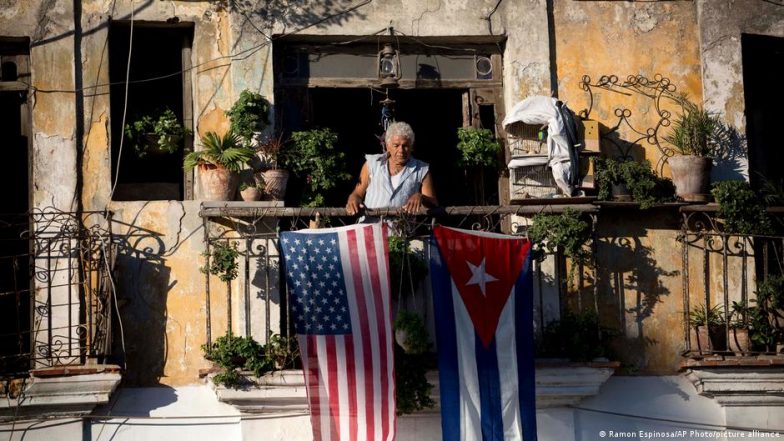
Donald Trump is not the first US president to have expansionist ambitions for Cuba. The US has a long history of trying to control the island — and of antagonistic relations with its government."I think I could do anything I want with it": That's what Donald Trump said about Cuba mid-March. Yet he is hardly the first US president with such expansionist desires, notes historian Michael Zeuske, a professor at the Center for Dependency and Slavery Studies at the University of Bonn. Zeuske says the US had already set its sights on the island as early as the mid-19th century.
Also Read | Business News | Chamelidevi Flour Mills Limited Received In-Principle Approval From BSE SME.
Cuba is not for sale
Also Read | Entertainment News | ‘Back to the Future’ Actor James Tolkan Passes Away at 94.
Back then, Cuba was still a Spanish colony. In 1820, Thomas Jefferson, who had served as the third president of the nascent United States from 1801-09, declared that his country should seize the first opportunity to annex Cuba.
Three years later, then-Secretary of State John Quincy Adams remarked: "There are laws of political as well as of physical gravitation; and if an apple severed by the tempest from its native tree cannot choose but fall to the ground, Cuba, forcibly disjoined from its own unnatural connection with Spain, and incapable of self support, can gravitate only towards the North American Union, which by the same law of nature cannot cast her off from its bosom."
In 1848, the 11th US president, James K. Polk, offered the Spanish $100 million for Cuba, only for the European colonial power to reportedly reply that it would rather sink the island into the sea. Spain desperately wanted to keep hold of the colony, one of the few still in its possession.
But just six years later the US was at it again: Its diplomats drafted a secret document in which they claimed the right to take Cuba by force should Spain continue to refuse their demand to sell the island. Nothing would come of it, however.
The 'apple' is ripe
All these plans were a result of the Monroe Doctrine, a foreign policy direction rooted in then-President James Monroe's 1823 message to the European colonial powers that "America [is] for the Americans."
On the surface, this message concerned the sovereignty of the young nation in North and South America. However, the US itself had already long ago embarked on a course of expansion. So wouldn't it be logical to finally pick that apple lying just 160 km (99 miles) off the south coast of Florida? It was practically on their doorstep.
Finally, in 1898, the US found a pretext to take over the island. The Cubans had been fighting bitterly for years to rid themselves of Spanish rule, and Washington established a strong military presence on the island, on the pretext that it was protecting its citizens there. As part of this, the USS Maine, a navy battleship, was anchored in Havana Harbor for weeks.
On February 15, 1898, a massive explosion tore open the ship's hull, sinking the vessel almost immediately. Was it caused by a smoldering fire that reached the ammunition? Or had the Spanish torpedoed the ship, as the US claimed? According to Zeuske, the accusation has never been substantiated; there is no proof it was an attack. The US nonetheless declared war on Spain.
Cuba becomes a de facto protectorate
The war lasted just four months and ended with Spain losing its last major colonies: Puerto Rico, Guam, the Philippines and Cuba. The United States finally took control of the Caribbean island — but it didn't become a state. This is due in large part to US Senator Henry M. Teller, who opposed Cuba's annexation, supposedly to protect the sugar industry in his home state of Colorado from Cuban competition.
Yet Cuba also wasn't given full independence. The United States refused to withdraw its troops unless the new government accepted the conditions of the "Platt Amendment." Cuban leaders had to include it in the constitution, Zeuske explains. The amendment would define future relations between the two countries, effectively allowing the US to have a say in foreign policy, national debt and health policy, as well as to intervene militarily and build naval bases. The base at Guantanamo still exists today.
On May 20, 1902, US military rule ended and the Republic of Cuba installed its first president. But even then, Cuba remained a quasi-protectorate of its powerful northern neighbor. The US was driven largely by economic interests: By 1926, US companies controlled about 60% of Cuba's sugar industry. American investors also poured large amounts of money into hotels, bars and casinos in Havana.
The mafia's long reach
In 1920 the US banned alcohol, and tourists began flocking to Cuba. Organized crime groups followed soon after. Cuba was close enough to the US to be easily reached but far enough away to avoid its law enforcement.
Havana became a major hub for gambling, drug and arms trafficking, money laundering and prostitution. US crime groups and the circle around Cuba's dictatorial leader Fulgencio Batista made millions in profits. Batista maintained close ties with mob boss Meyer Lansky, who became a key business partner and informal adviser.
The Cuban Revolution and its aftermath
While the elites were growing wealthier, much of the population was struggling in poverty. In 1953 Fidel Castro led an initial insurrection that government forces crushed. His "26th of July Movement" subsequently waged a guerrilla war that ended in 1959 with Batista fleeing the country.
"Castro initially tried to maintain a good relationship with the United States," Zeuske says, but US officials showed little interest in negotiating with a socialist revolutionary. What's more, Castro ordered the expropriation of US-owned refineries and sugar plantations and grew closer to the Soviet Union.
In 1960, President Dwight D. Eisenhower imposed a trade embargo on Cuba. In 1961, Cuban exiles, covertly supported by the CIA, attempted to land at the Bay of Pigs, on Cuba's southern coast, and overthrow the Castro government. The operation failed miserably and became a public embarrassment for the United States. Cubans celebrated Castro as he made further overtures toward Moscow, turning Cuba into a Soviet-aligned state in the Western Hemisphere.
In 1962, the Soviet Union deployed nuclear missiles to Cuba, bringing the world to the brink of nuclear war. The crisis ended when the Soviets withdrew the weapons in exchange for a US pledge not to invade Cuba. But US efforts to eliminate Castro continued, first through assassination plots and later through schemes involving poisoned cigars, a contaminated diving suit and an explosive device disguised as a seashell. These attempts caused Cubans to rally even more closely around their leader.
Is Cuba 'ready to fall'?
In the decades that followed, relations between the countries improved twice, under Presidents Jimmy Carter in the late 70s and Barack Obama in the 2010s. President Donald Trump later reversed that course.
In early January, Trump claimed Cuba was "ready to fall" and increased pressure on the island by blocking its foreign oil supplies, including those from Cuba-friendly Venezuela, where the US had taken military action. In March, Trump added on camera: "I think I will have the honor of taking Cuba."
The Cuban response was swift: Deputy Foreign Minister Carlos Fernandez de Cossío told NBC News that the country was sovereign and would not accept being controlled by another state.
Conditions in Cuba remain strained. Its energy supply has faltered, and blackouts have become common. Tourism has declined, garbage has piled up in the streets, and food has spoiled during power outages.
"When it comes to leadership, the military and territorial control, Cuba is extremely resilient," Zeuske says. "At the same time, people are deeply dissatisfied with their government, especially with the power cuts. Conditions continue to deteriorate. Many young people want to leave."
This article has been translated from German.
(The above story first appeared on LatestLY on Mar 28, 2026 01:40 PM IST. For more news and updates on politics, world, sports, entertainment and lifestyle, log on to our website latestly.com).