













 Quickly
 Socially
 Trending
 Crypto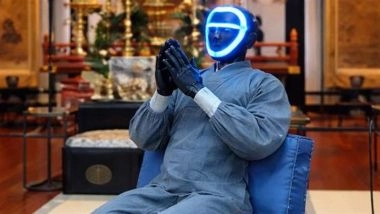
Kyoto, February 25: A research team from Kyoto University, in collaboration with tech ventures Teraverse and XNOVA, has officially unveiled the "Buddharoid," an AI-integrated robot monk designed to perform sacred rituals and provide spiritual guidance. The unveiling took place at the Shoren-in temple in Kyoto, marking a significant step in the integration of generative artificial intelligence with ancient religious traditions.
The Buddharoid is powered by a specialised system known as BuddhaBot-Plus, which is derived from OpenAI’s ChatGPT. This AI model has been trained extensively on sacred Buddhist scriptures, enabling the robot to offer spiritual advice on various personal and social issues. Unlike previous technological iterations, this new system allows for real-time, interactive dialogue between the machine and practitioners. MWC 2026: HONOR To Unveil Its 1st AI Humanoid Robot and ‘Robot Phone’ Concept During Mobile World Congress.
Buddharoid AI Monk Video
Advanced Hardware and Ritualistic Precision
The physical body of the Buddharoid was developed by Unitree Robotics, a firm based in China. The hardware is specifically calibrated to mimic the traditional movements of a human monk. This includes a slow, meditative gait, the act of bowing, and the gassho gesture, where the palms are placed together in prayer.
By combining physical presence with conversational AI, the developers aim to provide a level of psychological support that standard chat-based interfaces or augmented reality cannot achieve. The robot is intended to serve as a bridge for those seeking spiritual comfort in an increasingly digital world, providing a tangible sense of presence during religious observation.
Addressing the Decline of Traditional Temples
The development of the Buddharoid is a pragmatic response to the demographic crisis currently facing Japan’s religious infrastructure. With a rapidly ageing population and a decline in religious affiliation, approximately 30 per cent of Buddhist temples in the country are projected to vanish by 2040. Many rural temples struggle to find successors to maintain their physical presence.
Background of Techno-Spirituality in Japan
Japan has a growing history of "techno-spirituality." In 2019, the Kodai-ji temple introduced Mindar, a humanoid robot representing the deity Kannon Bodhisattva, which cost approximately 1 million USD to develop. While Mindar primarily delivered pre-recorded sermons, the Buddharoid represents an evolution in this field by offering dynamic interactions through generative AI. Humanoid Robots Deployment Will Bring ‘Employment Shocks’, Hyundai Motor’s South Korean Labour Union Warns Automaker.
This digital shift is seen by many as essential for the preservation of Buddhism in the 21st century. As younger generations move away from organised religion, the introduction of automated priests offers a way to keep ancient teachings accessible and relevant in a modern, tech-driven society.
(The above story first appeared on LatestLY on Feb 25, 2026 10:36 PM IST. For more news and updates on politics, world, sports, entertainment and lifestyle, log on to our website latestly.com).
 Share Now
 Google Trends



 Live Bot