How Can the EU Respond to US 'blackmail' over Greenland?
European leaders have three main options for responding to the Trump administration’s economic threats.

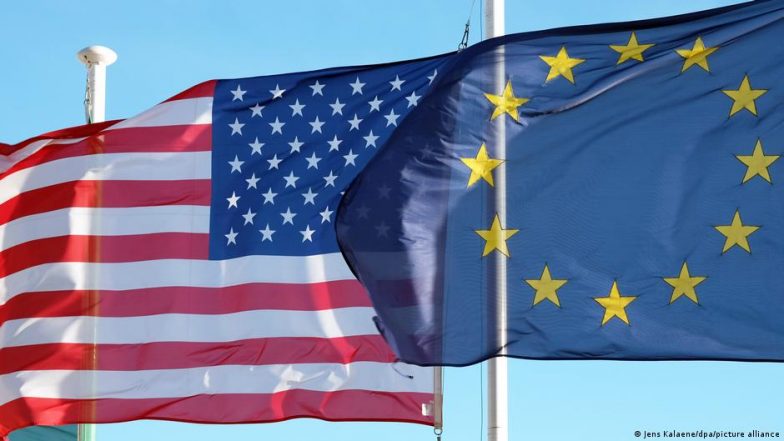
European leaders have three main options for responding to the Trump administration’s economic threats. If they don’t get it right, Trump may be emboldened to take over Greenland.After President Donald Trump announced he would levy 10% trade tariffs on eight European countries who oppose his annexation of Greenland, EU officials began mulling which measures to use to respond.
At their disposal are mainly three options:
The use of the so-called "trade bazooka" — a never-before-used instrument that could even go as far as restricting market access for US companies in the EU.
The implementation of retaliatory tariffs.
The suspension of the EU-US trade deal, which has yet to come into effect.
EU heads of state and government will meet for a summit on Thursday — a dinner cobbled together in haste to coordinate which of those options the bloc will use in response to Trump’s threats.
Danish Prime Minister Mette Frederiksen said at the weekend, "Europe won’t be blackmailed." German Chancellor Friedrich Merz said, "we don’t want a trade dispute with the US."
But he's getting one. Following Denmark, Norway, Sweden, France, Germany, the Netherlands, the UK, and Finland are all being targeted with Trump's tariffs after they sent a handful of military representatives to Greenland the previous week. They did so to signal solidarity with Denmark which has counted Greenland as autonomous country within its kingdom since 1953.
Economic Heavy Weaponry
The words on everyone's lips in Brussels right now are "Trade Bazooka" - the slang name for a technical piece of EU legislation agreed back in 2023, officially called the EU Anti-Coercion Instrument, or ACI.
Triggering it would allow the European Commission to impose sweeping trade barriers against any country targeted, potentially including market access restrictions and blocks on foreign investment.
French President Emmanuel Macron wants the EU to invoke it but Italian Prime Minister Georgia Meloni, among others, is hesitant.
"The ACI contains many tools that could be impactful if deployed, such as procurement or export controls on critical inputs for US supply chains," Penny Naas, senior vice president at the German Marshall Fund, told DW. "The tool, however, takes time to implement."
The ACI was created in reaction to China's economic coercion of Lithuania, a country supportive of Taiwanese independence from Beijing. It was never meant to be used against Europe's closest allies.
Ignacio García Bercero was once the EU's chief negotiator on the controversial "TTIP" trade deal between the EU and the US which failed to get off the ground under the Obama presidency and was buried when Trump first got elected in 2016.
Bercero believes grounds for the EU to use the ACI have already been met.
"What is happening now with Greenland is the clearest possible case of coercion," Bercero told DW in an interview. "It is a threat to the territorial integrity of a member state of the EU."
Is €93 Billion Enough?
Agreement on reviving a suite of reciprocal tariffs on US products worth €93 billion seems one likely outcome from Thursday's EU leader's summit.
The package was initially agreed earlier in 2025 in response to the tariffs Trump announced against countries all over the world.
There have been some suggestions that this response will be interpreted as soft by the White House, but Heather Grabbe, a senior fellow at the Bruegel think tank, believes pressure on the US economy ahead of the country's midterm elections could be significant.
"Those tariffs have been chosen to exert particular pain on firms that can lobby Trump, like American cigarette makers," Grabbe said, speaking with DW in Brussels.
"But ultimately, a trade war that involves tit-for-tat tariffs is going to damage the Europeans too, because we’re pretty export-oriented," she said. "Many goods in the US have also gone up in price because of Trump’s tariff policies, which will be weighing on Republican candidates in the run-up to midterms."
Time to ditch the trade deal
The third option would be to follow the demand of mainstream political groups in the European Parliament who are calling for the 2025 trade agreement with the US to be immediately thrown out in the wake of the tariff threat over Greenland.
Brussels and Washington signed a deal in the summer of 2025 whereby the EU agreed to accept 15% tariffs when trading with the US, rather than the original 20% Trump announced on what he called "Liberation Day". In exchange for the 5% reduction, the EU agreed to impose zero tariffs on the US, stepping back from introducing the €93 billion package outlined above.
At the time, Alberto Alemanno, Professor in European Union Law at HEC Paris, branded it an "economic surrender" by the European Union.
He says the EU could now hit the US where it really hurts.
"Europe’s actual leverage doesn’t come from matching Trump’s tariffs," Alemanno said. "It comes from what bothers the American administration the most: European high standards, protecting our people and markets — from data protection, to AI governance, to corporate accountability worldwide."
"What Europe should do instead is double down on enforcement and exporting its regulatory standards even more than before," he said.
Edited by: Jess Smee
(The above story first appeared on LatestLY on Jan 20, 2026 01:30 PM IST. For more news and updates on politics, world, sports, entertainment and lifestyle, log on to our website latestly.com).