How Restoring Kelp Forests in the Arctic Boosts Marine Life
For decades researchers in northern Norway had tried to bring back vital kelp forests after overfishing damaged marine ecosystems.

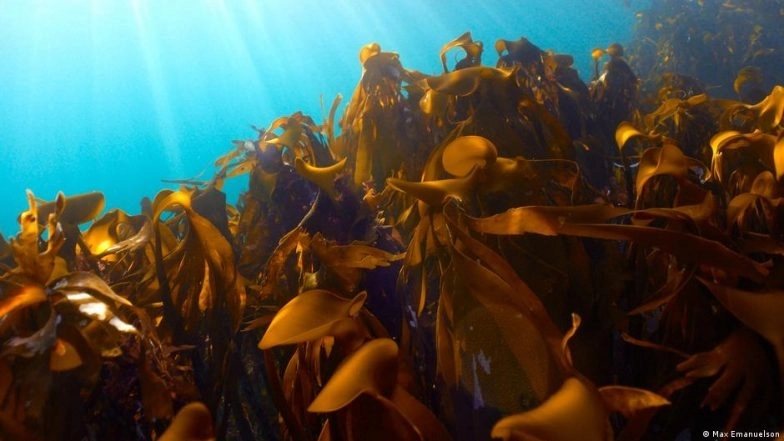
For decades researchers in northern Norway had tried to bring back vital kelp forests after overfishing damaged marine ecosystems. Now a simple solution is proving successful.When Norwegian researcher Hans Christian Strand stepped aboard a research boat in the arctic waters of northern Norway last May, his expectations weren't very high.
Also Read | Business News | Stock Market Ends on a Low Amid Selling Across Sectors, Nifty Below 25,250.
He had grown used to seeing a gray and lifeless sea, even in the spring. The tall kelp forests that had once billowed serenely beneath the waves had been replaced by the sea urchins that had devoured them.
Strand and a team of researchers had spent 25 years trying to restore the kelp — and with it, balance to a marine ecosystem that had been lost to human activity. But so far, the hungry sea urchins had outwitted them.
Efforts to tackle the sea urchins
Found along one-third of the world's coastline, kelp forests are the building blocks of the ocean. They provide food and shelter for marine life, purify the water, absorb carbon and act as coastal protection by buffering waves.
Over the past 40 years, northern Norway — home to a significant share of Europe's marine forests — has lost at least 5,000 square kilometers (1,930 square miles) of lush kelp growth. The depletion began in the 1950s, when heavy mechanization and a sharp increase in fishing capacity reduced wolffish and haddock populations.
Without these predators, sea urchins were free to graze the kelp forests, which systematically disappeared.
Karoline Stigum Kvalo, a freediver in northern Norway's Lofoten Islands, says the marine life she sees when exploring the depths is very different to descriptions from even a few decades ago.
"Some divers have told me how, when they dived in the 90s, there were so many wolffish it was almost impossible to move around in the ocean without seeing them," Kvalo explained. "Now there are almost none left. I have never seen any in the years I have dived here."
She is part of a freediver collective called the "Kelp Watchers," who have also been working to bring back the underwater forests. Their tactic was to kill the sea urchins, which they did once a month for over a year, even in winter storms and freezing temperatures.
"We experienced a big change. Many species that showed up when we started crushing sea urchins," Kvalo said.
But ultimately, they didn't see the results they'd been hoping for. In part because one species that did return was 'lurv,' a sponge-like seaweed that prevents the sun from reaching kelp.
A solution found on dry land
A healthy kelp forest is much like a terrestrial woodland. Come spring, it is in full bloom and in the autumn it decomposes, becoming part of the ecosystem's food web. But if there is no kelp left to break down in September, there are no spores in spring — meaning nothing grows.
Ever aware of this, and the need to keep looking for solutions, researcher Hans Christian Strand eventually found one in a forest.
One evening, walking among pine trees, which are narrow at the top and wide at the bottom, and seeing how they capture sunlight, he wondered if they could build something similar for use underwater.
He and his team began collaborating with a local seaweed company called Polaralge. They cut the reproductive part of mature kelp leaves known as sori and put them in a tank of water where they began releasing spores.
These spores were then spread like a thin brown slime onto ropes, which were attached to sand-filled plastic rings. This February, the whole structures — referred to as 'artificial reefs' by Strand — were dropped into the sea where they were exposed to sunlight.
After earlier attempts using other kelp-restoring structures had failed, Strand boarded the boat three months later unprepared for what he would find. With the ropes suspended beyond the reach of sea urchins, the kelp growing on them had been left untouched.
"I have to say, it was really surprising. We had tried different kinds of structures that didn't work, and when you deploy these in autumn or winter, you don't know what to expect when you return in spring," Strand said, adding that the first time they saw the artificial reefs covered in kelp, "was a rare experience."
So far he and his team have deployed 17 reefs in northern Norway. Looking ahead, the plan is to scale up, adding up to 1000 units of black plastic piping filled with sand. They have looked at alternatives to plastic, but have not come up with anything as easy to produce and transport for use in other parts of the world.
Why kelp forests matter
As rising sea temperatures, water pollution and overfishing slow the growth of kelp forests, that need is very real.
Recent research by climate nonprofit One Earth shows that kelp forests have declined by 40% to 60% over the past half century, while southern Australia and Northern California have lost as much as 95% of their giant and bull kelp forests.
Hidden away under the sea, kelp remains largely invisible, but for Strand it is never a case of out of sight, out of mind. He and his team hope their artificial reefs could become a long-term solution. Researchers from the Baltic region have already been in touch.
The freedivers' project is on hold and Kvalo says her diving experience has changed.
"When I dive now, and see kelp, I have become so aware of the small things and all the life that exists on a single kelp leaf. There are so many different species that live there," she said.
Edited by: Tamsin Walker
(The above story first appeared on LatestLY on Jan 20, 2026 04:50 PM IST. For more news and updates on politics, world, sports, entertainment and lifestyle, log on to our website latestly.com).