Inside Israel's Expansionist Ambitions
Israel has never officially defined its borders, but Israeli settlers and ministers are flirting with the biblical idea of extending them far beyond the current state.

Israel has never officially defined its borders, but Israeli settlers and ministers are flirting with the biblical idea of extending them far beyond the current state. What's behind the concept of "Greater Israel"?Daniela Weiss holds a laminated map of the Middle East with the title "The Promised Land" into the camera and says: "This is the promise of God to the patriarchs of the Jewish nation."
Also Read | Business News | What It Actually Feels Like to Have Full Camera Control Without a Camera.
The map shows a Jewish state that encompasses parts of Jordan, Lebanon, Egypt, Iraq, Syria and Saudi Arabia – extending way beyond the 1949 armistice line, the so-called Green Line that defines Israel's territory according to international law.
"It's 3,000 kilometers – almost as big as the Sahara desert," Weiss adds.
Weiss – sometimes nicknamed "the godmother of the Israeli settler movement" – is referring to the idea of "Greater Israel", or in Hebrew "Eretz Israel HaShlema" – "Complete Israel." It's an expansionist concept popular among the Israeli far right that originates in the Bible.
"For the proponents of the settlement policy like Bezalel Smotrich, the current finance minister, or Itamar Ben Gvir, the national security minister, it's not about making Israel greater than it actually should be," Gil Shohat, a historian and director of the Rosa Luxemburg Foundation in Tel Aviv, tells DW.
"It's about completing the job. This means that the claim to the whole of historical Palestine or 'Eretz Israel', as they frame it, is a divine promise," he adds.
Some Israelis interpret "Complete" or "Greater Israel" to include the territory Israel seized in 1967: The Occupied Palestinian Territories (OPT) – the West Bank, East Jerusalem and Gaza – as well as the Israeli-annexed Golan Heights in Syria and the Sinai Peninsula in Egypt that Israel returned decades ago. Others aim for the entire area promised in the Bible, stretching from the Egyptian Nile River to the Euphrates River, which flows through Turkey, Syria and Iraq.
Weiss' words are from a 2014 interview with Australian channel ABC News, but her ideas have only gained traction in Israeli politics since, as Israel continues its multi-front war across the Middle East.
'Greater Israel' in current politics
In March 2023, Israeli Finance Minister Bezalel Smotrich caused diplomatic turmoil when he spoke at a Paris memorial behind a podium featuring a "Greater Israel" map that included not only the territories Israel currently occupies but also Jordan.
A year later, he told the German-French channel ARTE that "the future of Jerusalem is to expand to Damascus."
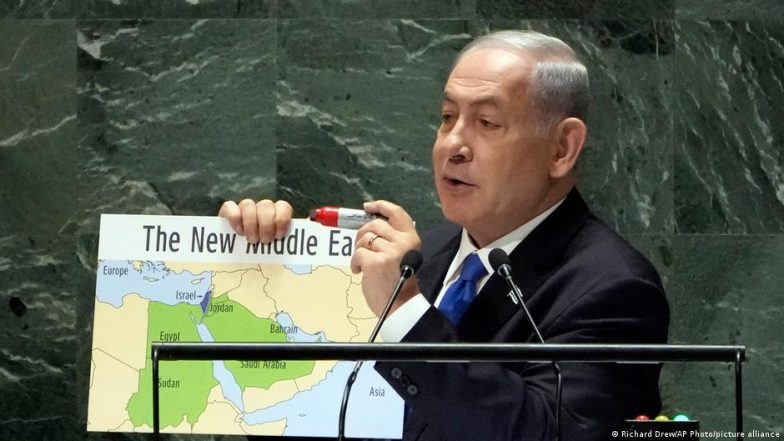
In September 2024, when speaking about his plans for "the day after" the Israel-Hamas war in Gaza, Israeli Prime Minister Benjamin Netanyahu presented a map that fully annexed the West Bank.
In August 2025, he told the Israeli channel i24NEWS that he was "very much" connected to the vision of "Greater Israel," prompting Egypt and Jordan to demand clarifications from Israel.
And just a few months ago, in February 2026, the US Ambassador to Israel, Mike Huckabee, told American talkshow host Tucker Carlson that it would be "fine" if Israel took over the entire Middle East.
The origins of 'Greater Israel'
In the biblical story (Genesis 15:18-21), God promises Abraham and his descendants a territory from the Nile to the Euphrates River. This vision was later picked up by some Jewish religious and nationalist thinkers and became a foundational element of Zionist ideology.
Zionist thinkers including Theodor Herzl and Ze'ev Jabotinsky referenced these biblical boundaries in their writings. Herzl called the idea of the biblical homeland "excellent" in his diaries, and Jabotinsky echoed this vision in his song "The East Bank of the Jordan". Each verse ends with the line: "The Jordan has two banks – this one is ours, and so is the other."
The song later became the theme of Jabotinsky's Revisionist Zionist youth movement, "Betar." Benjamin Netanyahu's father, Benzion Netanyahu, was active in Jabotinsky's Revisionist Zionist movement and served briefly as a close aide to Jabotinsky before his death.
Israel's first prime minister, David Ben-Gurion, also flirted with the idea of "Greater Israel" but ended up taking a more pragmatic approach. Before thinking about expansion, he tactically prioritized the establishment of a sovereign Jewish state. But he deliberately left Israel's borders undefined in the 1948 Declaration of the Establishment of the State of Israel, creating strategic ambiguity for future expansion.
In a 1937 speech, he said: "The acceptance of partition does not commit us to renounce Transjordan: one does not demand from anybody to give up his vision. We shall accept a state in the boundaries fixed today, but the boundaries of Zionist aspirations are the concern of the Jewish people and no external factor will be able to limit them."
Expansion is already reality
Israel expanded its borders beyond what was proposed in the UN Partition Plan in 1947. The plan allocated about 56% of former British Mandatory Palestine to a future Jewish state, but after the 1948 Arab-Israeli War, Israel controlled about 77%.
Since occupying East Jerusalem, the Gaza Strip and the West Bank in 1967, Israel effectively controls nearly all of former Mandatory Palestine, in addition to the Golan Heights.
The international community does not recognize these areas as part of sovereign Israeli territory. But most Israelis do, says Shohat: "It's been almost sixty years since Israel occupied these areas. Even in textbooks of more liberal schools in Tel Aviv, the map of Israel includes the West Bank and Gaza."
Today, more than 700,000 Jewish Israeli settlers live in the occupied West Bank and in East Jerusalem, according to the UN. Estimates for the Golan Heights range between 23,000 and 31,000 settlers, along with some 20,000 Druze who remained there when Israel seized the area.
The UN views all Israeli settlements beyond the Green Line as a violation of international law and the International Court of Justice found the occupation to be illegal in an advisory opinion of 2024.
After the territorial expansion following the 1967 war, the idea of "Greater Israel" gained momentum. Today, it remains influential among some far-right Israeli religious and nationalist groups, but is not a mainstream position in Israeli society, says Shohat.
"The occupation of historical Palestine – so basically Israel, the West Bank and Gaza – is normalized. I do not yet see the trend of normalizing permanent settlements in southern Lebanon, or even in parts of Syria. But this does not mean that the situation in these regions cannot develop into permanent settlement if there is no meaningful international and internal opposition to it."
But even though it is not a mainstream position in Israeli society, the idea of territorial expansion has long permeated key parts of the Israeli government. In March 2026, Finance Minister Smotrich called for the annexation of southern Lebanon.
In a 2024 conference hosted by Nahala, Weiss' settler organization, Finance Minister Smotrich, Security Minister Ben Gvir and settler leader Weiss lobbied for the "voluntary emigration" of Palestinians from Gaza.
On stage, Ben Gvir said: "If we don't want another October 7, we need to go back home and control [Gaza]. We need to find a legal way to voluntarily emigrate [Palestinians] and impose death sentences on terrorists."
Two years later, Ben Gvir got a step closer to what he wanted. On March 30, the Knesset, Israel's parliament, approved a law imposing the death penalty on Palestinians convicted of fatal attacks.
Edited by: Kyra Levine and Sarah Hofmann
(The above story first appeared on LatestLY on Apr 10, 2026 02:20 PM IST. For more news and updates on politics, world, sports, entertainment and lifestyle, log on to our website latestly.com).