












 Quickly
 Socially
 Trending
 Crypto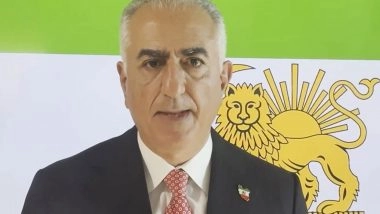
Paris [France], February 3 (ANI): Reza Pahlavi, Iran's exiled crown prince, has called on Iranians abroad and supporters worldwide to join street demonstrations on February 14, which he designated as the "Global Day of Action in solidarity with Iran's Lion-and-Sun Revolution."
In a post on X on Monday, Pahlavi outlined six demands for the international community, including dismantling the regime's machinery of repression, cutting off its financial lifelines, ensuring free internet and communications, expelling regime diplomats and prosecuting its criminals, releasing all political prisoners, and recognising a transitional government to guide Iran toward democracy.
Also Read | Marion Naipei Viral Video: I Am Saved, She Says as Old Clips Resurface.
"The Islamic Republic's occupying rule has tried to break our nation's will through massacre and brutal violence. It has failed," he wrote, adding, "The era of fear is over and era of freedom is near." He named Munich, Los Angeles and Toronto as major gathering locations, while urging supporters unable to travel to demonstrate in their own cities.
https://x.com/PahlaviReza/status/2018332814278627345?s=20
Also Read | NASA Artemis II Moon Launch 2026: Check Date, Time, and Live Streaming Details.
His appeal comes amid ongoing anti-government unrest in Iran, which authorities have blamed on foreign interference. Iran's Supreme Leader Ali Khamenei accused the United States and Israel of orchestrating the protests, claiming that US President Donald Trump's "help is on the way" remark had encouraged demonstrators.
Comparing protesters to Islamic State terrorists, Khamenei alleged they beheaded and killed innocent people. In a series of posts on X, he described the actions of shopkeepers and traders as valid protest while labelling those calling for the regime's fall as "seditionists." He further claimed that the US and Israel failed in a "coup attempt," asserting he had been informed that "CIA & Mossad deployed."
Amid the heightened tensions, Trump issued a warning over escalating developments, saying "big ships" were heading to the region and that "bad things" would probably happen if a nuclear deal could not be reached. "We have the biggest, most powerful ships in the world over there, very close, and in a couple of days, hopefully, we'll make a deal. If we don't make a deal, then we'll find out whether or not he was right," Trump said, adding that he hoped negotiations would produce an acceptable outcome.
As international focus sharpened on Iran, Tehran signalled cautious optimism about reviving nuclear talks with Washington. According to Al Jazeera, Iran said on Monday it was reviewing diplomatic initiatives proposed by regional countries to reduce tensions with the US and anticipated a framework for discussions in the coming days.
Iran's Foreign Ministry spokesman Esmaeil Baghaei confirmed that indirect negotiations were continuing, stating, "Countries of the region are acting as mediators in the exchange of messages." He added, "Several points have been addressed, and we are examining and finalising the details of each stage in the diplomatic process, which we hope to conclude in the coming days."
Al Jazeera reported that Iranian Foreign Minister Abbas Araghchi is expected to engage with US Special Envoy Steve Witkoff, though neither side has confirmed a meeting. Iran's state news agency IRNA said Araghchi held phone calls with counterparts in Saudi Arabia, Egypt and Turkiye to review recent developments.
Reports also suggested Iranian President Masoud Pezeshkian had instructed the resumption of nuclear discussions, with local media indicating that "Iran and the United States will hold talks on the nuclear file."
These developments follow Trump's deployment of warships to the Middle East and his call for Tehran to resume nuclear negotiations, which were halted in June after attacks by Israel and the US on Iranian facilities. On Sunday, Trump said the US was talking with Tehran, reiterating that "We have very big, powerful ships heading in that direction," while expressing hope for an agreement.
Khamenei maintained a firm stance, warning that any attack would trigger a "regional war." The United States and the European Union continue to express concern over Iran's nuclear activities, which Tehran insists are for civilian purposes. Washington has outlined conditions for resuming talks, including ending uranium enrichment, limiting the missile programme and ceasing support for regional armed groups.
While Iran has shown some willingness to discuss the nuclear issue, missiles and regional alliances remain non-negotiable. The urgency of the current diplomatic push is underscored by Iran's need for sanctions relief amid economic pressures and growing unrest following January's mass protests. (ANI)
(The above story is verified and authored by ANI staff, ANI is South Asia's leading multimedia news agency with over 100 bureaus in India, South Asia and across the globe. ANI brings the latest news on Politics and Current Affairs in India & around the World, Sports, Health, Fitness, Entertainment, & News. The views appearing in the above post do not reflect the opinions of LatestLY)
 Share Now
 Google Trends



 Live Bot