79th Independence Day 2025: Evolution of the Indian National Flag, Know History, Changes in Design and Significance Tiranga Over the Years
The journey of the tricolour reflects the country’s long struggle for independence and the ideals that shaped modern India. As per historical records, the journey of the Indian flag began in 1906, with the first unofficial version hoisted in Calcutta, featuring green, yellow, and red stripes with symbolic motifs

India’s national flag, also popularly known as the Tiranga, is a symbol of pride, unity, and sacrifice. The national flag of India, which we proudly hoist today, is the result of decades of evolution, shaped by the vision of leaders and the sacrifices of countless freedom fighters. The journey of the tricolour reflects the country’s long struggle for independence and the ideals that shaped modern India. As per historical records, the journey of the Indian flag began in 1906, with the first unofficial version hoisted in Kolkata, featuring green, yellow, and red stripes with symbolic motifs. When Is Independence Day 2025 in India? Is It the 78th or 79th I-Day? Here's What You Should Know About Swatantrata Diwas History and Significance.
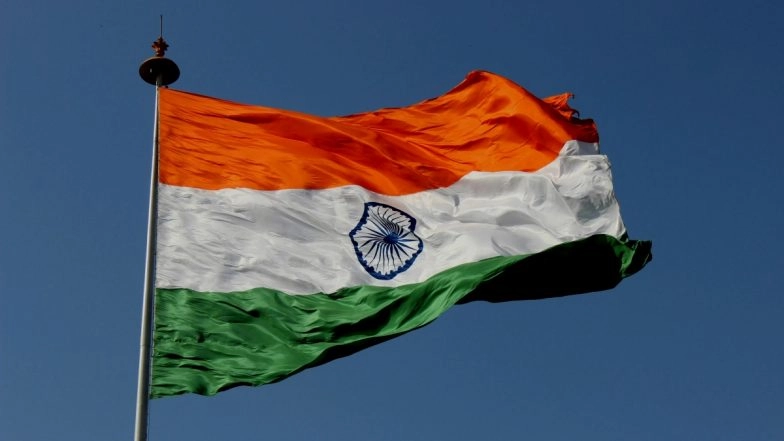
Over the years, several versions of Tiranga emerged. From Madame Bhikaji Cama’s 1907 design in Paris with ‘Vande Mataram’ inscribed, to the 1921 version by Pingali Venkayya, which included the spinning wheel representing self-reliance, each version reflected the socio-political aspirations of its time and the unity of India’s communities. The present-day Tiranga was officially adopted on July 22, 1947, just before Independence. It features three horizontal bands - saffron for courage and sacrifice, white for peace and truth, and green for faith and prosperity with the navy-blue coloured Ashoka Chakra at its centre, symbolising justice, progress, and the eternal wheel of law. Everything to Know About India’s Flag, Anthem and Emblem.
Take a look at the history of the Tricolour
1906 – The First National Flag
The first unofficial flag was hoisted on August 7, 1906 in Calcutta (now Kolkata). It had three horizontal stripes of green, yellow, and red, with symbols representing unity and strength.
1907 – The Berlin Committee Flag
The second version, unfurled by Madame Bhikaji Cama in Paris, carried green, saffron, and red stripes with “Vande Mataram” written across, symbolising the Swadeshi movement.
1917 – The Home Rule Movement Flag
Bal Gangadhar Tilak and Annie Besant used a flag with five red and four green stripes, Union Jack in the corner, and a star and crescent — a blend of Indian identity and British allegiance.
1921 – The Gandhi Flag
During the All India Congress Committee session in Bezwada (now Vijayawada), Pingali Venkayya presented a tricolour of white, green, and red, representing peace, agriculture, and courage. Mahatma Gandhi suggested adding a spinning wheel (charkha) to symbolise self-reliance.
1931 – The Tricolour Before Independence
A resolution in 1931 adopted saffron, white, and green with the charkha at the centre. This became a precursor to the present-day flag.
1947 – The Tiranga
On July 22, 1947, the Constituent Assembly adopted the current flag: saffron for courage, white for truth, and green for faith and prosperity, with the Ashoka Chakra replacing the charkha — symbolising law, progress, and the eternal wheel of time.
From its earliest versions in the early 1900s to the one adopted at the dawn of Independence, each design carried the hopes, struggles, and ideals of the era. Today, the Tiranga remains a living emblem of India’s sovereignty and democratic values.
(The above story first appeared on LatestLY on Aug 14, 2025 07:36 PM IST. For more news and updates on politics, world, sports, entertainment and lifestyle, log on to our website latestly.com).