Who Is Stronger, Iran or Israel?
Who is stronger, Iran or Israel? As tensions rise in the Middle East, both nations showcase contrasting military strengths. Israel relies on advanced air power and missile defense systems, while Iran banks on manpower, ballistic missiles and regional allies. Here is a detailed look at how their military capabilities compare.

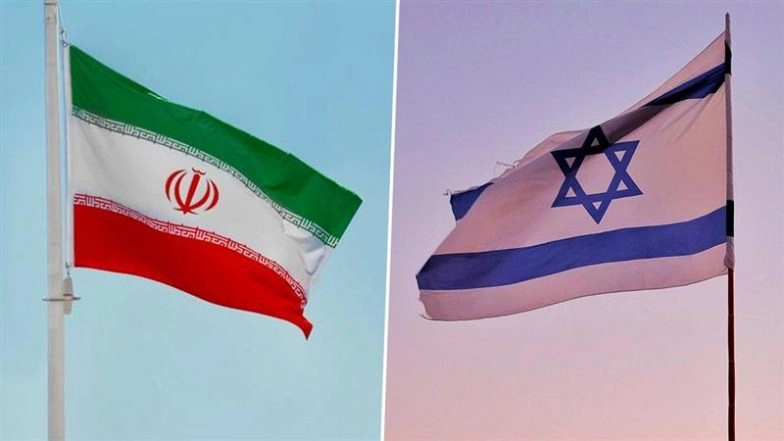
New Delhi, February 28: As tensions escalate in the Middle East, a key question dominates global debate: Who is stronger, Iran or Israel? While both nations possess formidable military capabilities, their strength lies in very different strategies. Israel emphasizes advanced technology, air superiority, and missile defense systems. Iran relies on manpower, ballistic missiles, and regional proxy networks.
Here is a detailed breakdown of how the two powers compare.
Personnel and Ground Forces
Iran Military Strength
Iran maintains approximately 610,000 active-duty personnel, including the regular army and the Islamic Revolutionary Guard Corps. It also has a large reserve force and paramilitary units.
Iran’s ground equipment consists of older Western supplied tanks and armored vehicles, along with domestically upgraded variants. Its advantage lies in sheer numbers and its ability to sustain prolonged regional conflict. Donald Trump Confirms US Military Campaign Against Iran, Urges Iranians to ‘Take Over Government’; Watch Full Speech.
Israel Military Strength
Israel has around 170,000 active personnel, but its strength lies in rapid mobilization. The Israel Defense Forces can call upon over 460,000 trained reservists at short notice.
Israel operates highly advanced Merkava tanks and modern armored systems, giving it qualitative superiority on the battlefield.
Verdict on manpower: Iran leads in numbers, but Israel holds an edge in training, readiness, and technology. Israel-Iran War: Air India’s Delhi–Tel Aviv Flight AI139 Returns Mid-Air As Israel Launches ‘Preventive’ Strikes on Iran.
Air Power and Defense Systems
Israel Air Superiority
The Israeli Air Force is among the most advanced globally. It operates U.S. made F-15, F-16, and fifth generation F-35 stealth fighters, allowing long range precision strikes with minimal detection.
Israel also possesses a world renowned multi layered missile defense system:
- Iron Dome for short range threats
- David’s Sling for medium range missiles
- Arrow missile system for long range ballistic threats
Iran Air Capabilities
Iran’s air force relies largely on aging aircraft such as the F-4 Phantom and F-14 Tomcat, acquired before the 1979 revolution. Due to sanctions, modernization has been limited.
However, Iran compensates with advanced air defense systems such as the Russian built S-300 and its domestically developed Bavar-373 system. It also operates a large and expanding fleet of military drones.
Verdict on air power: Israel holds clear technological dominance in air combat and missile interception.
Missile Arsenal and Asymmetric Warfare
Iran Ballistic Missile Power
Iran possesses one of the largest ballistic missile arsenals in the Middle East. Missiles such as the Shahab-3 and Kheibar Shekan have ranges capable of reaching Israeli territory.
Iran also leverages regional allies and proxy groups, including Hezbollah in Lebanon and Houthis in Yemen. This network provides strategic depth and the ability to pressure Israel indirectly.
Israel Strategic Edge
Israel’s advantage lies in precision strikes, intelligence capabilities, cyber operations, and strong Western alliances, particularly with the United States. Its doctrine focuses on deterrence and rapid neutralization of threats before escalation.
Verdict on missile threat: Iran poses a serious long range missile challenge, but Israel’s layered defense system reduces vulnerability.
Strategic Context
The rivalry between Iran and Israel has largely played out through shadow warfare, including cyberattacks, maritime sabotage, and targeted strikes.
Israel views Iran’s nuclear ambitions as an existential threat. Iran, on the other hand, describes its military posture as defensive and deterrent in nature.
Final Analysis: Who Is Stronger?
The answer depends on the type of conflict:
- Conventional war and air combat: Israel has a clear technological and operational advantage.
- Missile saturation and proxy warfare: Iran can create significant pressure through its large missile stockpile and regional allies.
- Defensive capability: Israel’s missile defense systems are among the best in the world.
- Manpower: Iran leads numerically.
Overall, Israel holds qualitative superiority, especially in air power, defense systems, and rapid mobilization. However, Iran’s missile arsenal and asymmetric strategy make it a formidable regional power capable of prolonged confrontation.
In short, Israel may be stronger in high tech conventional warfare, while Iran’s strength lies in numbers, missiles, and regional influence.
(The above story first appeared on LatestLY on Feb 28, 2026 03:08 PM IST. For more news and updates on politics, world, sports, entertainment and lifestyle, log on to our website latestly.com).