













 Quickly
 Socially
 Trending
 Crypto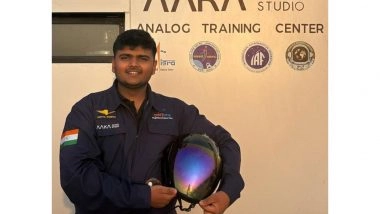
VMPL
New Delhi [India], February 9: AAKA Space Studio, a space research and simulation organisation and a registered ISRO Space Tutor working on planetary analog environments, successfully conducted a lunar-habitat-inspired analog astronaut mission designed to simulate isolation, habitat living, and autonomous operations under Moon-like conditions. The mission was carried out from 1st February to 8th February . in the white plains of Dholavira, Kutch.
Also Read | Epstein Files: Elon Musk and Mark Zuckerberg Seen at Dinner in Jeffrey Epstein Files Released by US DoJ.
The mission involved a four-member analog astronaut crew, who lived together inside a container-based lunar analog habitat for the full mission duration. Among them was Aditya Pandya (17), who has now become India's youngest male analog astronaut, while also serving as the lead for the mission's hardware, IoT, and habitat intelligence systems.
The lunar analog habitat was engineered to replicate the physical and operational constraints of a Moon-like environment. It incorporated a digital twin framework, enabling real-time synchronisation between the physical habitat and mission control systems, allowing continuous monitoring and post-mission analysis of habitat and crew parameters.
Also Read | Faridabad Jail Shocker: 20-Year-Old Terror Accused Abdul Rahman Killed by Fellow Inmate With Sharp Object.
Aditya, as a core technical team member, had been involved in building and developing the mission's technology stack over the six months leading up to the mission. His work included the design, development, and integration of key systems such as:
- Internal and external sensor modules for continuous environmental monitoring
- Astronaut biometric systems to track physiological parameters of the crew
- Embedded hardware for habitat health, safety, and fault detection
- A centralized mission control system for real-time telemetry and diagnostics
- Modular hardware components developed using 3D printing and rapid prototyping
Throughout the mission, the four-member crew remained in strict isolation, operating under predefined protocols similar to planetary missions. The mission focused on experiments related to long-duration confinement, crew autonomy, system reliability, and human machine interaction inside confined habitats.
Notably, Aditya was not only responsible for designing and building the habitat's technological infrastructure but was also one of the astronauts residing inside the habitat, validating the systems he engineered under real operational stress throughout the nine-day mission.
According to AAKA Space Studio, the lunar analog mission was aimed at strengthening India's analog research ecosystem by combining hands-on engineering, simulation science, and experiential astronaut training, aligned with future human spaceflight and planetary habitation requirements.
Aditya's dual role: as both system architect and analog astronaut, reflects a new model of space training, where young engineers actively build, test, and inhabit the systems designed for extraterrestrial exploration.
(ADVERTORIAL DISCLAIMER: The above press release has been provided by VMPL. ANI will not be responsible in any way for the content of the same.)
(The above story is verified and authored by ANI staff, ANI is South Asia's leading multimedia news agency with over 100 bureaus in India, South Asia and across the globe. ANI brings the latest news on Politics and Current Affairs in India & around the World, Sports, Health, Fitness, Entertainment, & News. The views appearing in the above post do not reflect the opinions of LatestLY)
 Share Now
 Google Trends



 Live Bot