Why Minor and Influencer Suicides Are Rising in India: Digital Addiction and Mental Health Trends 2026
Following the tragic Ghaziabad triple suicide case, a look at why minor and influencer suicides are surging in India. With NCRB data showing a 65% rise in student deaths, this report explores the impact of digital addiction, academic pressure, and the fragmenting social safety net on India’s youth in 2026. Help and helplines included.

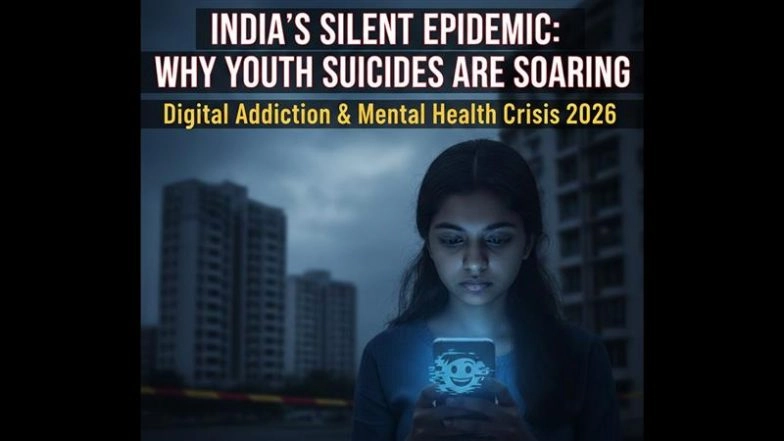
India is grappling with a surge in suicides among minors and young digital creators, a trend that experts say is fuelled by a volatile mix of academic pressure, digital addiction, and shifting social structures. According to the latest National Crime Records Bureau (NCRB) data released in late 2025, student suicides in India reached a record high of 13,892 in 2023, marking a 65% increase over the last decade. This rate of increase significantly outpaces the 27% rise in overall suicides across the country, signalling an urgent mental health crisis among the nation’s youth. Kerala Influencer Chinnu Pappu Found Dead at Home; Police Probe Suspected Suicide.
Economic Survey Flags Digital Addiction Risk
A primary driver in recent years is the "intensely digital environment" in which Indian youth now live. The Economic Survey 2026, tabled in Parliament this January, explicitly flagged digital addiction as a significant public health threat. Nearly half of urban Indian parents surveyed reported that their children spend three or more hours online daily, often linked to symptoms of aggression, depression, and lethargy.
Experts Warn on Influencer Pressure
For young influencers and digital-native minors, the pressure is two-fold. Beyond consumption, the "influencer economy" demands a constant performance of perfection. Psychologists note that the dopamine-driven algorithms of social media platforms often lead to "social comparison," where young users measure their self-worth against curated, unrealistic standards. When digital access is suddenly removed as seen in the recent Ghaziabad triple suicide case the resulting "digital isolation" can act as a severe psychological trigger. Mumbai: IIT Bombay Student Dies by Suicide After Jumping From Hostel Terrace.
Academic Stress and the ‘Safety Net’ Gap
While the digital world presents new risks, traditional stressors remain potent. Academic failure and the intense competition for professional degrees continue to be leading causes of distress. The NCRB data reveals that "family problems" and "illness" (including mental health conditions) remain the top reported causes for suicide among those under 30, accounting for nearly half of all cases. Experts point out that as India shifts from traditional multi-generational households to nuclear family setups, the "social capital" or familial safety net has fragmented. This leaves many minors without immediate emotional outlets, a gap often filled by unregulated online communities that may inadvertently normalize self-harm.
Vulnerability Among Young Women
The data highlights a concerning gender disparity: 55% of all suicides among those under 18 involve girls. Research indicates that young women are often more sensitive to online cyberbullying and the lack of real-world connections. They also face unique interpersonal challenges, including higher instances of sexual harassment and limited emotional support within conservative family structures, which can compound with academic and digital pressures. CJ Roy Suicide Case: Karnataka Home Minister G Parameshwara Says ‘Too Early’ To Blame Income Tax Pressure for Death of Confident Group Chairman; SIT Probe Underway.
The Path to Prevention
In response to the rising numbers, the Indian government has expanded its Tele-MANAS helpline, which has handled over 2.3 million calls as of August 2025. The Economic Survey 2026 has recommended a multi-pronged strategy, including:
- Digital Wellness Curriculums in schools to teach "digital hygiene."
- Age-based access limits for social media platforms.
- Creation of offline youth hubs to rebuild physical social networks.
As investigators in cases like the Ghaziabad tragedy continue to look for answers, the consensus among mental health professionals is clear, suicide is rarely the result of a single factor, but rather a complex interplay of socioeconomic, psychological and digital vulnerabilities that require a systemic rather than a reactionary response.
Suicide Prevention and Mental Health Helpline Numbers:
Tele Manas (Ministry of Health) – 14416 or 1800 891 4416; NIMHANS – + 91 80 26995000 /5100 /5200 /5300 /5400; Peak Mind – 080-456 87786; Vandrevala Foundation – 9999 666 555; Arpita Suicide Prevention Helpline – 080-23655557; iCALL – 022-25521111 and 9152987821; COOJ Mental Health Foundation (COOJ) – 0832-2252525.
(The above story first appeared on LatestLY on Feb 09, 2026 06:21 PM IST. For more news and updates on politics, world, sports, entertainment and lifestyle, log on to our website latestly.com).