













 Quickly
 Socially
 Trending
 Crypto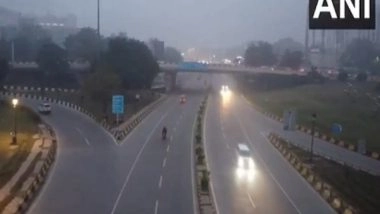
New Delhi [India], January 17 (ANI): With cold waves hitting the national capital, the city continued to shudder under the effect of cold, with fog shrouding many areas of the city.
Meanwhile, the air quality in the national capital continued in the 'poor' category.
According to the Central Pollution Control Board, the AQI was recorded at 294 in Delhi today at 7 am.
Delhi Pollution Control Committee (DPCC), Mundka recorded an AQI of 324, Narela reached 320, Nehru Nagar hit 360, and Patparganj registered an AQI of 377. Additionally, Okhla Phase-2 reported an AQI of 351, while Sonia Vihar stood at 323.
Also Read | RG Kar Doctor Rape-Murder Case: Sealdah Court Likely To Pronounce Its Judgment on January 18 (Watch Video).
Notably, Vivek Vihar had the highest reading at 390. Other areas like R K Puram (344), Rohini (343), and Najafgarh (221) also exhibited unhealthy air quality. However, data from Punjabi Bagh remained insufficient in the last 24 hours.
Meanwhile, areas such as Mandir Marg (144) and Sri Aurobindo Marg (156) showed relatively lower but still moderate AQI levels.
Visuals from the AIIMS night shelter depicted individuals resting comfortably despite the ongoing air quality concerns in the city.
An AQI between zero and 50 is considered 'good, 51 and 100 'satisfactory,' 101 and 200 'moderate,' 201 and 300 'poor,' 301 and 400 'very poor,' and 401 and 500 'severe.
A layer of dense fog blankets parts of Uttar Pradesh's Mathura as winter's chill intensifies in Northern India.
The iconic Taj Mahal was also clouded as the dense fog covered the city of Agra.
Meanwhile, on Wednesday, the Commission for Air Quality Management (CAQM) revoked Stage-III measures under the revised Graded Response Action Plan (GRAP), effective immediately across Delhi- NCR after air quality deteriorated.
The Supreme Court, in its earlier directives, had emphasized, "If the AQI crosses 400 on a given day, Stage-IV measures will have to be reintroduced."
The CAQM's approach aligns with the Supreme Court's directive issued in December 2024, mandating immediate escalation of GRAP measures if the AQI surpasses critical thresholds. (ANI)
(The above story is verified and authored by ANI staff, ANI is South Asia's leading multimedia news agency with over 100 bureaus in India, South Asia and across the globe. ANI brings the latest news on Politics and Current Affairs in India & around the World, Sports, Health, Fitness, Entertainment, & News. The views appearing in the above post do not reflect the opinions of LatestLY)
 Share Now
 Google Trends



 Live Bot