Afghan Women Cannot Pray Loudly or Recite Quran in Front of Other Women, Says Taliban Minister Khalid Hanafi
During an event in eastern Logar province on Sunday, Vice and Virtue Minister Khalid Hanafi said, 'It is prohibited for a grown woman to recite Quranic verses or perform recitations in front of another grown woman. Even chants of takbir (Allahu Akbar) are not permitted.'

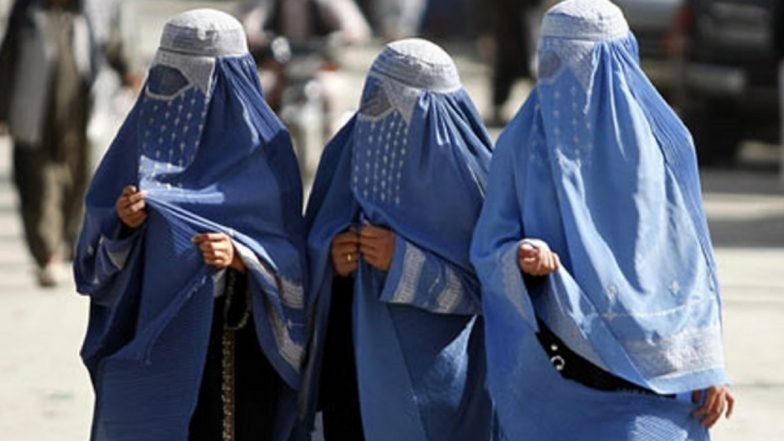
Islamabad, October 30: Afghan women are forbidden from praying loudly or reciting the Quran in front of other women, according to a Taliban government minister. It's the latest restriction on women following morality laws that ban them from raising their voice and baring their faces outside the home. They are already excluded from education after sixth grade, many public spaces and most jobs.
Nobody from the Vice and Virtue Ministry was immediately available Wednesday to clarify the official's remarks or confirm if the prohibition would also become part of the morality laws. Taliban Imposes New Restrictions on Women: Taliban Silences Afghan Women With New Laws, Bans Public Speaking.
During an event in eastern Logar province on Sunday, Vice and Virtue Minister Khalid Hanafi said: “It is prohibited for a grown woman to recite Quranic verses or perform recitations in front of another grown woman. Even chants of takbir (Allahu Akbar) are not permitted.”
He said that uttering similar expressions like “subhanallah,” another word central to the Islamic faith, was also not allowed. A woman was not permitted to perform the call to prayer, he told the gathering. “So, there is certainly no permission for singing.” Audio of Hanafi's remarks was shared on the ministry's social media platforms but was later deleted. Afghanistan: Taliban Imposes Severe Restrictions on Sikh and Hindu Minorities.
The ministry said Tuesday that a nationwide awareness programme about the laws is underway involving ministry officials at provincial and district levels. “Organising such programmes will contribute to shaping public perception and increasing awareness of divine rulings,” the ministry added.
Afghan provinces are already barring the media from showing images of living things, another controversial and widely criticised feature of the morality laws. The Taliban set up the ministry for the " propagation of virtue and the prevention of vice” after seizing power in 2021.
Since then, the ministry has enforced decrees issued by the Taliban leadership that have a disproportionate impact on women and girls, like dress codes, segregated education and employment, and having a male guardian when they travel.
(The above story is verified and authored by Press Trust of India (PTI) staff. PTI, India’s premier news agency, employs more than 400 journalists and 500 stringers to cover almost every district and small town in India.. The views appearing in the above post do not reflect the opinions of LatestLY)