'Hum Dekhenge' Anti-Hindu? RJ Sayema Counters Charge With Complete Translation and Explanation of Faiz Ahmed Faiz's Urdu Poem
RJ Sayema, in her video as shared below, points out that the poem gained prominence after a noted Pakistani singer - Iqbal Bano - sung the same in 1980 during a protest-rally against the dictatorial regime of military general Zia-ul-Haque. Since then, 'Hum Dekhenge' is used as a song to rally against totalitarian governments and rulers, the radio jockey said.

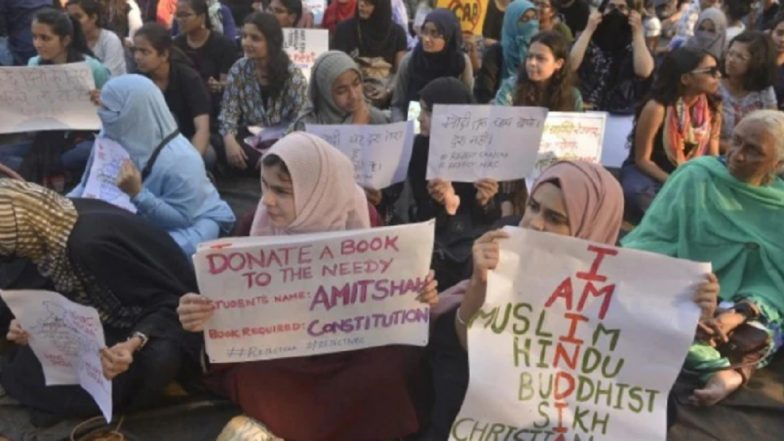
New Delhi, January 2: With controversy escalating over the use of late Pakistani poet Faiz Ahmed Faiz's 'Hum Dekhenge' in anti-Citizenship Amendment Act (CAA) protests in IIT Kanpur, prominent radio jockey Sayema Rahman has presented the complete translation and explanation of the Urdu nazm to counter the "anti-Hindu" charge. The "revolutionary" rendition, she said, is not Islamist but has served as a theme for revolution in the subcontinent over the last four decades. IIT Kanpur Mulling Action Against Students Singing 'Hum Dekhenge' During Anti-CAA Stir, Probing Whether Faiz Ahmed Faiz's Poem is 'Anti-Hindu'.
RJ Sayema, in her video as shared below, points out that the poem gained prominence after a noted Pakistani singer - Iqbal Bano - sung the same in 1980 during a protest-rally against the dictatorial regime of military general Zia-ul-Haque. Since then, 'Hum Dekhenge' is used as a song to rally against totalitarian governments and rulers, the radio jockey said.
Watch RJ Sayema Explaining Hum Dekhenge With Complete Translation
This is the simple translation of the much controversial Faiz's poetry "Hum Dekhenge". Every single line explained lucidly. English translation taken from an article published in TOI in 2016. Should help those who wish to understand just the poetry. #Faiz #UrduKiPaathshala pic.twitter.com/0KUwQtMONc
— RJ Sayema (@MirchiSayema) January 2, 2020
The poem, in its first stanza, states that people would definitely see the day which has been promised -- when truth will triumph over falsehood. "Hum dekhenge, Lazim hai ke hum bhi dekhenge. Wo din ke jiska wada hai
Jo lauh-e-azl mein likha hai (We shall Witness, it is certain that we too, shall witness the day that has been promised of which has been written on the slate of eternity)," states the first paragraph of the song.
The second stanza reads as follows: Jab zulm-o-sitam ke koh-e-garan, Rooi ki tarah ur jaenge. Hum mehkoomon ke paaon tale, Ye dharti dhar dhar dharkegi. Aur ahl-e-hakam ke sar oopar, Jab bijli kar kar karkegi. This is translated as follows: When the enormous mountains of tyranny, blow away like cotton. Under our feet- the feet of the oppressed- when the earth will pulsate deafeningly and on the heads of our rulers when lightning will strike.
In the third stanza, Faiz refers to how God's land has been inhabited by undeserving rulers. He states as follows: Jab arz-e-Khuda ke kaabe se, Sab but uthwae jaenge. Hum ahl-e-safa mardood-e-harm, Masnad pe bethae jaenge. Sab taaj uchale jaenge, Sab takht girae jaenge.
The translation of the third paragraph is as follows: "From the abode of God, When icons of falsehood will be taken out, When we- the faithful- who have been barred out of sacred places will be seated on high cushions, When the crowns will be tossed, When the thrones will be brought down."
In the final stanza, Faiz expresses his dream of seeing the day when only the name of God will be held high and the powers on earth would be equally distributed among the people. Bas naam rahega Allah ka, Jo ghayab bhi hai hazir bhi. Jo manzar bhi hai nazir bhi, Utthega an-al-haq ka nara, Jo mai bhi hoon tum bhi ho. Aur raaj karegi Khalq-e-Khuda, Jo mai bhi hoon aur tum bhi ho.
The translation of the final stanza is as follows: "Only The name will survive, Who cannot be seen but is also present. Who is the spectacle and the beholder, both I am the Truth- the cry will rise, Which is I, as well as you. And then God's creation will rule, Which is I, as well as you."
(The above story first appeared on LatestLY on Jan 02, 2020 04:40 PM IST. For more news and updates on politics, world, sports, entertainment and lifestyle, log on to our website latestly.com).