Indian Army Set to Become World’s First to Deploy Ramjet-Powered 155 MM Artillery Shells
New Ramjet-Powered 155 artillery shells act as a hybrid between a projectile and a missile. By drawing in oxygen from the atmosphere to sustain combustion mid-flight, these shells can strike targets at distances approaching 80 kilometers, significantly outpacing the 45-kilometer limit of conventional 'base bleed' rounds.

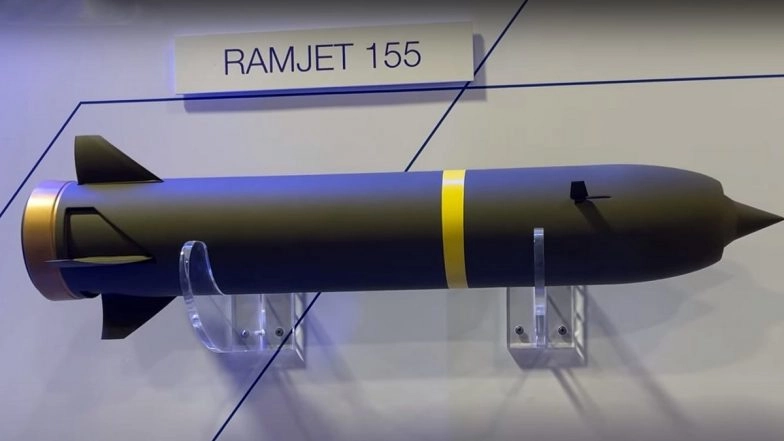
Mumbai, January 3: In a major breakthrough for indigenous defense technology, the Indian Army is on track to become the first military force globally to deploy ramjet-powered 155 mm artillery shells. Developed in collaboration with the Indian Institute of Technology (IIT) Madras, this "air-breathing" ammunition is expected to increase the strike range of standard artillery by 30% to 50% while maintaining full lethal effectiveness.
Traditional artillery shells rely solely on the initial explosive blast from a gun's barrel to reach their targets. In contrast, the new ramjet-assisted shells act as a hybrid between a projectile and a missile. By drawing in oxygen from the atmosphere to sustain combustion mid-flight, these shells can strike targets at distances approaching 80 kilometers, significantly outpacing the 45-kilometer limit of conventional "base bleed" rounds. Indian Army Social Media Guidelines: New Rules for WhatsApp, Instagram, LinkedIn, X, YouTube, Telegram and More Explained.
This project is a center-piece of the Army Technology Board (ATB) and the broader Atmanirbhar Bharat (self-reliant India) initiative. Beyond increasing reach, the technology allows the Army to strike deep into enemy territory with high precision, reducing the need for more expensive rocket systems for medium-range engagements.
How Ramjet Technology Works
Unlike standard jet engines, a ramjet has no moving parts like compressors or turbines. According to Professor P.A. Ramakrishna of IIT Madras, the engine requires a high initial velocity—approximately Mach 2—to function.
- The Launch: An artillery gun fires the shell at supersonic speeds.
- Compression: As the shell travels, ambient air is forced into its intake and compressed by its own forward motion.
- Thrust: The compressed air mixes with a fuel-rich propellant and ignites, creating sustained thrust that propels the shell much farther than a ballistic arc would allow.
Compatibility and Strategic Impact
One of the technology's most significant advantages is its retrofit capability. The ramjet unit can be integrated into existing 155 mm shells, making it compatible with the Army’s entire modern arsenal. This includes the indigenous Dhanush and ATAGS howitzers, the K9 Vajra-T self-propelled guns, and the M777 ultra-light howitzers used in mountainous high-altitude regions. Indian Army Successfully Conducts Trial of Indigenous ‘Akash Prime’ Air Defence System at 15,000 Feet in Ladakh.
Developmental trials have already been successfully conducted at the Pokhran Field Firing Ranges in Rajasthan. As of early 2026, the project has moved into final refinement stages, with manufacturing expected to be handled by Munitions India Limited (MIL) once final validation is complete.
Global Significance
While international defense firms in the U.S. and Europe are exploring similar technologies, India’s progress places it at the forefront of operationalizing these munitions. By effectively blurring the line between medium artillery and heavy long-range bombardment, the Indian Army aims to gain a decisive edge in counter-battery fire and long-range deterrence along its contested borders.
(The above story first appeared on LatestLY on Jan 03, 2026 10:55 AM IST. For more news and updates on politics, world, sports, entertainment and lifestyle, log on to our website latestly.com).