ISRO PSLV-C62 Successfully Launches EOS-N1 ‘Anvesha’ and 14 Co-Passenger Satellites From Sriharikota
The Indian Space Research Organisation's (ISRO) on Monday made the first launch of 2026 with the EOS-N1 Earth observation satellite aboard its PSLV-C62 rocket. The EOS-N1, also called the Anwesha, took off on the 64th flight of the Polar Satellite Launch Vehicle (PSLV) at 10:17 am IST from the First Launch Pad (FLP) at the Satish Dhawan Space Centre, Sriharikota.

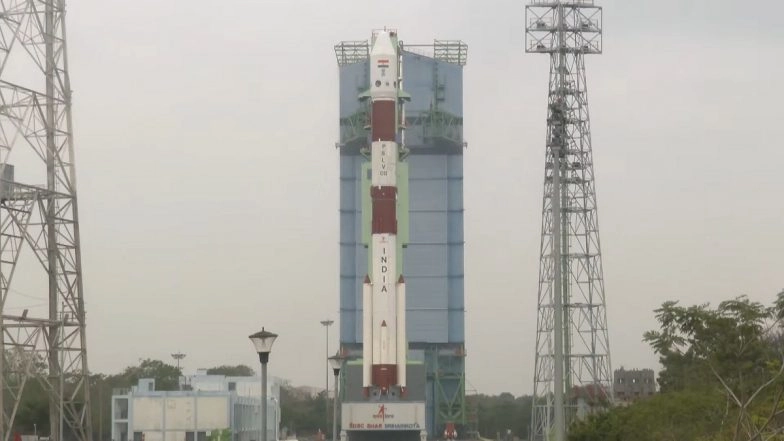
New Delhi, January 12: The Indian Space Research Organisation's (ISRO) on Monday made the first launch of 2026 with the EOS-N1 Earth observation satellite aboard its PSLV-C62 rocket. The EOS-N1, also called the Anwesha, took off on the 64th flight of the Polar Satellite Launch Vehicle (PSLV) at 10:17 am IST from the First Launch Pad (FLP) at the Satish Dhawan Space Centre, Sriharikota. "Liftoff! PSLV-C62 launches the EOS-N1 Mission from SDSC-SHAR, Sriharikota,"
ISRO shared in a post on the social media platform X. The launch aims to enhance India’s remote sensing capabilities across agriculture, urban mapping, and environmental monitoring. The mission, which carries 15 co-passenger satellites, is planned for injection into Sun Synchronous Orbit. “The PSLV-C62 mission will also demonstrate KID or Kestrel Initial Technology Demonstrator from a Spanish startup, which is a small-scale prototype of a re-entry vehicle being developed by the startup,” the Indian space agency shared before launch. ISRO PSLV-C62 Mission Launch Live Streaming: Watch Online Telecast As Indian Space Agency Deploys EOS-N1 Satellite in 1st Mission of 2026
ISRO PSLV-C62 Launch Video
Liftoff!
PSLV-C62 launches the EOS-N1 Mission from SDSC-SHAR, Sriharikota.
Livestream link: https://t.co/fMiIFTUGpf
For more information Visit:https://t.co/3ijojDaYB2
— ISRO (@isro) January 12, 2026
The KID capsule is planned for a re-entry trajectory, according to ISRO. The KID will be the last co-passenger to be injected, after which it is slated to re-enter the Earth’s atmosphere towards splashdown in the South Pacific Ocean. The PSLV-C62 / EOS-N1 Mission is the 9th dedicated commercial mission undertaken by NewSpace India Limited (NSIL), the commercial arm of ISRO. The launch is the fifth to use the PSLV-DL variant with two solid strap-on motors. SPT2349-56: University of British Columbia Astronomers Discover Earliest Superheated Galaxy Cluster Existing Just 1.4 Billion Years After Big Bang
PSLV has completed 63 flights, including notable missions like Chandrayaan-1, Mars Orbiter Mission, Aditya-L1, and Astrosat Mission. In 2017, PSLV set a world record by launching 104 satellites in a single mission. ISRO undertook the 101st launch endeavour with PSLV-C61 mission, in May, to deploy the 1,696 kg EOS-09 Earth Observation Satellite into a 505 km Sun-Synchronous Polar Orbit. While the initial stages of the flight performed as expected, a technical anomaly in the rocket's third stage prevented the mission from reaching its intended orbit.
(The above story first appeared on LatestLY on Jan 12, 2026 11:08 AM IST. For more news and updates on politics, world, sports, entertainment and lifestyle, log on to our website latestly.com).