What Is Paraselene? 4 Moons Seen Over Russia’s St Petersburg in Rare Sky Phenomenon (Watch Video)
Residents of St Petersburg were treated to a rare celestial display early Monday, February 2, as a phenomenon known as "paraselene" created the optical illusion of four moons appearing simultaneously in the night sky. Local meteorologists confirmed that the rare occurrence was caused by specific atmospheric conditions involving ice crystals, rather than any astronomical shift.

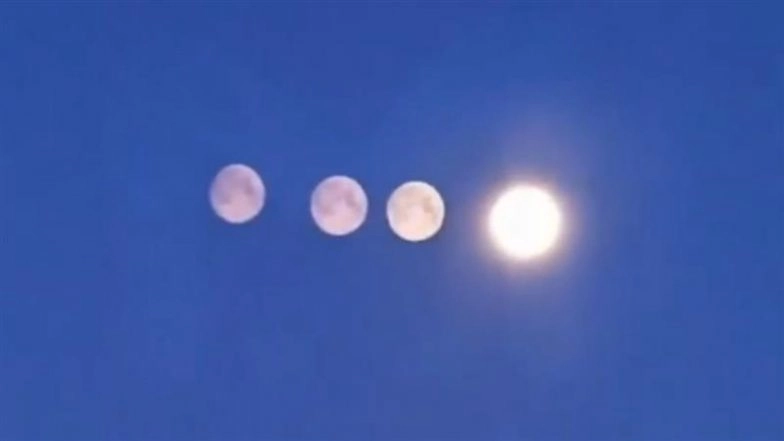
Moscow, February 2: Residents of St Petersburg were treated to a rare celestial display early Monday, February 2, as a phenomenon known as "paraselene" created the optical illusion of four moons appearing simultaneously in the night sky. The event, occurring amidst freezing temperatures, was captured in several viral videos showing a central bright moon flanked by luminous patches of light, known as "moon dogs."
Local meteorologists confirmed that the rare occurrence was caused by specific atmospheric conditions involving ice crystals, rather than any astronomical shift. Full Snow Moon 2026: When and How To Watch Lunar Spectacle.
4 Moons Seen Over Russia’s St Petersburg
🌚 A sign? Four moons were seen over St Petersburg last night
This is a paraselene — a rare atmospheric phenomenon.
Light from the real Moon is refracted by ice crystals in the freezing air, creating the illusion of several lunar discs. pic.twitter.com/EgCF8CdSnz
— NEXTA (@nexta_tv) February 1, 2026
What Is Paraselene?
The paraselene phenomenon, often referred to as "moon dogs", is the lunar equivalent of the "sun dog" (parhelion). It occurs when moonlight is refracted through hexagonal, plate-shaped ice crystals suspended in high-altitude cirrus or cirrostratus clouds.
When these crystals align horizontally as they sink through the air, they act like a prism. This bends the moonlight at a specific angle, usually 22 degrees, creating bright spots on either side of the actual moon. In the St. Petersburg event, the clarity and intensity of the refraction created a distinct appearance of multiple lunar bodies. NASA Delays Artemis II Moon Mission to February 8 Due to Freezing Weather Conditions in Florida.
Ideal Weather Conditions in St Petersburg
For paraselene to be visible, the air must be sufficiently cold to maintain ice crystal formations, and the sky must be clear enough for the moon’s light to be concentrated. St. Petersburg's current winter deep-freeze provided the perfect environment for this display.
Witnesses reported that the "extra" moons appeared to have a slight reddish tint on the side closest to the real moon, fading into a bluish-white "tail" pointing away from it. The phenomenon lasted for several minutes before the shifting cloud layers caused the spectral moons to fade.
While sun dogs are relatively common, paraselene is significantly rarer because it requires a very bright, nearly full moon to provide enough light for refraction to be visible to the naked eye. The timing of this event, coinciding with the "Snow Moon" phase, provided the necessary luminosity to trigger the display.
Historically, such events were often viewed with superstition or as omens. Today, they are celebrated by astrophotographers and atmospheric scientists as one of the most beautiful examples of meteorological optics.
Video of the event quickly dominated Russian social media platforms, with many users initially confused by the symmetrical arrangement of the lights. "It looked like a celestial formation or something out of a science fiction movie," one local resident noted on Telegram. Authorities in St. Petersburg noted that while the event caused a brief stir among commuters, it posed no threat and was purely a visual result of the region's intense winter weather patterns.
(The above story first appeared on LatestLY on Feb 02, 2026 10:33 AM IST. For more news and updates on politics, world, sports, entertainment and lifestyle, log on to our website latestly.com).