A Roadmap to Move Away from Fossil Fuels Would Be a Big Deal
Two years since countries agreed to transition away from coal, oil and gas, billions are still pouring into the industry, and emissions are at record levels.

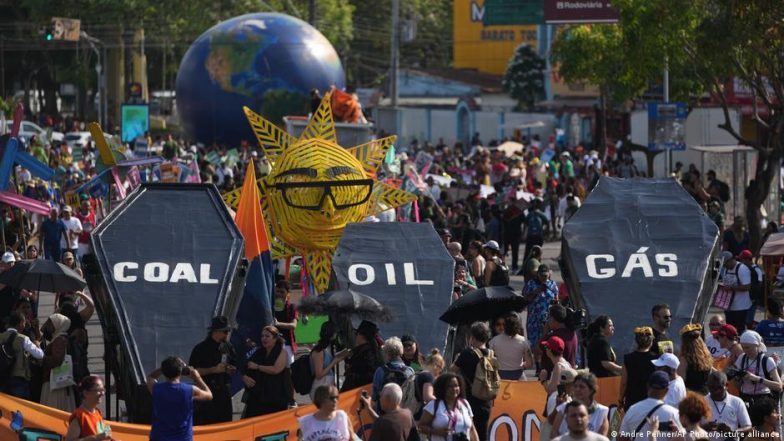
Two years since countries agreed to transition away from coal, oil and gas, billions are still pouring into the industry, and emissions are at record levels. Could countries meeting in Brazil be about to change that?As talks heat up in the final days of the UN climate conference in Belem, hopes have been tentatively raised that progress on moving away from fossil fuels could be within reach.
Also Read | Business News | Looking for Your Next Great Read? Meet the Writers Who Deserve Your Attention.
The subject is among several thorny discussion topics, including increasing finance and climate-friendly trade, that COP30 President Andre Correa do Lago is trying to get over the line. He has said he expects countries to reach a decision on a so-called roadmap to phase out oil, gas and coal this Wednesday, with outstanding issues being wrapped up on Friday.
Also Read | India News | BJP MP Ravi Shankar Prasad Congratulates Samrat Choudhary and Vijay Kumar Sinha.
While phasing out fossil fuels was not originally on the official agenda at COP30, the past week has seen political momentum grow around the issue.
Colombia is one of the countries spearheading around 80 nations — including Germany, Kenya, and the UK — calling for a roadmap on transitioning away from fossil fuels to be included in the summit's final agreement. Support has emerged from both rich and poor nations from across Europe, Africa, Latin America and the Small Island Developing States.
"People around the world are mobilizing on a massive scale, demanding concrete action for climate justice, particularly against the expansion of fossil fuel," said Irene Velez Torres, Colombia's environment minister, adding that despite being a producer of oil and coal, the country is not granting new exploration contracts. "We have to leave here with a call for a roadmap," she said.
Brazil is among the countries supporting this push, although a draft text of the final summit agreement, drawn up by negotiators and circulated by the COP30 Presidency, stopped short of concrete proposals, only listing it as an option for inclusion.
Why a roadmap would be such a departure
It was only two years ago, after fierce debate and almost three decades of annual climate conferences, that nations at COP28 in Dubai finally agreed to transition away from the fossil fuels causing the rising temperatures linked to storms, flooding and heat waves.
But that has not yet happened. Fossil fuel emissions are set to hit record levels in 2025, despite scientists spelling out the need to shift to clean energy sources in order to prevent runaway heat and more devastating extreme weather.
A roadmap to rapidly accelerate the shift to renewables could provide pointers on how to make the change, but it would require tackling the huge amounts of money still flowing into fossil fuels.
While some big oil and gas companies are planning production to peak or decline in the longer term, there's a general trend toward increasing it in the short term.
This expansion is underpinned by vast investment sums. Public fossil fuel finance has increased $75 billion per year (€65 billion) since 2014, rising to a total of $1.6 trillion (€1.4 trillion) per year, according to recent research.
Opposition and optimism
The topic of fossil fuels has long been politically charged at annual two-week climate conferences, and those pushing for a fossil fuel roadmap this week are likely to face strong opposition from some quarters. Not least from oil-producing nations such as Saudi Arabia and Iran.
Brazil has said there are still wide gaps on the issue and that a suggestion requiring countries to submit plans on how to reduce their fossil fuel dependency, had already been rejected by several nations. "Most of the countries are either very favorable or it's a red line," said COP President Andre Correa do Lago.
China is one country that won't say publicly that it will phase out fossil fuels, Bin Hu, associate professor at the Institute of Climate Change and Sustainable Development at China's Tsinghua University, told DW. "Because China needs to balance economic development, energy security and also combating climate change at the same time."
He added that certain regions in China are concerned about how a transition to clean energy may increase unemployment.
The draft text has also faced criticism from some of those supporting a clearer path forward on how to move beyond reliance on fossil fuels. Its current reference to the roadmap is "weak and it is presented as an option," said Tina Stege, climate envoy from the low-lying Marshall Islands, a country facing an existential threat from rising sea levels. "It must be strengthened and adopted."
Do Lago has also raised hopes by suggesting that as the idea of a fossil fuel transition was already approved by consensus in 2023, this year the roadmap might not need such a high bar. It could be adopted with near unanimous support instead.
As COP30 draws into its critical last hours, many will be hoping stronger language on fossil fuels will emerge in the next draft text.
There is no other way forward, said Ed Miliband, the United Kingdom's top official for energy and climate change, adding it was an issue uniting the Global South and North. "Saying with one voice that this is an issue that cannot be ignored, cannot be swept under the carpet, and this is where the momentum is."
Edited by: Tamsin Walker
(The above story first appeared on LatestLY on Nov 19, 2025 07:20 PM IST. For more news and updates on politics, world, sports, entertainment and lifestyle, log on to our website latestly.com).