













 Quickly
 Socially
 Trending
 Crypto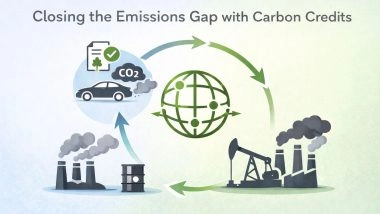
VMPL
New Delhi [India], February 4: The automotive industry is at a critical stage in its decarbonization journey. Over the past decade, manufacturers, logistics providers, and mobility companies have invested heavily in electric vehicles, renewable electricity, and energy-efficient manufacturing. These efforts have helped reduce Scope 1 and Scope 2 emissions across operations.
MMCM is working in this transition space, focusing on a part of the automotive lifecycle that remains largely outside climate accounting. End-of-life vehicles.
Net Zero commitments are now common across global automotive OEMs and mobility-led industries. Regulators and investors increasingly expect emissions disclosures across the full value chain. As a result, attention has shifted toward Scope 3 emissions, which account for the largest share of total emissions for most automotive manufacturers.
While upstream sourcing and in-use emissions are receiving growing attention, the end-of-life phase of vehicles remains structurally disconnected from carbon markets, ESG reporting, and Net Zero strategies. This gap is where MMCM's work is focused.
ELVs as an Unaccounted Emissions Source
End of life vehicles are still treated mainly as a regulatory or waste issue rather than a climate issue. Once vehicles leave the road, their environmental impact is rarely tracked within the automotive value chain. Carbon savings from dismantling, recycling, material recovery, and reuse are largely unquantified.
This gap is most visible in emerging markets dominated by informal scrappage, leading to higher pollution and untracked emissions. Despite clear benefits from ethical scrapping, ELVs remain disconnected from carbon markets and Net Zero accounting. MMCM addresses this by integrating ELVs into carbon markets as a measurable stage of the automotive lifecycle.
Why This Gap Is Becoming a Risk
* Unresolved ELV emissions sit within Scope 3 but outside OEM operational control during disposal stages.
* Automotive emissions remain partially invisible as end of life vehicle disposal lacks accounting frameworks.
* Carbon markets increasingly demand outcome based traceable credits reducing acceptance of proxy driven estimates approaches.
* ESG disclosures are shifting from intent toward verification requiring data backed emissions evidence across value chains.
* Regulators are increasing scrutiny on lifecycle emissions and circularity claims across industries globally and nationally.
Without a structured ELV carbon mechanism, circularity narratives lack measurable proof. This increases compliance risk and exposes organizations to greenwashing concerns.
No Clear Owner of the ELV Carbon Problem
Once a vehicle reaches the end of its usable life, responsibility for that vehicle becomes fragmented. Automotive manufacturers no longer control how the vehicle is dismantled or where materials are recovered. Their operational and reporting systems typically stop tracking the vehicle at deregistration or sale.
Authorized scrapping facilities are responsible for safe dismantling and regulatory compliance. Their mandates focus on meeting disposal rules, environmental safeguards, and documentation requirements. They are not designed to calculate emissions reductions, access carbon markets, or issue climate-linked assets.
Government agencies regulate vehicle disposal to address safety, pollution, and compliance. ELV policies define how vehicles should be scrapped, but they do not usually include mechanisms for carbon measurement, emissions attribution, or market participation.
Carbon markets operate separately from ELV systems. Existing methodologies have not been designed to link emissions reductions from scrappage and material recovery to individual vehicles.
Because these responsibilities sit across different actors and systems, no single stakeholder has had the infrastructure to convert ELV scrappage outcomes into verified carbon assets.
MMCM is addressing this gap by building shared digital infrastructure that connects vehicle scrappage data, verification processes, and carbon accounting.
How MMCM Is Structuring ELV Carbon Credits
MMCM is building automotive circularity-based ELV carbon credit infrastructure designed around vehicle-level accountability. ELV carbon credits are generated through scrapping at government-registered facilities. Each credit is linked to a uniquely identified vehicle and recorded on a public distributed ledger.
Credits are outcome-based and fractional, reflecting the actual emissions reductions achieved through verified dismantling and material recovery. More than 41 digital measurement, reporting, and verification data points are captured across scrappage, recovery, and recycling processes.
Blockchain-enabled systems ensure full traceability, prevent double counting, and support auditability. This structure allows ELVs to be integrated into carbon markets without relying on proxy assumptions.
Who ELV Carbon Credits Are Designed For
ELV carbon credits are designed to support Scope 1, Scope 2, and Scope 3 strategies across sectors.
* Auto OEMs use ELV credits to address Scope 3 exposure and align with vehicle disposal policies.
* Logistics and mobility-heavy sectors apply ELV credits to emissions linked to road and fleet operations.
* Oil and shipping companies address Scope 3 obligations through ethical scrappage outcomes.
* Financial institutions offset funded emissions tied to automotive portfolios while meeting ESG disclosure requirements.
* Individuals and voluntary buyers support national and global efforts to transition toward zero-waste mobility systems.
Lifecycle-Based Net Zero Is Becoming Necessary
Net Zero strategies that focus only on manufacturing and vehicle sales leave lifecycle emissions unaccounted. When vehicles exit use, emissions linked to dismantling, disposal, and material recovery continue to occur. Excluding this stage results in incomplete climate accounting.
ELV-linked carbon credits provide a traceable mechanism to include end-of-life emissions reductions within Net Zero strategies. A circular economy approach ensures eco-friendly disposal of ELVs, reduces pollution from informal scrappage, and promotes material recovery and reuse.
MMCM is building infrastructure that connects ELV scrappage, data capture, verification, and carbon accounting, enabling organizations to address end-of-life vehicles, circularity gaps, and GHG emissions using measured and verifiable outcomes.
(ADVERTORIAL DISCLAIMER: The above press release has been provided by VMPL. ANI will not be responsible in any way for the content of the same.)
(The above story is verified and authored by ANI staff, ANI is South Asia's leading multimedia news agency with over 100 bureaus in India, South Asia and across the globe. ANI brings the latest news on Politics and Current Affairs in India & around the World, Sports, Health, Fitness, Entertainment, & News. The views appearing in the above post do not reflect the opinions of LatestLY)
 Share Now
 Google Trends



 Live Bot