
Business News | SPJIMR's TaSIC 2026 Catalyses Dialogue on Responsible Growth
Get latest articles and stories on Business at LatestLY. Mumbai (Maharashtra) [India], February 23: 'How can India meet rising consumer aspirations without compromising responsibility, resilience, and long-term societal well-being?' This question anchored the two-day international Technology and Societal Impact Conference (TaSIC) 2026, hosted by Bharatiya Vidya Bhavan's S.P. Jain Institute of Management & Research (SPJIMR) at its Mumbai campus on February 20 and 21. Designed as an Academic-Practice Sprint, the conference brought together global scholars, industry leaders, innovators, and policymakers to move beyond dialogue towards actionable solutions.

PRNewswire
Mumbai (Maharashtra) [India], February 23: 'How can India meet rising consumer aspirations without compromising responsibility, resilience, and long-term societal well-being?' This question anchored the two-day international Technology and Societal Impact Conference (TaSIC) 2026, hosted by Bharatiya Vidya Bhavan's S.P. Jain Institute of Management & Research (SPJIMR) at its Mumbai campus on February 20 and 21. Designed as an Academic-Practice Sprint, the conference brought together global scholars, industry leaders, innovators, and policymakers to move beyond dialogue towards actionable solutions.
Also Read | Why Did IDFC First Bank Stock Crash 20% Today, February 23?.
Research-led perspectives meet practice
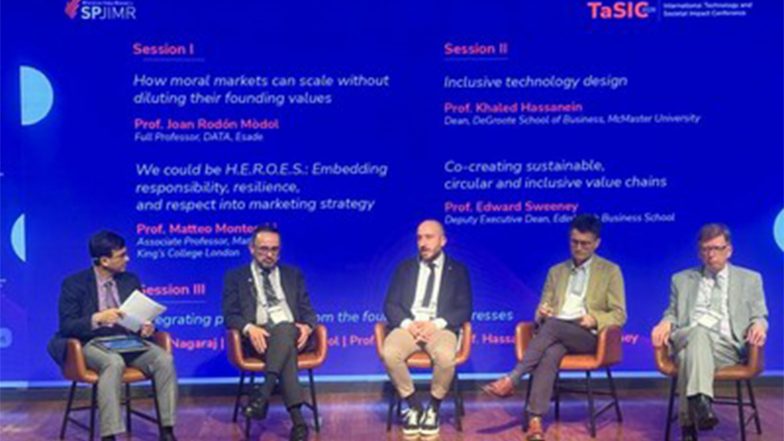
The Academic Plenary on February 20 featured four internationally respected scholars who examined the intersection of technology, markets, and sustainability through complementary lenses. Prof. Joan Rodon Modol (Esade) explored how moral markets can scale without diluting founding values; Prof. Matteo Montecchi (King's College London) presented the H.E.R.O.E.S. framework for embedding responsibility, resilience, and respect into marketing strategy; Prof. Khaled Hassanein (McMaster University) emphasised inclusive technology design and responsible AI; and Prof. Edward Sweeney (Heriot-Watt University) focused on the co-creation of sustainable, circular, and inclusive value chains.
Also Read | Rajpal Yadav Resumes Shooting for 'Welcome to the Jungle' After Interim Bail From Tihar Jail (Watch Video).
In a synthesis roundtable, Prof. Varun Nagaraj, Dean, SPJIMR reframed these insights around a central provocation posed to both speakers and the audience: India's aspiration-sustainability paradox: affordability versus sustainability, innovation versus regulation, and inclusion versus resource limits. SPJIMR's second-year PGDM participants presented 12 pressing problem statements across five sectors, challenging the audience to respond not in theory, but in systems terms.
Their mapping revealed a single, uncomfortable insight: systemic interdependence. Environmental stress surfaced through single-use packaging, food loss, toxic e-waste, groundwater depletion, inefficient energy systems, and AI's growing carbon footprint. Simultaneously, BNPL-driven debt, algorithm-led overconsumption, EV-linked job displacement, and rising non-communicable diseases exposed deepening socio-economic fragilities. Assumptions were challenged. Simplistic binaries were dismantled. The message was unequivocal: isolated interventions cannot solve interconnected failures.
Reflecting on the conference, Prof. Nagaraj said: "India does not face a shortage of aspiration; it faces a shortage of explicit choices. At TaSIC, we asked scholars to surface systemic tensions and industry leaders to commit to prescriptions they would defend before a CEO or policymaker. India's challenge is not whether we grow, but how consciously we design that growth. When interdependencies are mapped this clearly, it becomes evident that incremental fixes are insufficient. Responsible growth will not emerge from consensus slogans; it will emerge from clarity about trade-offs, sequencing, and accountability. Durable impact requires redesigning systems, not managing symptoms."
The day also featured peer-reviewed Research Paper Presentations across five thematic tracks aligned with the conference theme, and the Best Paper Awards. The tracks reflected TaSIC 2026's core intellectual lenses and reinforced its central proposition: that technological and market innovation must be evaluated within interconnected social and ecological contexts. The Best Paper Awards honoured research demonstrating strong theoretical and empirical rigour, robust and generalisable evidence, originality, and clear real-world impact -- recognising scholarship that advances academic knowledge while informing responsible enterprise and policy design.
From ideas to implementation
Day two (February 21) shifted decisively from insight to action through a closed-door, executive-level Industry Design Sprint. Nearly 50 senior leaders from organisations including Mondelez International, Mahindra & Mahindra, Cummins India, Godrej Agrovet, Delhivery, and Myntra, alongside SPJIMR alumni, faculty and students, collaborated to develop practical, implementable recommendations.
Working in small groups, participants produced structured 'Prescription Cards' -- concrete, experience-backed actions for industry and policymakers. Each prescription made trade-offs explicit: what aspiration it enables, the sustainability risk it mitigates, who bears the cost, and the consequences of inaction. These contributions will inform SPJIMR's forthcoming policy paper, India 2026: Solutions for meeting consumer aspirations responsibly and sustainably.
Simultaneously, the Wise Innovation Showcase featured six standout ventures selected from nearly 1,000 nationwide nominations, recognising technology-led solutions with clear social and environmental impact. Winners included FluXGen (AI-enabled industrial water efficiency), Languify AI (affordable employability and communication skills for non-metro youth), and YourDOST (scalable access to professional mental wellness support). Finalists included BatX Energies, also named the Jury Special Award winner for high-recovery battery recycling, Thinkerbell Labs (Braille literacy through inclusive learning technology), and LogyAI (low-cost, AI-based cataract screening). Together, these innovations demonstrated how technology, guided by ethics and empathy, can deliver inclusive impact at scale.
A blueprint for responsible growth
TaSIC 2026 was deliberately designed not as a conventional conference where experts speak and audiences listen but as a space where leading scholars, practitioners, and policymakers think together, challenging assumptions, confronting trade-offs, and jointly shaping solutions that matter for India's future. By integrating research excellence with executive action and grassroots innovation, the conference demonstrated that responsible growth is both achievable and practical.
As India navigates rapid technological and economic transformation, TaSIC 2026 marked a decisive step towards shaping markets that are resilient, inclusive, and future-ready.
About SPJIMR
Bharatiya Vidya Bhavan's S.P. Jain Institute of Management & Research (SPJIMR) is one of India's leading postgraduate management institutes. It is recognised in the Financial Times MiM rankings as the #35 business school globally and among the Top 3 in India, ranked by Business Today as one of the country's top five business schools, and rated by the Positive Impact Rating as one of the top five schools worldwide for societal impact. Known for its innovative and socially conscious approach to management education, research, and community engagement, SPJIMR aims to influence managerial practice and promote the value-based growth of its students, alumni, organisations and its leaders, and society. SPJIMR holds the international 'Triple Crown' of accreditations from EQUIS, AACSB, and AMBA.
Visit SPJIMR.org for more information.
Photo: https://mma.prnewswire.com/media/2918121/SPJIMR_TaSIC_2026.jpg
Logo: https://mma.prnewswire.com/media/1896222/5639305/SPJIMR_Logo_1.jpg
(ADVERTORIAL DISCLAIMER: The above press release has been provided by PRNewswire. ANI will not be responsible in any way for the content of the same.)
(The above story is verified and authored by ANI staff, ANI is South Asia's leading multimedia news agency with over 100 bureaus in India, South Asia and across the globe. ANI brings the latest news on Politics and Current Affairs in India & around the World, Sports, Health, Fitness, Entertainment, & News. The views appearing in the above post do not reflect the opinions of LatestLY)