Fuel Shortage Rumours: Why Buying Petrol in Bottles is Dangerous and Illegal
Amid rumours of fuel shortages due to the Israel-Iran war, Indians are panic-buying petrol in plastic bottles. This article explores why this is illegal under the Petroleum Act 1934, the explosive safety risks involved, and the reality of India’s 50-day strategic fuel reserves.

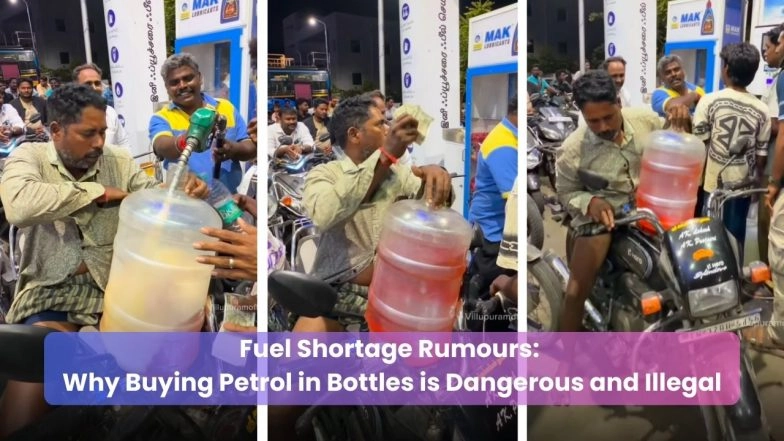
Recently, social media across India has been flooded with images of long queues at petrol pumps, with many citizens carrying plastic water bottles and 20-litre jars to stockpile fuel. These scenes are driven by viral rumours of an imminent fuel shortage due to the ongoing Israel-Iran conflict. While the geopolitical situation in West Asia is tense, the reaction by citizens on the ground seems to ignore two critical factors: the reality of India’s fuel reserves and the legal and safety risks of buying "loose" fuel.
The Reality Check: Is there a Fuel Shortage?
As of March 12, 2026, the Government of India and major Oil Marketing Companies (OMCs) like IOCL have issued clear statements that "There is no shortage of petrol or diesel in India." Also Read: Petrol and Diesel Shortage in India Rumours Untrue; Hindustan Petroleum Assures Adequate Fuel Availability.
Strategic Reserves: India maintains a "fuel shield" consisting of strategic petroleum reserves and commercial stocks sufficient for approximately 25–50 days of national consumption.
Supply Diversification: While the Strait of Hormuz is a critical chokepoint, India has successfully shifted its sourcing. Nearly 70% of crude imports now come from non-Hormuz regions (including increased Russian intake), reducing the immediate impact of the West Asia conflict.
Price Stability: Government sources have confirmed that despite Brent crude volatility, retail prices for petrol and diesel are expected to remain stable for the foreseeable future. Also Read: Petrol Price Reaching INR 500 per Litre Is Fake News.
The "shortage" is a product of panic, not a lack of supply. Crowding pumps only creates artificial local scarcity and logistical hurdles for distributors.
Is it Legal in India to Buy Petrol and Diesel in Cans or Bottles?
Based on the Petroleum Act (1934) and Petroleum Rules (2002), it is generally illegal to sell or transport petrol in plastic bottles, water cans, or unauthorised containers in India. In India, the sale of "loose" fuel is strictly regulated by the Petroleum and Explosives Safety Organization (PESO) under the Petroleum Rules (2002). While the general rule is "no bottles or cans," there are specific legal pathways for legitimate needs like generators or industrial machinery.
The Legal Standing:
Unauthorised Containers: Under the Petroleum Rules, fuel must only be dispensed into the vehicle’s tank or into PESO-approved (Petroleum and Explosives Safety Organization) containers. Common plastic water bottles or 20-litre water cans (like the one below) are not approved.
Example Video of Panic Buying in Water Cans and Plastic Bottles
View this post on Instagram
Container Standards: Approved containers must be airtight, leak-proof, and made of materials (usually high-density metal or specific treated plastics) that do not react with the fuel or build up static electricity.
State-Level Bans: In 2025 and 2026, several states (including Odisha, Jammu & Kashmir, and Meghalaya) issued strict district-level bans on "loose fuel" sales specifically to prevent fire hazards, self-immolation, and the creation of "petrol bombs" during civil unrest or elections.
Why is it dangerous?
Static Electricity: Plastic creates static friction. Pouring fuel into a non-conductive plastic container can generate a spark, leading to an immediate explosion.
Material Degradation: Petrol is a solvent; it can dissolve many types of plastic over time, leading to leaks and structural failure of the container.
Vapour Pressure: Improperly sealed bottles allow highly flammable vapours to escape, which can ignite from a cigarette, a hot engine, or even a cell phone signal spark nearby.
Penalties
For the Consumer: Transporting fuel in unauthorised containers can lead to prosecution under the Essential Commodities Act and the Explosives Act. During times of civil unrest, carrying "loose" fuel is often viewed by police as a security threat (potential for "petrol bombs"). Also Read: What Is the Essential Commodities Act, 1955?
For the Petrol Pump: A station found dispensing fuel in bottles faces the cancellation of its operating license and heavy monetary fines.
Note: For specific needs like generators or farm equipment, you are typically required to use a metal jerry can or provide an Aadhaar card/valid documentation to the station manager to get fuel in an approved container.
Approved Guidelines for Buying "Loose" Fuel
If you have a legitimate need for fuel (for a generator or farm equipment), the law provides a specific, safe protocol:
Containers:
The law specifies that containers for carrying fuel must be approved by the Chief Controller of Explosives (PESO). Only specific certified containers are legal.
Material: Must be made of tinned, galvanised, or rust-proofed sheet iron or steel. High-density specialised plastic is sometimes allowed if it has BIS (Bureau of Indian Standards) or TÜV certification specifically for fuel.
Airtight & Leak-proof: The container must have a secure, "stoppered" seal to prevent vapour escape.
Approved Type of Containers
If you need to buy petrol or diesel legally, you should use one of the following:
Steel Jerry Cans (PESO Approved): These are the most common legal containers. Brands like GoldRock Infratech manufacture 5-litre steel cans that are officially BIS/PESO certified.
Specialised Plastic Fuel Cans: Certain high-grade plastic containers (often black or red) labelled with UN/TÜV/BIS approval for fuel are acceptable.
Glass (Small Scale): Legally, glass bottles up to 2.5 litres are technically allowed if they are of a "type approved" by the Chief Controller, though petrol pumps will almost always refuse them for safety reasons.
Requirements for Buying Fuel for Generators/Industry
If you arrive at a petrol pump with an empty bottle, you will (and should) be turned away. To buy fuel legally for secondary use, follow these steps:
| Requirement | Details |
| Identification | Carry a copy of your Aadhaar card or a valid Govt ID. Many pumps now require this to record "loose" sales to prevent misuse (e.g., for arson). |
| Quantity Limits | Without a license, you can generally store up to 30 litres of Petrol (Class A) or up to 2,500 litres of Diesel (Class B) provided it is in approved containers. |
| The "Shell" Model | Some premium petrol pumps (like Shell) offer a Refundable Deposit Scheme. You pay a deposit (approx. ₹300–₹500), they provide a certified jerry can, and you get your money back when you return the can. |
| Doorstep Delivery | For large quantities (generators/commercial), it is now legal to order Diesel via PESO-approved "mobile dispensers" or apps like FuelBuddy or Jio-bp. This is currently the safest and most legal way for B2B needs. |
Rules for Special Situations (Running out of fuel on the road)
If your vehicle runs out of fuel, you are technically allowed a small emergency quantity (usually 1 litre for bikes, 4 litres for cars). To get this, you should:
- Show your Vehicle RC (Registration Certificate) to the station manager.
- If they have an approved can for loan, use that.
- Avoid using the 20-litre water cans or Bisleri/Local Water; if a fire occurs, you (and the pump owner) will be held legally liable for "unauthorised transport of hazardous substances."
Fuel Shortage Rumours: Why Buying Petrol in Bottles is Dangerous and Illegal
| News | The Rumour/Panic | The Reality (March 2026) |
| Supply | We will run out in days. | India has 25-50 days of buffer stock. |
| Containers | Water bottles are okay "just for now." | Illegal & Explosive. Plastic builds static sparks. |
| Price | Prices will double tomorrow. | Govt has activated a supply management plan to keep prices stable. |
| Legality | Anyone can buy in cans. | Requires PESO-approved cans and often a Govt ID. |
In times of geopolitical uncertainty, the urge to stockpile is a natural human response, but with fuel, the risks far outweigh the benefits. It is a critical responsibility of fuel stations to strictly avoid dispensing petrol or diesel in plastic bottles or unapproved containers. Beyond just following the law, pump owners and attendants are the first line of defence in preventing catastrophic fires and discouraging the spread of panic-driven rumours.
By refusing to sell fuel in unsafe containers, stations protect their licenses and, more importantly, the lives of their customers and the surrounding community. For the public, the most effective way to counter a "shortage" is to maintain regular consumption patterns, allowing the national supply chain to function smoothly. Choosing only PESO-approved channels, such as legal doorstep delivery apps or certified jerry cans, ensures that safety and lawfulness remain a priority even during global instability.
(The above story first appeared on LatestLY on Mar 12, 2026 02:53 PM IST. For more news and updates on politics, world, sports, entertainment and lifestyle, log on to our website latestly.com).