Red Aurora Over Ladakh: Why Northern Lights Seen in Hanle Signal a Growing Solar Threat
The night sky over Hanle, Ladakh, is usually a canvas of deep sapphire, punctuated only by the distant glow of galaxies. But on the nights of January 19 and 20, that darkness was pierced by an eerie, blood-red glow that left scientists and skywatchers stunned.

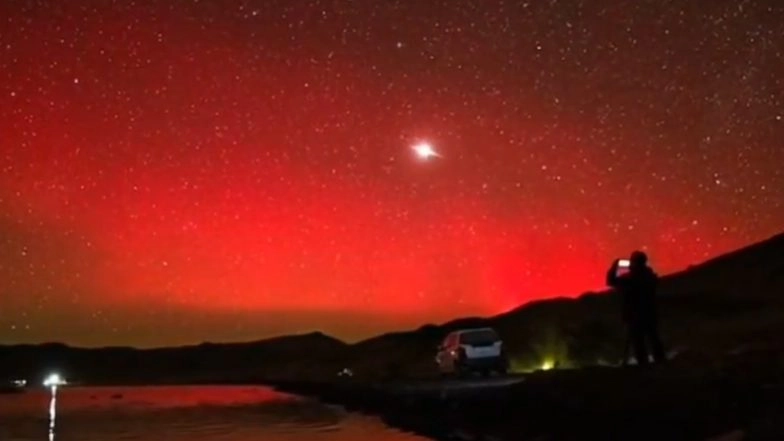
New Delhi, January 29: The night sky over Hanle, Ladakh, is usually a canvas of deep sapphire, punctuated only by the distant glow of galaxies. But on the nights of January 19 and 20, that darkness was pierced by an eerie, blood-red glow that left scientists and skywatchers stunned.
As striking images of rare Northern Lights over India flooded social media, experts warned that the phenomenon was more than a visual spectacle. The red auroras were a visible sign of an increasingly volatile Sun, one whose outbursts can directly threaten Earth’s digital and space infrastructure.
How Did a Solar Storm Reach India?
The red auroras seen from the Hanle Dark Sky Reserve were triggered by the most intense solar radiation storm since 2003. On January 18, an X-class solar flare erupted from the Sun, hurling a massive Coronal Mass Ejection (CME), a cloud of magnetised plasma, towards Earth. Northern Lights in India! Auroras Light Up Ladakh Skies in Rare Display (See Pic).
Travelling at nearly 1,700 km per second, the plasma cloud reached Earth in just 25 hours. When it struck our planet’s magnetic field, it triggered a G4-level geomagnetic storm, severely disturbing Earth’s magnetic shield. Northern Lights Pictures and Videos: Netizens Share Stunning Photos of Aurora Borealis Lighting Up the Night Sky Across the World.
The red colour occurs when high-altitude oxygen atoms, above 300 km, are excited by incoming solar particles. At lower latitudes like Ladakh, observers see only the upper edges of auroral curtains, which appear red rather than the familiar green seen near the poles.
Red Aurora Over Ladakh
RARE EVENT: Red auroras illuminated the skies over Hanle, Ladakh, following the most intense solar storm in over two decades. pic.twitter.com/SK1ygwcmFv
— AsiaWarZone (@AsiaWarZone) January 29, 2026
Rare red auroras lit up the night sky over Hanle, Ladakh, after the most intense solar storm in over two decades hit Earth. This stunning celestial show is caused by charged solar particles interacting with our atmosphere, a beautiful yet sobering reminder of solar volatility. pic.twitter.com/sroPBA69S6
— Baba Banaras™ (@RealBababanaras) January 29, 2026
Why Are Red Auroras Rare in India?
Auroras are usually confined to polar regions. Seeing them over Ladakh means the geomagnetic storm was powerful enough to push auroral activity far from the poles. According to recent Indian Space Research Organisation assessments, such events are becoming more frequent as the Sun approaches its solar maximum, the peak of its 11-year activity cycle.
Is India’s Digital Infrastructure at Risk?
Behind the beauty lies a serious warning. This January 2026 event was classified as an S4 severe radiation storm, marked by intense streams of high-energy solar protons. Both NASA and ISRO tracked how the storm compressed Earth’s magnetic shield.
Data from Aditya-L1 revealed that the magnetic boundary was pushed so close that some geostationary satellites were briefly exposed to harsh solar winds.
For India’s fast-growing digital economy, the stakes are high. Strong geomagnetic storms can induce currents in power grids, cause transformer failures, disrupt GPS navigation, and interfere with banking and communication systems. During the storm, astronauts aboard the International Space Station were even asked to take shelter due to elevated radiation levels.
How Is India Preparing for Solar Storms?
The key to defence lies in early warning and resilient systems. Aditya-L1, positioned at the Sun-Earth L1 Lagrange point, acts as a solar sentry. By detecting CMEs early, scientists can issue 24–48 hour alerts, allowing satellite operators to switch spacecraft to safe mode and power grid managers to rebalance loads.
On Earth, engineers are strengthening the national power grid by installing sensors to detect geomagnetically induced currents in real time, reducing the risk of widespread blackouts.
Why Protecting Hanle’s Darkness Matters
The event has also spotlighted the fragile future of the Hanle Dark Sky Reserve. As India’s first designated dark sky sanctuary, it provides critical ground-based observations that validate satellite data. Rising tourism and light pollution threaten to dull this natural advantage.
If Hanle loses its darkness, India risks losing an early warning window into space weather, phenomena that increasingly dictate the health of our technological world.
The crimson sky over Ladakh was majestic, but it was also a message. As the Sun awakens, our electronic civilisation stands more exposed than ever. Admiring the glow is easy; preparing for what it represents is the real challenge.
(The above story first appeared on LatestLY on Jan 29, 2026 12:19 PM IST. For more news and updates on politics, world, sports, entertainment and lifestyle, log on to our website latestly.com).