












 Quickly
 Socially
 Trending
 Crypto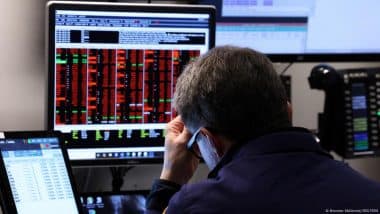
Global markets from Europe to Asia have continued to feel the pain of Donald Trump's tariffs. The US president has shown no sign of reconsidering despite the economic turmoil. DW has the latest.
Sell-off continues on Wall Street as trade war escalatesAlso Read | Saurabh Rajput Murder Case: Muskan Rastogi, Accused of Killing Her Husband With Lover Sahil Shukla, Is Pregnant, Say Officials.
EU offers US 'zero-for-zero tariffs' on industrial goods
Key stock markets in Asia closed with decades-high lossesAlso Read | UP Shocker: Ballia Youth Arrested for Abducting 16-Year-Old Girl to Mumbai, Raping Her for One Month.
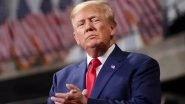
US President Donald Trump has shown no signs of backing down, calling the global market turmoil a necessary 'medicine'
Here are the latest developments from the fallout of the Trump tariffs on Monday, April 7:
VW clobbers Tesla, tops German EV market
Despite overall gloom in the German car industry, top brand Volkswagen (VW) offered some good news by leading a domestic manufacturers' rout of US rival Tesla in 2025 first-quarter electric vehicle (EV) sales.
Statistics compiled by Germany's Federal Motor Transport Authority (KBA) showed that VW sold 25,393 of a total of 112,968 electric vehicles registered between January and March.
Bavarian automaker BMW was next with 10,315 units sold; VW subsidiaries Skoda, Audi and Seat took up spots three, four and five, with Mercedes at number six.
Elon Musk's EV company Tesla sold only 4,935 vehicles in Q1 2025, ranking it eighth after having topped the market just a year ago.
With Tesla owner Musk's politics and media presence becoming increasingly contentious — his activities at DOGE, his bankrolling of Donald Trump, and his tendency to use his enormous wealth and media power to back far-right anti-establishment parties and candidates in numerous countries — EV sales at the company have fallen precipitously.
Tesla sales have plummeted since January — when many came to see Musk as the bullying face of mass US government firings — pushing the company to a 13% drop in annual sales and shedding 36% of its total value.
What is a 'bear market'?
In the investing world, the term "bear market" symbolizes a sustained market downturn, when a stock index falls 20% from its last peak.
The S&P 500, the benchmark US stock index, entered bear market territory on Monday for the first time since 2022.
During a downtrend, more people are looking to sell than buy stocks. The demand to buy is significantly lower than the supply, leading to a drop in share prices.
However, it may be good to buy in a bear market since investing involves buying low and selling high. In a bear market, share prices may fall even further, which is why they are risky to invest in.
The worst-case scenario is a market crash.
The opposite of a bear market is a bull market, which indicates a positive and upward trend in the stock market.
Wall Street opens, show downward swing
Wall Street's main indexes have opened sharply lower, with all three major US indices were down more than three percent in early trading.
The drop reflects continued angst after US President Donald Trump's team over the weekend dismissed the worldwide market carnage since his tariff announcement last week.
Investors sought refuge in government bonds amid economic worries over the fallout of US President Donald Trump's sweeping tariff plans.
The S&P 500 index slumped further on Monday and was down more than 20% from its all-time highs.
The Dow Jones Industrial Average was down 1,200 points, and the tech-heavy Nasdaq composite was 4% lower.
Snapshot of market turmoil
Trump trade advisor says EU must lower non-tariff barriers
President Donald Trump's White House trade adviser Peter Navarro says the European Union (EU) will need to lower its non-tariff barriers (NTBs), including those created by value-added taxes, if it wants to reach a deal to lower US tariffs.
"I would say to the EU when you make those announcements, would you be very careful to tell us you're going to lower your non-tariff barriers?" Navarro told CNBC.
Non-tariff barriers (NTBs) are trade obstacles that aren't import or export taxes but imposed through laws, minimum standards, and policies such as sales tax.
Canada launches WTO complaint over auto tariffs
Canada has asked the World Trade Organization (WTO) to step in and settle its dispute with the US over auto import taxes, the organization has confirmed.
"Canada has requested WTO dispute consultations with the United States concerning US measures imposing a 25% duty on automobiles and automobile parts from Canada," the trade body said.
Amongst other things, according to the WTO, Ottawa claims Washington is violating its obligations under the 1994 General Agreement on Tariffs and Trade (GATT).
The tariffs have already wreaked havoc on the North American auto industry. On top of the cars that roll into the US every day from Canadian factories, many of the parts needed for American auto manufacturing are made in Canada.
Trump tariffs spark fears of global recession
Financial markets are pricing in the heightened risk of a global recession as a result of US President Donald Trump's unprecedented tariffs.
One US investment bank believes there is now a 60% chance that the United States and global economies will suffer an economic slump.
Trump's tariffs have already caused a severe stock market rout and are set to spike inflation, knock business confidence and shink both public and private investment.
Both Trump and China, which has been hit hardest by the new US tariffs, are playing down talk of a deal to resolve the growing trade war.
Read our article about what market analysts are saying about recession fears.
EU chief says offered US 'zero-for-zero tariffs' on industrial goods
European Commission President Ursula von der Leyen has says the EU has offered the United States "zero-for-zero" tariffs on flows of industrial goods.
The move comes as Brussels works to avert an all-out transatlantic trade war.
"We stand ready to negotiate with the United States. Indeed, we have offered zero-for-zero tariffs for industrial goods, as we have successfully done with many other trading partners, because Europe is always ready for a good deal," she said.
Von der Leyen added that the offer was made before Trump's announcement last week of sweeping new tariffs.
Berlin says hopes to avoid trade war escalation
The German government hopes that an escalation in the trade war unleashed by US President Donald Trump can still be avoided.
The comments came as EU trade ministers met in Luxembourg to assess strategies to convince Trump to rethink his latest trade moves.
"We don't want to start a trade war, but the aim should be to further reduce trade barriers," government spokesman Steffen Hebestreit said in Berlin on Monday.
"Secondly, we need to protect our domestic businesses from whatever comes next," he said.
Hebestreit stressed that it was important to understand the effects of the tariffs announced by Trump last week, cautioning against an emotional response.
"We must now act smartly and act clearly to avoid... escalating a trade war," he told a press briefing, adding that the European Union needed "to represent our interests clearly and resolutely."
Hebestreit said plunging stocks were a "wake-up call" that show there would "only be losers at the end" of any trade war.
Outgoing German Chancellor Olaf Scholz has been in touch his European counterparts and leading German firms after Trump said he would impose blanket tariffs of 10% on all imports to the US, effective since Saturday.
Extra levies on a host of trading partners are due to take effect on Wednesday, including 20% tariffs on imports from the EU.
Summary: What we know so far
If you are just joining us, here is what you need to know:
The US markets are set to open soon, and judging by futures trading, they are expected to fall like the rest of the world markets.
Asian shares experienced significant losses, with Hong Kong's stock exchange closing with a 13.22% drop, marking its largest one-day decline in nearly three decades.
European shares followed Asian markets lower, led by Germany's DAX index, which briefly fell more than 10% at the open on the Frankfurt exchange.
The downward spiral comes after US President Donald Trump's tariff announcements last week. Trump told reporters late on Sunday that investors must endure the consequences. He said he didn't want global markets to fall, but also that he wasn't concerned about the massive sell-offs, adding, "sometimes you have to take medicine to fix something."
Meanwhile, EU trade ministers are meeting to figure out what their unified response to the tariffs should be.
We will continue to cover the fallout and the impact it might have on your pocket.
JPMorgan CEO predicts high inflation, low growth due to tariffs
Jamie Dimon, the head of JPMorgan Chase, has warned that Trump's tariffs will likely have an "inflationary" impact in the US and could trigger a recession.
"The economy is facing considerable turbulence (including geopolitics), with the potential positives of tax reform and deregulation and the potential negatives of tariffs and 'trade wars,' ongoing sticky inflation, high fiscal deficits and still rather high asset prices and volatility," Dimon wrote in his annual letter to shareholders.
"We are likely to see inflationary outcomes ... Whether or not the menu of tariffs causes a recession remains in question, but it will slow down growth," the 69-year-old CEO of the largest bank in the US added.
JPMorgan's economists have given a 60% chance that the world will tip into a recession this year in light of Trump's tariffs.
"The quicker this issue is resolved, the better because some of the negative effects increase cumulatively over time and would be hard to reverse," Dimon wrote.
It adds to the corporate voices that have warned against the impact of Trump's policies. Bill Ackman, a billionaire fund manager who backed Trump for the presidency, has criticized the tariffs saying that Trump is now losing the confidence of business leaders.
Trump calls for interest rate cut, lashes out at China tariffs
US President Donald Trump has started posting on his Truth Social platform, trying to play up the achievements of his tariffs while attacking China for imposing their own retaliatory tariffs.
Trump said that "Oil prices are down," which is true, as investors seek to price in the potential of a recession brought on by his tariffs.
He also said that "there is no inflation," using his preferred all caps, which is not true according to the latest data. Inflation in February was at 2.8% while March inflation has not yet been published.
He said interest rates were down, but also added "the slow moving Fed should cut rates."
He made no mention of the trillions of dollars that have been wiped off of US and global stock markets.
Instead, he lashed out at China, calling them "the biggest abuser of them all" for the 34% tariffs they announced to match Trump's "reciprocal" tariffs.
He lamented that Beijing had not acknowledged his "warning for abusing countries not to retaliate."
EU trade chief calls for 'paradigm shift' in international trade
The European Union's trade chief has said that Monday's meeting will focus on the "paradigm shift" in international trade.
"What we are going to discuss is how to position Europe in what I would describe as the paradigm shift of the global trading system," Maros Sefcovic told reporters before meeting with the bloc's 27 trade ministers.
Ahead of the 20% tariffs against the EU coming into effect on Wednesday, Sefcovic said "our next move in relation vis-a-vis the United States but also how to prepare our trading system back in the European Union to prevent eventual trade diversion."
There have been calls for a united position, but splits have already emerged with France and Germany pushing for the use of the so-called "trade bazooka," a relatively recent option that would allow the EU to aggressively target US sectors.
But Ireland, reliant on US investment, has come out against using the "anti-coercion instrument," as it is officially known, with Irish Trade Minister Simon Harris calling it the "nuclear option."
What can Europe do to respond to Trump's tariffs?
Trump said he would slap 20% tariffs on European Union goods, to which the bloc has promised countermeasures if negotiations with Washington fail.
The United States and the EU have the world's largest commercial relationship, trading some €1.6 trillion ($1.7 trillion) in goods and services in 2023.
Trump frequently hits out at the EU over the balance, given the higher volume of European goods sold in the US compared to vice versa.
US goods imports into the EU totaled €334 billion in 2024, against €532 billion of EU exports to the US, according to EU statistics agency Eurostat.
However, the overall balance of trade is roughly even.
While Europe exports more goods to the US than it imports in the opposite direction, that situation is reversed when looking at services.
That means the service sector, particularly tech, could be the main avenue through which Brussels could hit back.
Economists say that Europe could widen the trade war, in particular by targeting Big Tech — a category more vulnerable to retaliation because of the US surplus.
Brussels could hit back with a tax targeting US tech titans like Google, Apple, Meta, Amazon, and Microsoft — a move French EU-US trade balance 2014–202 officials have pushed for.
At the same time, the EU’s powerful new Anti-Coercion Instrument (ACI), in force since late 2023, gives the bloc sweeping authority to strike back at foreign countries trying to strong-arm its members into policy changes.
German Economy Minister Robert Habeck says Europe should be prepared to use the new instrument, described as a trade "bazooka," in any transatlantic trade war.
The EU can also limit access to public procurement tenders for companies from a third country or take action when it comes to the services trade or investment.
Europe's strategy on goods so far has been to limit retaliation to early tariff rounds to just a few politically sensitive goods, rather than escalate an all-out trade war.
When Trump hit steel and aluminum imports with a 25% tariff in March, Brussels opted for "an eye for an eye" approach.
With Trump's extra levies, Brussels opted to target US goods from mid-April, including Harley Davidson motorbikes and agricultural products.
Officials have previously said the EU will target goods from politically important US states, including soybeans produced in Louisiana.
Ireland says EU tech tariffs would be an 'extraordinary escalation'
EU member state Ireland has expressed concern over the possibility that the EU may respond to Trump's tariffs with measures against the US tech industry.
Irish Trade Minister Simon Harris said: "It would be an extraordinary escalation at a time when we must be working for de-escalation."
Ireland is home to several major US tech companies that take advantage of its low tax rates and access to the European market.
As such, any impact on the tech industry could take a heavy toll on the Irish economy.
(The above story first appeared on LatestLY on Apr 07, 2025 10:30 PM IST. For more news and updates on politics, world, sports, entertainment and lifestyle, log on to our website latestly.com).
 Share Now
 Google Trends



 Live Bot