What Are ‘No Kings’ Protests? Millions Rally Across US Against Donald Trump (Watch Videos)
The 'No Kings' protests saw millions rally across the US and globally against policies of Donald Trump. Organised by groups like Indivisible, the movement opposes perceived authoritarianism and highlights issues including immigration, war and civil rights. Demonstrations were held in over 3,000 locations across all 50 states.


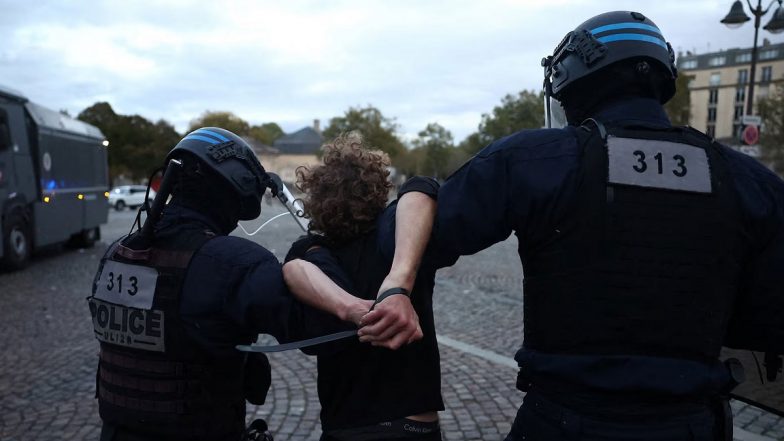
New York, March 29: Large crowds gathered across the United States and in several countries on Saturday, March 28, as part of the “No Kings” protests, a coordinated movement opposing the policies of Donald Trump. Organisers said more than 3,000 events were held nationwide, with participation expected to reach into the millions, marking one of the largest protest mobilisations in recent years.
The demonstrations were organised by a coalition of groups including Indivisible and other grassroots organisations, labour unions and advocacy networks. Protests were reported in all 50 states, as well as in parts of Europe and other regions, reflecting the movement’s widening reach. ‘No Kings’ Protests: Massive Anti-Trump Rallies Fill Times Square, Los Angeles as Nationwide Marches Gain Momentum.
‘No Kings’ Protests in New York
NEW YORK CITY: ‘No Kings’ protesters have ended their march on Times Square. They have now brought out a speaker playing an Anti-Republican song.@Bodittle | @TPUSA pic.twitter.com/jlqxz8tvKQ
— FRONTLINES TPUSA (@FrontlinesTPUSA) March 28, 2026
In Washington DC
Protesters in Washington, D.C. carry an inflatable effigy of corrupt fascist war criminal Donald Trump shitting on the US Constitution pic.twitter.com/1hX0HsHlD1
— Marco Foster (@MarcoFoster_) March 28, 2026
Boston Sees Millions on Road for Protest
Boston erupts as huge ‘No Kings’ anti-Trump protest draws tens of thousands https://t.co/gDj6xoItc0 pic.twitter.com/RcKzMj2ud5
— RT (@RT_com) March 28, 2026
What Are ‘No Kings’ Protests?
The “No Kings” protests are part of a broader anti-authoritarian movement that opposes what organisers describe as the centralisation of power and erosion of democratic norms. The name reflects a rejection of leadership styles perceived as authoritarian.
The campaign has grown over multiple rounds of demonstrations. Organisers estimate earlier protests drew more than 5 million people in June and around 7 million in October. Ahead of Saturday’s rallies, they projected participation could rise further, though final figures are yet to be confirmed. US Protests: Donald Trump Shares AI Video of Spraying Mud on ‘No Kings’ Protestors.
Large Turnout in Minnesota
Minnesota emerged as the focal point of the latest protests, with organisers estimating around 200,000 people gathered in the Twin Cities of Minneapolis and St. Paul. Crowds filled streets around the state capitol, where speakers addressed issues including immigration enforcement and civil rights.
Among those present were Bernie Sanders, who spoke about economic inequality, and Bruce Springsteen, who performed during the event. Minnesota Governor Tim Walz also addressed the gathering. The protests in the state were shaped in part by recent incidents involving federal immigration enforcement, which have become a rallying point for demonstrators.
Nationwide Protests Across Major Cities
In New York City, thousands marched through Manhattan, including areas such as Times Square and Central Park. Public figures including Robert De Niro and civil rights activist Al Sharpton joined the demonstrations.
Protesters carried signs and banners addressing a range of issues, including immigration policies, economic concerns, LGBTQ+ rights and foreign policy. Similar scenes were reported in cities such as Chicago, Washington, DC and San Diego, where large crowds participated in marches and rallies.
Key Issues Driving the Movement
While opposition to the Trump administration remains the central theme, the protests have brought together a wide range of concerns. These include immigration enforcement actions, particularly by US Immigration and Customs Enforcement (ICE), as well as the war in Iran and domestic economic issues.
Participants also highlighted concerns about healthcare, housing affordability and civil liberties. In Washington, DC, demonstrators gathered near major landmarks, while smaller rallies were reported in towns and rural areas, indicating broader geographic participation.
International Demonstrations
The movement also saw participation outside the United States. Protests were held in cities including London, Paris and Rome, where demonstrators echoed similar concerns about governance, war and civil rights.
In some countries, events were adapted to local contexts but retained the core message of opposing authoritarianism and supporting democratic institutions.
The protests drew criticism from officials aligned with the Trump administration. A White House spokesperson described the rallies as lacking broad public support, while Republican political groups also criticised the movement.
Despite this, organisers said participation extended beyond major urban centres into smaller towns and conservative-leaning states, suggesting a wider base of engagement.
Saturday’s demonstrations mark the third major round of “No Kings” protests, with organisers indicating that the movement is continuing to expand in scale and scope. While final attendance figures are still being assessed, the widespread turnout across multiple regions highlights sustained mobilisation around political and social issues in the United States and beyond.
(The above story first appeared on LatestLY on Mar 29, 2026 04:38 PM IST. For more news and updates on politics, world, sports, entertainment and lifestyle, log on to our website latestly.com).