












 Quickly
 Socially
 Trending
 Crypto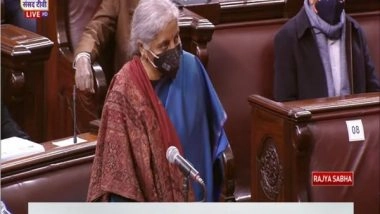
New Delhi [India], January 31 (ANI): The economic impact of the "second wave" of COVID-19 was much smaller than that during the full lockdown phase in 2020-21, though the health impact was more severe, according to the Economic Survey 2021-22 tabled in the parliament on Monday.
While presenting the annual survey report ahead of the Union Budget, Finance Minister Nirmala Sitharaman said that the Centre's unique response to the second wave of COVID-19 comprised of safety-nets to cushion its impact on vulnerable sections of society and the business sector.
Also Read | Latest ATP Rankings 2022: Roger Federer Hits 21-Year Low at 30th Spot, Novak Djokovic Remains World No. 1.
She added that the government significantly increased the capital expenditure to spur growth and introduced supply-side reforms for a sustained long-term expansion of the economy.
"The government's flexible and multi-layered response is partly based on an "Agile" framework that uses feedback-loops, and the use of eighty High-Frequency Indicators (HFIs) in an environment of extreme uncertainty," she stated.
As per the report, the Indian economy is estimated to grow by 9.2 per cent in real terms in 2021-22 (as per first advanced estimates) subsequent to a contraction of 7.3 per cent in 2020-21 and the GDP is projected to grow by 8- 8.5 per cent in real terms in 2022-23.
The year ahead is poised for a pickup in private sector investment with the financial system in a good position to provide support for the economy's revival, said the survey report.
The projection is comparable with World Bank and Asian Development Bank's latest forecasts of real GDP growth of 8.7 per cent and 7.5 per cent respectively for 2022-23, it added.
As per IMF's latest World Economic Outlook projections, India's real GDP is projected to grow at 9 per cent in 2021-22 and 2022-23 and at 7.1 per cent in 2023-2024, which would make India the fastest-growing major economy in the world for all three years.
Macroeconomic stability indicators suggest that the Indian Economy is well placed to take on the challenges of 2022-23.
A combination of high foreign exchange reserves, sustained foreign direct investment, and rising export earnings will provide an adequate buffer against possible global liquidity tapering in 2022-23. (ANI)
(The above story is verified and authored by ANI staff, ANI is South Asia's leading multimedia news agency with over 100 bureaus in India, South Asia and across the globe. ANI brings the latest news on Politics and Current Affairs in India & around the World, Sports, Health, Fitness, Entertainment, & News. The views appearing in the above post do not reflect the opinions of LatestLY)
 Share Now
 Google Trends



 Live Bot