













 Quickly
 Socially
 Trending
 Crypto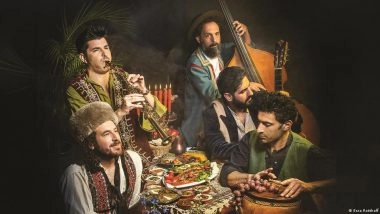
The Berlin-based music ensemble Sistanagila brings together musicians from Iran and Israel who offer a message of hope for a better future.The current US-Israel war with Iran follows decades of political tensions that have shaped perceptions of the relationship between Israel and Iran. But despite the historical hostility, Berlin-based musicians from both countries are determined to demonstrate that a cultural dialogue is still possible.
Also Read | Entertainment News | Steven Spielberg Praises Tom Cruise’s Work Ethic.
The musical ensemble Sistanagila was initiated by Babak Shafieian, an Iranian who moved to Germany as a young adult for his studies.
Also Read | World News | Weather Observation Key to Global Economic Resilience: WMO President.
He began the project about 15 years ago when he decided to take a position against the antisemitic rhetoric promoted by Iran's then-president, Mahmoud Ahmadinejad — who was making international headlines by denying the Holocaust and threatening the destruction of the state of Israel.
"That didn't reflect my stance on Israel and the Jewish people," Shafieian told DW. "So I thought we could create something together, Iranians and Israelis, that could show that there is a sense of solidarity between the two people."
Shafieian was inspired by his own family's musical background, as well as by Daniel Barenboim's West-Eastern Divan Orchestra, in which Jewish and Palestinian musicians play classical music side by side.
To form the group, Shafieian first approached Yuval Halpern, an Israeli musician and composer who would later become the ensemble's musical director.
Halpern remembers his initial reaction to Shafieian's introductory email: "I was at first a bit cautious, because usually Iranians don't contact Israelis. And I thought he might be a terrorist or somebody who wants to kidnap me," he told DW.
But after looking up Shafieian on the internet, Halpern decided it was safe enough to meet the stranger — in a hummus restaurant in Neukölln, Berlin's most prominent district for Arab culture.
From there, they found more musicians from both of their home countries. "It's a project that could only happen in Berlin — not in Israel, not in Iran," points out Halpern, who also sings in the band.
Persian and Jewish folk meets jazz and prog rock
Sistanagila's Israeli and Iranian musicians explore their musical heritage together, finding ways to merge various traditions, such as elements of Persian classical music, Jewish chants and Klezmer melodies.
"We found a lot of similarities in the Sephardic music, which has the more oriental sounds, like Arabic keys," explained Halpern. But each musician brings their own influences into the mix: "Our guitar player likes heavy metal, I come from classical music, and we have jazz musicians," noted the Israeli composer.
The name of the ensemble also connects the two cultures: "Sistan" refers to the Iranian province of Sistan-Baluchistan, while "Nagila" evokes the well-known Jewish song, "Hava Nagila."
A political statement through music
Amid the complex geopolitical situation in the Middle East, the group's members each have "their own political opinion," said band manager, Babak Shafieian. "It's very diverse in this regard," he added. "There are always discussions, but luckily, in general, we are on the same page regarding the friendship of the Israeli and the Iranian people."
"People ask us if it's a political project. And per se, our content is not political," said Halpern "We don't sing songs against a regime or for a country, or to say, 'Is Israel or Iran better?' This is not the focus of the project. We make music together. We want to create something beautiful together. And that's the peace project."
"Of course, it is a political project and it is a statement of Israelis and Iranians working together," he added. "That's why this project is so important, to show that the people are not the problem. It's the government and the politicians."
Reacting to the US-Israel war with Iran, Shafieian hopes that the Iranian people will not be forgotten. "Now it could be more dangerous for them if they are left alone with the regime," he said. He can only hope that this war "will also be the last."
Sistanagila's founder sees his musical project as one of many artistic, political and social initiatives currently working to build stronger ties between the Iranian and Israeli people.
"Sistanagila shows a perspective for the future — and hopefully for the near future — that Iranians and Israelis can be friends," he said. "And that both countries can become friends and develop extensive relations."
Edited by: Brenda Haas
(The above story first appeared on LatestLY on Mar 23, 2026 04:00 PM IST. For more news and updates on politics, world, sports, entertainment and lifestyle, log on to our website latestly.com).
 Share Now
 Google Trends



 Live Bot