How to Merge 2 PF Accounts? Know If Your Provident Fund Withdrawal Is Taxable
Managing multiple Provident Fund accounts has become a common challenge for salaried employees who switch jobs frequently. In many cases, a new employer allots a fresh Universal Account Number even though one already exists. Financial experts and recent clarifications stress that merging these accounts is not just about convenience but also about protecting tax benefits on PF withdrawals.

- Read in
- हिंदी
New Delhi, January 29: Managing multiple Provident Fund accounts has become a common challenge for salaried employees who switch jobs frequently. In many cases, a new employer allots a fresh Universal Account Number even though one already exists. Financial experts and recent clarifications stress that merging these accounts is not just about convenience but also about protecting tax benefits on PF withdrawals.
Why Merging PF Accounts Is Important
When an employee changes jobs, the existing PF balance should ideally be transferred to the new employer under the same UAN. However, if a second UAN is generated, the employee ends up with two active PF accounts. As per guidelines issued by the Employees’ Provident Fund Organisation, the latest UAN linked to the current employer should remain active, while the older UAN must be merged into it. EPFO 3.0 Set for Rollout With UPI Withdrawals and User-Friendly PF Services.
This consolidation ensures continuity of service, which plays a crucial role in determining whether PF withdrawals will be tax-free.
How to Merge Two UANs
Experts recommend following these steps to consolidate PF accounts smoothly:
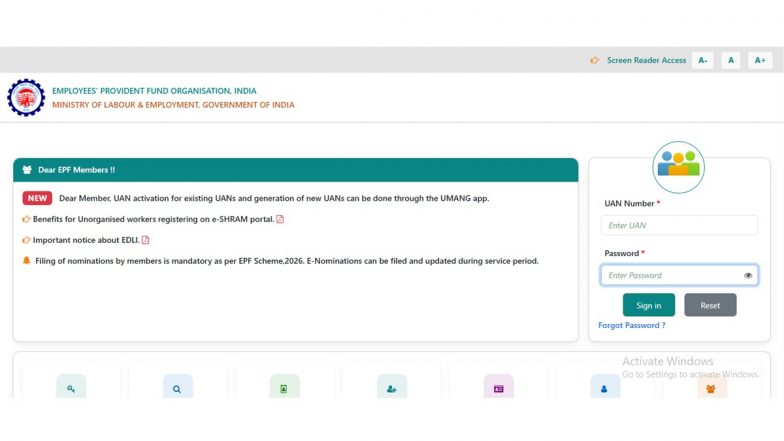
• File Form 13 online: Initiate the transfer of PF balance by submitting Form 13 through the EPFO unified member portal.
• Update KYC details: Aadhaar, PAN and bank details must be updated and verified on the active UAN before starting the transfer.
• Inform EPFO: Employees should email details of dual UANs to uanepf@epfindia.gov.in and also inform previous employers. Once verified, the older UAN is blocked.
PF Withdrawal Eligibility
An employee can withdraw the PF balance if they are unemployed or working with an organisation not covered under the EPF Act for at least two continuous months. However, the tax treatment of such withdrawals depends on the length of service. PF Interest: EPFO Members To See Annual Interest Credit of up to INR 46,000, Know How To Check Provident Fund Balance.
Five-Year Rule and Tax Impact
Under the Income-tax Act, PF withdrawals are tax-free only if the employee has completed five years or more of continuous service.
• If money is withdrawn from an account with less than five years of service, the amount becomes taxable.
• When PF accounts are merged, service periods from different employers are added together.
For example, four years of service with one employer and three years with another becomes seven years after transfer. A withdrawal made after such consolidation qualifies as tax-free.
Interest on Dormant PF Accounts
Experts caution that interest earned during non-contributory periods remains taxable, even if the withdrawal meets the five-year rule. This makes timely account consolidation and withdrawals essential for long-term tax efficiency.
Merging PF accounts early can simplify retirement planning and prevent unnecessary tax outgo later.
(The above story first appeared on LatestLY on Jan 29, 2026 12:35 PM IST. For more news and updates on politics, world, sports, entertainment and lifestyle, log on to our website latestly.com).