What Is Doomsday Clock? Why It Was Moved Forward to 85 Seconds to Midnight? All You Need To Know About the Symbolic Timepiece
On January 27, the Bulletin of the Atomic Scientists moved the Doomsday Clock to 85 seconds to midnight - the closest humanity has ever been to global catastrophe. The four-second advance from 2025 reflects the expiration of the New START nuclear treaty, worsening climate change, and unregulated AI disinformation. Scroll below to know more.

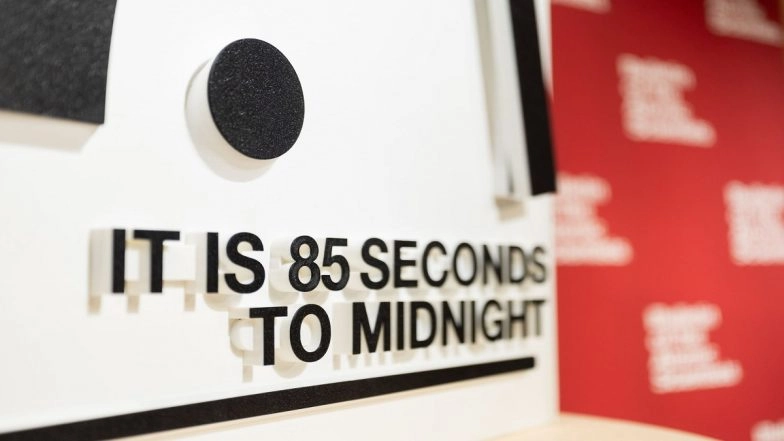
Mumbai, January 28: The hands of the Doomsday Clock were moved forward to 85 seconds to midnight on Tuesday, January 27, marking the closest point to global catastrophe in the clock's 79-year history. The Bulletin of the Atomic Scientists, which manages the symbolic timepiece, cited a "perfect storm" of eroding nuclear treaties, record-breaking climate disasters, and the unregulated rise of artificial intelligence as the primary drivers for the shift. The new setting moves the world four seconds closer to the brink than last year's 89-second mark.
The Drivers of the 2026 Shift
The decision to advance the clock was dominated by concerns over the collapsing framework of international nuclear diplomacy. Scientists specifically highlighted the February 5 expiration of the New START Treaty between the U.S. and Russia, warning that for the first time in decades, there will be no legal limit on the world’s two largest nuclear arsenals. What Does the Doomsday Clock Tell Us About the Future?
Doomsday Clock Moved to 85 Seconds to Midnight
Additionally, the Bulletin noted that 2025 was a year of record-shattering global temperatures, heatwaves, and floods, with insufficient political action to curb greenhouse gas emissions. The group also raised alarms over "information armageddon", where AI-driven disinformation is increasingly used to destabilise democratic institutions and hinder international cooperation.
What Is the Doomsday Clock?
Created in 1947 by Manhattan Project scientists - including Albert Einstein and J. Robert Oppenheimer - the Doomsday Clock is a metaphor for how close humanity is to destroying civilisation with technologies of its own making.
-
Midnight: Represents the point of total global catastrophe or human extinction.
-
The Setting: It is updated annually by the Bulletin’s Science and Security Board in consultation with a Board of Sponsors that includes eight Nobel laureates.
Historical Context: Doomsday Clock's Journey from Minutes to Seconds
When the clock debuted, it was set at seven minutes to midnight. Over the decades, it has fluctuated based on the geopolitical climate. The furthest it has ever been from midnight was 17 minutes in 1991, following the end of the Cold War and the signing of major arms reduction treaties.
However, since 2020, the Bulletin has shifted from measuring time in minutes to seconds, reflecting what they describe as a "new abnormal" of persistent, high-stakes existential threats. The move to 85 seconds underscores a belief among experts that the window for meaningful global intervention is rapidly closing. What Is the US ‘Doomsday Plane’? Why the Boeing E-4B’s Rare LAX Landing Has Drawn Global Attention.
A Call to Action, Not a Prediction
Despite the grim setting, the Bulletin emphasises that the clock is not a tool for doom-mongering, but a call to action. "The Doomsday Clock is not a forecast," said Alexandra Bell, President and CEO of the Bulletin. "It is a reflection of current reality. We can turn the hands back, but it requires a level of global engagement and scientific leadership we haven't seen in recent years."
(The above story first appeared on LatestLY on Jan 28, 2026 10:46 AM IST. For more news and updates on politics, world, sports, entertainment and lifestyle, log on to our website latestly.com).