Why Greenland Is Important for the US National Security
Greenland's importance has surged following renewed efforts by the Donald Trump administration to bring the autonomous Danish territory under American control, citing a "national security emergency." Legislative moves such as the "Greenland Annexation and Statehood Act" have formalised Washington’s intent to secure the remote Arctic territory. Scroll below to know why Greenland is important for the United States.

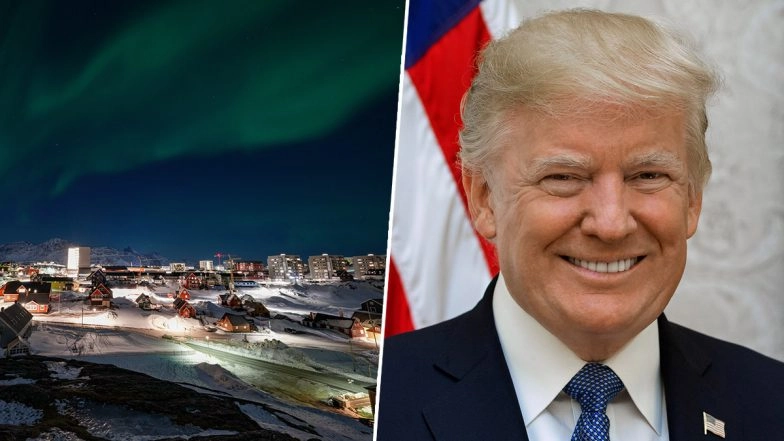
Mumbai, January 13: In the opening weeks of 2026, Greenland has transitioned from a remote Arctic territory to a central pillar of the United States' foreign and defense policy. The island's importance has surged following renewed efforts by the Trump administration to bring the autonomous Danish territory under American control, citing a "national security emergency." As of January 12, legislative moves such as the "Greenland Annexation and Statehood Act" have formalised Washington’s intent to secure what officials describe as the most strategic ground in the Western Hemisphere.
Greenland Serves As 'Top of the World' Vantage Point
Greenland’s primary value to the United States lies in its unique geography. Positioned between the Arctic and North Atlantic oceans, it serves as a natural "monitoring station" for North America. US-Greenland Tensions: How NATO Works as Donald Trump Threatens to Seize the Arctic Territory.
The Pituffik Space Base (formerly Thule Air Base) remains the crown jewel of US Arctic infrastructure. Operated by the US Space Force, the base provides:
Missile Warning: Detection of intercontinental ballistic missiles (ICBMs) launched toward North America.
Space Surveillance: Tracking thousands of objects in Low Earth Orbit.
Satellite Control: Serving as the northernmost node for the global Air Force Satellite Control Network.
Greenland - A New Frontier for Mineral Security
Beyond defense, Greenland is viewed as a solution to the US dependency on foreign supply chains. The island contains some of the world's largest untapped deposits of rare earth elements (REEs), including neodymium and dysprosium. These minerals are essential for manufacturing high-tech military hardware, such as the F-35 fighter jet, as well as consumer electronics and green energy infrastructure.
Currently, China dominates nearly 90 per cent of the global rare earth processing market. By securing Greenland's resources, the US aims to decouple its defense industry from Chinese influence, particularly following Beijing’s recent export restrictions on critical minerals. Why is Greenland in the News?
Emerging Arctic Trade Routes
Climate change has accelerated the melting of Arctic sea ice, opening the Northern Sea Route and the Northwest Passage for longer periods each year. These routes can reduce shipping distances between Europe and Asia by up to 40 per cent compared to the Suez Canal. Control over Greenland’s coastline would grant the United States significant influence over these emerging "Polar Silk Roads." US officials have expressed concern that allowing Russia or China to establish deep-water ports in Greenland would give adversarial powers a permanent foothold in the North Atlantic.
Diplomatic Tensions Between the US and Greenland
The US push for control has met significant resistance. The Danish government and Greenlandic Prime Minister Jens-Frederik Nielsen have repeatedly affirmed that "Greenland is not for sale." The situation has placed the NATO alliance in an unprecedented position. While the US argues that Denmark is unable to adequately defend the vast territory against Russian maritime expansion, European allies have warned that any unilateral US military action would fundamentally break the North Atlantic Treaty. ‘Two Dog Sleds’: Donald Trump Mocks Greenland’s Defenses, Says US Should ‘Acquire’ Greenland.
Why Is America Interested in 'Acquiring' Greenland?
The American desire for Greenland is not a new phenomenon. The United States first offered to buy the island in 1867 and again in 1946 under the Truman administration. The current 1951 Defense Agreement already allows the US extensive military access, but the 2026 push seeks a permanent territorial change to "set the rules" in the Arctic for the next century.
(The above story first appeared on LatestLY on Jan 13, 2026 06:40 PM IST. For more news and updates on politics, world, sports, entertainment and lifestyle, log on to our website latestly.com).