IDF Says ‘Soldier’s Conduct Is Wholly Inconsistent’ After Viral Photo Shows Israeli Soldier Smashing Jesus Statue With Sledgehammer in Lebanon (See Pic)
The IDF is investigating a viral image showing an Israeli soldier hitting a statue of Jesus Christ with a sledgehammer in southern Lebanon. The military confirmed the photo's authenticity and opened a probe following widespread outrage from lawmakers and religious leaders. The act has intensified concerns over the desecration of sacred sites.

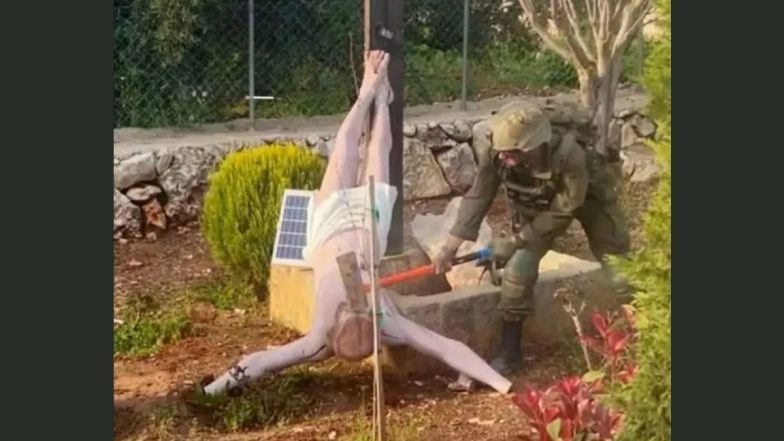
The Israeli military has launched a formal investigation after a photograph surfaced showing a soldier striking a statue of Jesus Christ with a sledgehammer in a southern Lebanese village. The image, which garnered over five million views on social media, has sparked widespread condemnation from religious leaders and lawmakers. On Sunday, April 19, the Israel Defense Forces (IDF) confirmed the photograph's authenticity, describing the behaviour as "wholly inconsistent" with military values.
The Incident in Debel
The photograph was traced to the outskirts of Debel, a predominantly Maronite Christian village located about four miles from the Israeli border. The image depicts a uniformed soldier using a hammer to strike the head of a statue of a crucified Jesus, which appears to have been removed from its cross and placed against a pole. Hezbollah Commander Ali Rida Abbas Killed As Israel Launches Pre-Ceasefire Strikes in South Lebanon.
Following the completion of an initial examination regarding a photograph published earlier today of an IDF soldier harming a Christian symbol, it was determined that the photograph depicts an IDF soldier operating in southern Lebanon.
The IDF views the incident with great… https://t.co/U6P3x8KWBb
— Israel Defense Forces (@IDF) April 19, 2026
Local leaders in Debel expressed deep distress over the desecration. Maroun Nassif, the deputy head of the Debel municipality, described the act as a "shameful" offense against religious feelings and sacred beliefs. In response to the backlash, the IDF stated that its Northern Command is handling the disciplinary process and that the military is coordinating with local community leaders to assist in restoring the statue.
Political Outrage and Context
The incident has drawn sharp rebukes from members of the Israeli Knesset. Ayman Odeh, a Palestinian member of parliament, sarcastically noted that the public is "waiting to hear the police spokesperson claim the soldier felt threatened by Jesus". Ahmad Tibi, another member of the Knesset, linked the act to a broader pattern of religious desecration, citing past incidents of vandalism against mosques and churches in Gaza and the West Bank. He also referenced recent international tensions, noting that such acts are emboldened when the "Western world remains silent" regarding attacks on religious symbols.
Wider Religious Tensions Amid Targeting of Christian Symbols
The desecration in Lebanon comes amid a reported rise in incidents targeting Christian symbols and clergy. According to the Religious Freedom Data Center (RFDC), at least 201 acts of violence or harassment against Christians were documented between January 2024 and late 2025, primarily in Jerusalem's Old City. These incidents have ranged from verbal abuse and spitting to physical assaults and vandalism. Critics argue that the lack of stringent punishment for such acts in the past has contributed to an environment where soldiers and settlers feel empowered to target religious sites. ‘Completely Open’: Iran Restores Strait of Hormuz Access for Commercial Vessels During Lebanon Ceasefire.
Military Operations and Ceasefire Status
The incident occurred during ongoing Israeli ground operations in southern Lebanon, which began in early March 2026. While a ten-day ceasefire reportedly took effect at midnight on April 16, tensions remain high as both sides have reported violations. The IDF maintains that its mission in the region is focused exclusively on dismantling Hezbollah infrastructure and that it does not intend to damage civilian or religious sites. Military officials have vowed that "appropriate measures will be taken" against the personnel involved in the statue's destruction once the internal probe is complete.
(The above story first appeared on LatestLY on Apr 20, 2026 08:42 AM IST. For more news and updates on politics, world, sports, entertainment and lifestyle, log on to our website latestly.com).