Is Strait of Hormuz Closed? Iran’s Revolutionary Guards Bars Vessel Movement, Says Report
The IRGC has warned ships that passage through the Strait of Hormuz is 'not allowed' following US-Israeli strikes on Iran. The EU naval mission confirmed VHF radio warnings to vessels, raising fears of a total blockade. As 20% of global oil flows through this chokepoint, the move has triggered an international energy crisis and halted maritime traffic.

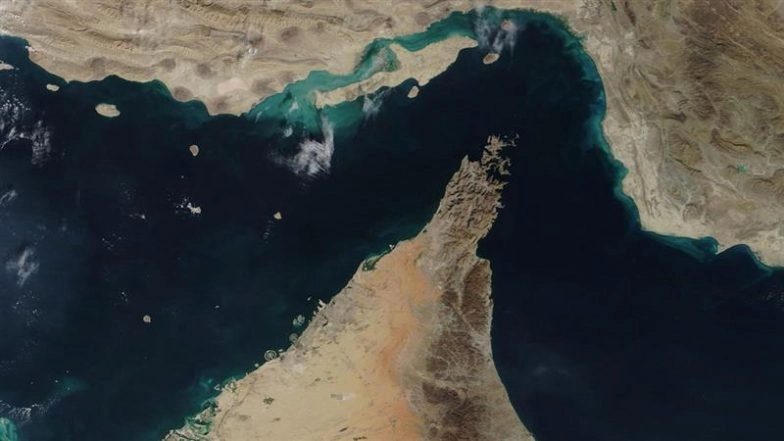
Dubai, February 28: Iran’s Revolutionary Guard (IRGC) has begun broadcasting warnings to commercial vessels stating that passage through the Strait of Hormuz is "not allowed," signaling a potential blockade of the world’s most vital oil chokepoint. According to an official from the European Union’s naval mission, Operation Aspides, ships in the region have been receiving VHF radio transmissions from the IRGC explicitly forbidding entry into the waterway.
The maritime warnings follow hours after a massive joint military offensive by the United States and Israel, codenamed "Operation Epic Fury," which targeted Iranian military command centers, drone facilities, and senior leadership. In retaliation, Iran has launched hundreds of missiles and drones toward Israel and US bases in the Gulf. The apparent move to restrict the Strait of Hormuz appears to be a strategic attempt by Tehran to leverage its control over global energy supplies to halt the ongoing air campaign. Palm Jumeirah Blasts: Dubai’s Iconic Man-Made Island Hit by Drones, Missiles As Iran Strikes Spread Across Gulf, Fairmont Hotel on Fire (Watch Videos).
Economic Impact and Global Supply
The Strait of Hormuz is the primary export route for the world’s largest oil producers, including Saudi Arabia, Iraq, Kuwait, and the UAE. Approximately 20 million barrels of oil per day, roughly one-fifth of global consumption, pass through this narrow channel. Additionally, nearly 20% of the world’s liquefied natural gas (LNG) trade, primarily from Qatar, transits the waterway.
Industry analysts warn that even a temporary disruption could cause global oil prices to skyrocket. "There are very few alternative options to move this volume of oil if the Strait is fully obstructed," noted a briefing from the U.S. Energy Information Administration (EIA). While Saudi Arabia and the UAE possess pipelines that can partially bypass the Strait, their combined capacity covers only a fraction of the daily flow. Why Did the US Attack Iran?
The Strategic Chokepoint
Tehran has long used the threat of closing the Strait of Hormuz as a "nuclear option" in its geopolitical standoff with the West. The waterway is only 21 miles wide at its narrowest point, with shipping lanes passing through Iranian territorial waters.
In previous years, the IRGC has conducted "harassment" operations, including the seizure of foreign tankers, but a full-scale blockade has historically been avoided due to the severe economic consequences for Iran’s own remaining oil exports. However, with the current direct military strikes on Tehran, analysts suggest the Iranian leadership may believe they have "nothing left to lose" in disrupting the global economy.
(The above story first appeared on LatestLY on Feb 28, 2026 10:49 PM IST. For more news and updates on politics, world, sports, entertainment and lifestyle, log on to our website latestly.com).