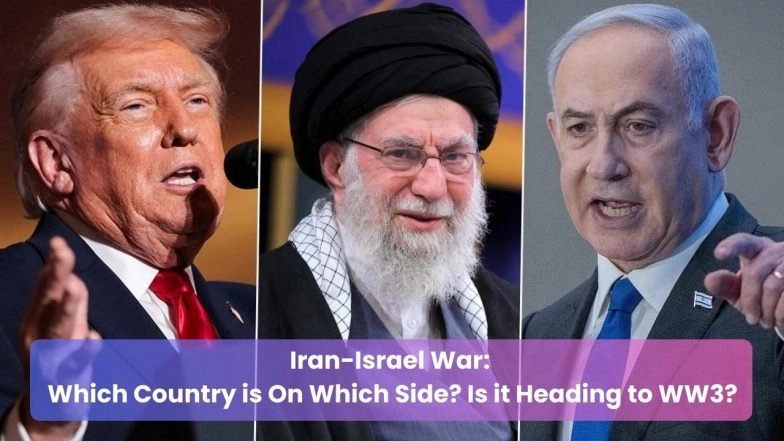
Iran-Israel War: Which Country is On Which Side? Is it Heading to WW3?
Who is on Whose Side in the Iran-Israel War? Alliances and WW3 Risks in 2026: A complete guide to global alliances. Is WW3 starting? Explore Operation Epic Fury, Lion's Roar, and the Axis of Resistance. Details on the roles of the countries like US, Russia, China, India, and Saudi Arabia, plus the Strait of Hormuz crisis and emergency FAQs.

- Read in
- हिंदी
TEHRAN/TEL AVIV: The decades-long "shadow war" between the Middle East’s two most formidable powers has officially ignited into a direct, state-on-state conflict of unprecedented scale. In the early hours of Saturday, February 28, 2026, a massive, coordinated offensive was launched by Israel and the United States, striking the heart of the Islamic Republic. Codenamed Operation Lion’s Roar by the Israeli Defence Forces (IDF) and Operation Epic Fury by the U.S. Department of Defence, the campaign involves over 200 fighter jets and naval assets targeting Iranian nuclear facilities, IRGC command centres, and missile infrastructure in Tehran, Isfahan, and Qom.
This seismic shift in global geopolitics follows the collapse of nuclear negotiations and a period of intense regional upheaval. With President Donald Trump declaring the start of "major combat operations" and Iran responding with Operation True Promise 4, the world now stands at a historic crossroads, questioning if these opening salvos mark the beginning of a global conflagration risking the Third World War. Read More: Iran-Israel Conflict: Over 200 Killed Across Country in Israel-US Strikes, State TV Quotes Red Crescent; Tehran Promises Decisive Response.
Iran-Israel War Alliances: Comparing the Global Blocs and Which Country is On Which Side
To understand the scale of the current escalation, it is essential to look at how international loyalties have hardened. The following table outlines the strategic roles of the major countries involved in the current conflict.
| Strategic Role | Western Coalition (Offensive) | Axis of Resistance (Defensive) | Defensive & Intelligence Partners | Diplomatic & Neutral Players |
| Operations | Lion's Roar & Epic Fury | True Promise 4 | N/A | N/A |
| Primary Country | United States, Israel | Iran | Jordan, United Kingdom | Russia, China, Saudi Arabia, India |
| Non-State Actors | N/A | Houthis, Hezbollah, Iraqi Militias | N/A | N/A |
| Current Action | Strikes on nuclear sites and IRGC command centres; aiming for regime change. | Retaliatory missile waves targeting Israel and U.S. Gulf bases. | Intercepting missiles in sovereign airspace; providing surveillance (ISR). | Condemning escalation; calling for ceasefires; focusing on energy security. |
| Key Objectives | Dismantle Iran’s nuclear program; eliminate the missile industry. | Survival of the Islamic Republic; expulsion of U.S. forces from the region. | Protecting national borders; maintaining treaty obligations. | Maintaining regional influence; securing oil trade; protecting citizens. |
The Countries Involved: US-Israel Coalition vs. Iran’s Axis of Resistance
The core of this conflict pits two major military coalitions against one another in direct warfare. Operation Lion's Roar (Israel) focuses on the "existential" removal of nuclear threats, while the US-led Operation Epic Fury is a broader campaign to "annihilate" Iran's military infrastructure. In response, Tehran has activated Operation True Promise 4, officially targeting U.S. bases in Bahrain, Qatar, and Kuwait for the first time.
US-Israel Coalition: The Dual Offensives
While the strikes are coordinated, the names reflect the different strategic priorities of the two allies:
-
Operation Lion's Roar (Israel): Named by Prime Minister Benjamin Netanyahu, this operation represents Israel's "pre-emptive" strike to remove what it terms an existential nuclear threat. The focus is on precision: targeting the leadership in Tehran and key enrichment sites like Natanz.
-
Operation Epic Fury (United States): The Pentagon’s codename for its broader involvement. Under President Donald Trump, the U.S. goal is more expansive: the destruction of Iran's missile industry and navy to facilitate potential regime change.
Retaliation: Iran’s "Operation True Promise 4"
Tehran has not remained silent. Under the banner of Operation True Promise 4, the Islamic Revolutionary Guard Corps (IRGC) has launched hundreds of projectiles. For the first time, these strikes have directly targeted U.S. military installations in Bahrain, Kuwait, and Qatar, signalling that the entire region is now a live combat zone.
Will the Iran-Israel Conflict Lead to a Total World War III (WW3)?
Military analysts are monitoring three specific tripwires and risks that could turn this regional war into a global one:
-
Superpower Intervention: If the U.S. moves to a ground invasion, nuclear powers like Russia and China may move from diplomatic condemnation to active military support for Tehran to protect their strategic and energy interests.
-
The Strait of Hormuz Blockade: Iran has already issued VHF radio warnings stating "no ship is allowed to pass" the Strait. If this chokepoint is closed, 20-30% of global oil trade ceases, likely triggering a global military intervention to prevent an economic collapse.
-
Horizontal Escalation: If the war spreads through cyber warfare on Western infrastructure or maritime attacks in the Indian Ocean, it will cease to be a "Middle Eastern" war and become a global security crisis with risk of a full-fledged Third World War (WW3). Read More: Iran-Israel Conflict Intensifies: UN Security Council to Meet Amid Calls for Ceasefire and Diplomatic Intervention.
Saudi Arabia, Jordan, and India: The Role of Neutral Powers
While the primary belligerents trade blows, regional neighbours are struggling to contain the fallout:
-
Jordan has emerged as a critical shield, with its armed forces intercepting over a dozen ballistic missiles since this morning to prevent a spillover into its territory.
-
The Gulf States: Nations like Saudi Arabia and the UAE have condemned the violation of their sovereignty. The conflict hit a tragic milestone today when shrapnel from an intercepted missile killed a civilian in Abu Dhabi.
-
India: For India, the stakes are immediate. Over 8 million Indian nationals in the Gulf are in direct danger. External Affairs Minister S. Jaishankar has called for "maximum restraint," as Indian carriers like Air India and IndiGo suspend all flights to the region, creating a massive repatriation challenge.
Frequently Asked Questions (FAQ) on Iran-Israel War
Q1: Which countries are currently launching attacks?
The primary offensive is being carried out by Israel and the United States. Additionally, Iran-backed groups, including the Houthis (Yemen), Hezbollah (Lebanon), and various militias in Iraq (such as Kata'ib Hezbollah), have launched retaliatory strikes against Israeli territory and U.S. regional assets.
Q2: Which countries have been physically attacked?
-
Iran: Multiple cities, including Tehran, Isfahan, Qom, Tabriz, and Karaj, have been hit by U.S.-Israeli air and missile strikes.
-
Israel: Targeted by hundreds of Iranian ballistic missiles and drones.
-
Gulf States: U.S. military installations in Bahrain (5th Fleet HQ), Qatar (Al Udeid), Kuwait, and the UAE have been targeted by Iranian counter-strikes. One person was reportedly killed in Abu Dhabi by shrapnel from an intercepted missile.
-
Iraq & Syria: Drone and missile strikes have hit militia headquarters and U.S. bases in these territories.
Q3: Which countries have issued emergency warnings for their citizens?
Dozens of nations have issued "Leave Immediately" or "Do Not Travel" advisories:
-
India: Issued a high-level safety advisory; carriers like Air India and IndiGo have suspended flights to the region. Read More: Iran-Israel War: Air India, IndiGo, SpiceJet Suspend West Asia Flights, Issue Travel Advisory Amid Escalating Airspace Curbs.
-
United States: Authorised the departure of non-emergency personnel from its mission in Israel and warned citizens in the region to shelter in place.
-
European Union: Countries including France, Germany, Italy, Poland, and the UK have urged citizens to leave Iran and Israel immediately and avoid travel to Lebanon and Iraq. Read More: Israel-Iran War: British Nationals in UAE, Qatar, Bahrain, and Kuwait Urged to Seek Cover as Tehran Retaliates Against US-Israeli Strikes.
-
Regional States: Jordan, UAE, Bahrain, and Qatar have temporarily closed their airspaces, grounding all civilian flights.
Q4: Who is intercepting the missiles?
Jordan, the UAE, and Bahrain have confirmed the successful interception of Iranian projectiles over their sovereign airspace using advanced defence systems to prevent domestic casualties.
Latest News and Updates on Iran-Israel War 2026
Who is winning the Iran-Israel war right now?
As of February 28, 2026, the conflict is in its opening phase. The U.S.-Israeli coalition's Operation Epic Fury has successfully struck high-value nuclear and leadership targets in Tehran and Isfahan. However, Iran’s Operation True Promise 4 has successfully hit several U.S. bases in the Gulf, indicating a prolonged and costly exchange rather than a swift victory for either side.
Is the Strait of Hormuz closed today?
Yes. Following the morning strikes, the IRGC announced a maritime blockade of the Strait of Hormuz. Iran has warned that any vessel attempting to pass will be considered a hostile target. This has effectively halted 20% of the world's oil supply, causing a global spike in energy prices.
Which countries are supporting Iran against Israel? Who is on Whose Side?
Iran is primarily supported by its "Axis of Resistance," including Hezbollah in Lebanon, the Houthis in Yemen, and militias in Iraq and Syria. While Russia and China have not entered the war militarily, they are providing diplomatic support and intelligence to Tehran.
Is it safe for Citizens to stay in the UAE or Qatar?
Many countries have issued a high-level safety advisory for their citizens in the Gulf. While not currently in a state of war, U.S. bases in Qatar, Bahrain, and the UAE have been targeted by Iranian missiles. Citizens are advised to stay away from military installations and register with their respective local embassy for potential evacuation.
Will the US launch a ground invasion of Iran? Is WW3 starting?
While Operation Epic Fury is currently an air and naval campaign, President Donald Trump has not ruled out "further measures" to ensure regime change. Military experts warn that a ground invasion would be the "World War III (WW3) tripwire," likely forcing a direct military response from Russia.
A Region at the Point of No Return
As night falls over a burning Middle East, the transition from proxy skirmishes to total state warfare marks a point of no return. Whether the combined weight of Operation Lion’s Roar and Epic Fury achieves its goal of neutralising the Iranian threat or instead ignites a decade-long global conflagration remains to be seen. What is certain is that the map of the Middle East is being redrawn in real-time, and the global economy now hangs in the balance of the next 24 hours.
-
(The above story first appeared on LatestLY on Mar 01, 2026 12:04 AM IST. For more news and updates on politics, world, sports, entertainment and lifestyle, log on to our website latestly.com).