The Telephone at 150: Are We Hanging Up on Phone Calls?
Today, 150 years after the invention of the telephone, it has never been easier to call someone.

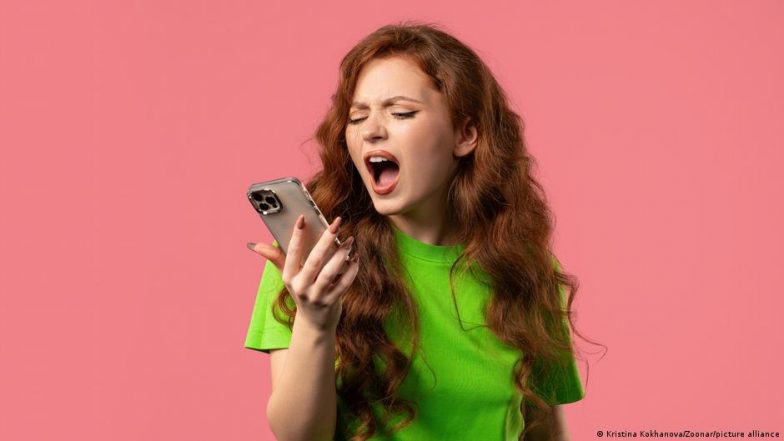
Today, 150 years after the invention of the telephone, it has never been easier to call someone. But in some ways, and for some people, picking up the phone is still a very hard thing to do."Mr. Watson, come here, I want to speak to you." With these words, Alexander Graham Bell revolutionized communication. They were the first words to be intelligibly transmitted over distance — the first telephone call. On February 14, 1876, Bell applied for a patent for his invention, signaling the rise of spoken communication as the primary way people stay connected.
Also Read | India News | MP HC Seeks Status Report on Tiger Deaths in Bandhavgarh Reserve.
Real-time, long-distance communication stunned those experiencing it for the first time. "A wonderful invention," the Wichita City Eagle, a Kansas newspaper, wrote in 1877. It described an audience bursting into applause upon seeing a demonstration of the telephone.
Shifting preferences in a sea of communication options
While it would still take a few decades for the telephone to enter everyday life, today, calling someone on the phone is easier than ever. Mobile phones have made it possible to talk while walking down the street, driving or even using the bathroom — it seems there are nearly no limits to when and where we can make a phone call. And yet for many, it's no longer the go-to communication option it once was.
From email to the simple SMS to third-party messaging apps and social media platforms, communication methods have multiplied, and communication preferences seem to be shifting, with texting and messaging increasingly preferred.
According to an international YouGov survey conducted in December 2023, SMS or text messages are the most popular methods for personal communication, with 40% listing them as their first choice. Mobile phone calls were second, at 29%, and landline calls were a mere 3%.
These preferences seem to cleave along generational lines, with younger people moving away from the telephone as their first communication port of call. The same survey found the highest preference for text among respondents aged 18 to 24 and the highest preference for phones calls, both mobile and landline, among respondents aged 55 and up.
The 'mute generation'
This penchant for written messaging has seen Gen Z (and sometimes Millennials) dubbed "The mute generation."
"I would say it's primarily young people who have gotten used to much of our communication taking place via text or audio messages," explains Lea Utz, a young millennial. She hosts the German podcast "Telephobia," in which she helps people of all ages make particularly difficult and emotional telephone calls.
Young people have grown up with — and grown used to — other ways of communicating. They're used to being able to mull over word choices and emojis, delete or edit messages they've already sent, and maintain control over when they read or even receive a message from someone else.
"Those who have grown up with this kind of communication have arguably internalized it totally differently than older people," she told DW.
For young people, calling someone spontaneously can even seem impolite, a selfish demand of the recipient's time. It's perhaps why a British Uswitch survey from April 2024 found that 68% of 18-34-year-olds prefer pre-arranged calls.
"If you send a text message, it gives the feeling of, 'You can answer it whenever is best for you, I don't want to disturb you, maybe you're not really reachable right now," Utz says.
An awkward phone call?
However, even if older people are more inclined to make phone calls, they can also have feelings of awkwardness and hesitancy around calling someone on the phone.
Amit Kumar is an assistant professor of Marketing and Psychological and Brain Sciences at the University of Delaware who has studied the expectations people have around voice calls and how these compare to actual outcomes.
Across multiple studies, he has found that people expect voice calls to be more awkward than text-based communication, and that this belief appears to hold across generations.
"The evidence that we have suggests that there were no meaningful differences based on participants' age," he told DW. Old or young, people think calling someone on the phone will be an uncomfortable experience. But, he says more studies specifically focusing on age are needed.
Kumar points out, however, that the more experience you have doing something, the more accurate your expectations will be.
"If people try [phone calls] more, they might be more likely to be accurate when it comes to predicting awkwardness. But the problem is that if they don't try it, they can't learn."
And when mistaken expectations persist, this can drive us to send messages rather than pick up the phone, he explains.
Please pick up that phone!
Phone anxiety and awkwardness aside, people, including young people, still want to be informed about certain things via phone call. The USwitch survey found that 53% of respondents aged 18 to 24 would be offended if they didn't get a phone call for happy or important occasions, like an engagement or a birth.
But difficult subjects can also be ones that people would rather talk about in a phone call than via text — once they can push through their reservations about dialing.
Utz's protagonists make calls about highly intimate and personal affairs, from confronting a childhood bully to speaking with long-lost family members to connecting with a driver who caused a serious accident.
"I think it's usually clear to the caller that this isn't something that can be discussed in a [text] chat, for instance," she says of her protagonist's topics.
For Utz, a phone call is a "sweet spot" that offers emotional connection with the safety of distance. "It's a very personal connection but at the same time it's not as emotionally demanding as meeting in person."
And if connection is what is desired, a phone call has a lot to offer. "What we found is that people actually did form significantly stronger bonds when they were interacting over the phone" than over a text-based medium, Kumar says, referring his multiple studies.
And those expectations of awkwardness? Misplaced. People don't actually experience phone calls as being any more awkward than text communication. "And so these costs are just kind of imagined. We think it's going to be sort of weird to talk to somebody on the phone," he explained.
"When they do actually interact with someone using their voice, they do feel more connected," he adds.
Interestingly, Kumar's studies have shown that video calls do not lead to stronger bonds than voice calls. Connective power still seems to be in the voice.
Edited by: Sarah Hucal
(The above story first appeared on LatestLY on Feb 13, 2026 09:20 PM IST. For more news and updates on politics, world, sports, entertainment and lifestyle, log on to our website latestly.com).