












 Quickly
 Socially
 Trending
 Crypto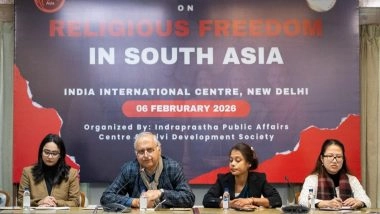
New Delhi [India], February 8 (ANI): Indraprastha Public Affairs Centre (IPAC) and Shivi Development Society (SDS) jointly organised a high-level consultation on "Religious Freedom in South Asia," on Friday at the India International Centre, New Delhi, bringing together policymakers, scholars, civil society leaders and legal experts to deliberate on the challenges faced by vulnerable communities across the region.
The event featured in-depth discussions on the roles of institutions, justice delivery mechanisms, and the lived realities of religious minorities in South Asia. Speakers emphasised that while constitutional guarantees exist in countries such as Pakistan and Bangladesh, their effective implementation remains weak, particularly during periods of social and political unrest.
Also Read | Gold Medalist Viral Video Scandal: Why Clicking This Zyan Cabrera Link Is Dangerous.
Narendra Kumar, Executive Director of SDS, opened the consultation and emphasised that one of its key objectives was to highlight the strength of India's constitutional and institutional framework in managing religious diversity. He noted that despite social and political pressures, India's judiciary and constitutional safeguards continue to act as stabilising forces, offering lessons for the wider South Asian region.
The event also marked the release of a comparative structural assessment report, "Religious Freedom in South Asia", authored by Bhrigu Bhardwaj, Sheikh Safina and Pengsomir E Borah. It introduced the concept of a "Great Divergence" in the region.
The report argued that while India has strong constitutional protections, in countries such as Pakistan, Bangladesh and Sri Lanka, discrimination is deeply embedded within legal and institutional frameworks.
It also highlighted demographic trends, including the sharp decline of Hindu populations in Bangladesh, contrasted with India's continued state support to even its smallest religious minorities, to underline that religious freedom depends not just on laws but on institutional intent and practice.
The first panel, "Role of Institutions and Justice," examined how state institutions in South Asia respond to religious diversity and conflict.
Panellists emphasised the need for stronger implementation of constitutional safeguards in India, alongside urgent legal and institutional reforms in neighbouring countries, particularly Pakistan and Bangladesh, where discrimination against minorities remains entrenched.
The second panel, "Impact on Vulnerable Communities," focused on the everyday realities faced by religious minorities across the region. Speakers highlighted the heightened vulnerability of women at the intersection of religion and gender, drawing attention to practices such as forced conversions in Pakistan as a form of coercion and social control.
The consultation concluded with a call for a more nuanced and context-specific approach to religious freedom in South Asia. Participants stressed the need for urgent legal and institutional reforms in neighbouring countries, especially Pakistan and Bangladesh, where discrimination remains systemic. (ANI)
(The above story is verified and authored by ANI staff, ANI is South Asia's leading multimedia news agency with over 100 bureaus in India, South Asia and across the globe. ANI brings the latest news on Politics and Current Affairs in India & around the World, Sports, Health, Fitness, Entertainment, & News. The views appearing in the above post do not reflect the opinions of LatestLY)
 Share Now
 Google Trends



 Live Bot