GRAP 4 Restrictions Re-Activated in Delhi: GRAP-IV Curbs Reimposed As Delhi-NCR Air Quality Hits ‘Severe’ Levels
The restrictions under GRAP-4 have been reimposed in Delhi and its neighbouring areas once again, as air quality index (AQI) have plunged to the 'severe' category in the national capital region (NCR) again, said the Commission for Air Quality Management (CAQM) on Saturday evening.

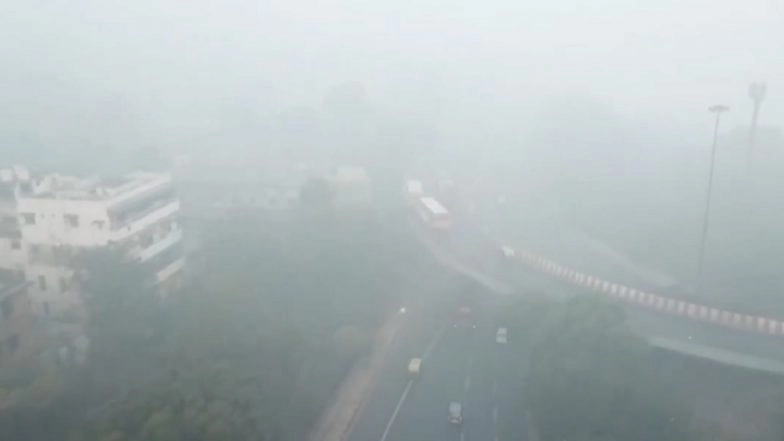
New Delhi, January 17: The Commission for Air Quality Management (CAQM) on Saturday reimposed the strictest level of anti-pollution measures, known as Stage IV of the Graded Response Action Plan (GRAP), across Delhi and the National Capital Region (NCR). The decision follows a sharp deterioration in air quality, with the region’s Air Quality Index (AQI) slipping back into the "severe" category. The escalation to Stage IV comes just one day after Stage III curbs were enforced as a precautionary measure.
The move to invoke GRAP Stage IV is typically triggered when the AQI exceeds the 450 mark, categorized as "severe+." Authorities noted that despite previous efforts to stabilize the air quality, unfavorable meteorological conditions—including low wind speeds and a dense fog cover—have led to the rapid accumulation of pollutants. Delhi AQI Turns Severe Plus; GRAP IV Restrictions Imposed.
The CAQM clarified that while Stage IV is now in effect, all existing restrictions under Stages I, II, and III will continue to be strictly implemented. These include bans on non-essential construction, demolition activities, and the operation of stone crushers and brick kilns across the region.
Under the newly reimposed Stage IV guidelines, vehicular movement faces significant tightening. While there is no blanket ban on private vehicles, restrictions are heavily dictated by emission standards. Air Pollution: Toxic Smog, Dense Fog Grips Parts of North India; Delhi-NCR Invokes GRAP-IV.
Specifically, BS-III petrol and BS-IV diesel four-wheelers are prohibited from plying in Delhi-NCR. Additionally, the entry of non-essential, diesel-powered medium and heavy goods vehicles into the capital has been restricted. Exceptions remain in place for vehicles carrying essential commodities or providing emergency services, as well as for BS-VI compliant, CNG, and electric vehicles.
Impact on Daily Life and Services
The pollution crisis has begun to impact public health and regional infrastructure. Dense fog accompanying the toxic haze has significantly reduced visibility, leading to flight delays at Delhi’s Indira Gandhi International Airport.
In the sports world, the deteriorating air quality has already had consequences; Danish shuttler Anders Antonsen recently withdrew from the India Open 2026, citing health concerns related to the pollution.
To reduce exposure, authorities have reiterated advisories for children, the elderly, and individuals with respiratory conditions to avoid outdoor activities. Many schools have already transitioned to hybrid or online learning models for younger students to minimize their time spent outdoors.
Background and Outlook
Delhi-NCR has been grappling with fluctuating but generally poor air quality for several months. GRAP-IV measures were previously lifted in late December 2025 following a brief period of improvement, only to be brought back as winter conditions intensified.
Meteorological forecasts suggest that the "severe" conditions may persist for the next few days. The CAQM sub-committee is expected to monitor the situation closely, with the possibility of further emergency measures if the AQI does not show signs of recovery.
(The above story first appeared on LatestLY on Jan 17, 2026 09:59 PM IST. For more news and updates on politics, world, sports, entertainment and lifestyle, log on to our website latestly.com).